Introduction: Why Data Cleaning Matters More Than Ever
Data volumes are growing exponentially as businesses digitize operations. New channels like mobile apps, IoT devices, cloud platforms, and social media add more complexity to the data landscape. All of this data looks useful on the surface, but raw data contains errors, duplicates, missing information, and inconsistent formatting. Without structured preparation, BI tools struggle to process it correctly.
This is where the Role of Data Cleaning becomes vital. It ensures that data analytiucs processes run smoothly and produce insight that business teams can trust. According to a major industry study, nearly 60% of a data analyst’s time is spent cleaning and preparing data rather than building visualizations or models. This statistic itself highlights how central data cleaning is to analytics success.
Learners joining Google data analytics certification or Data analyst certification online programs come across data cleaning within their first few lessons. They gradually understand that no matter how advanced a BI system is, it cannot compensate for inaccurate or inconsistent data. A solid foundation in data cleaning ensures smooth reporting, accurate forecasting, and effective analytics.
What Is Data Cleaning? A Simple and Practical Definition
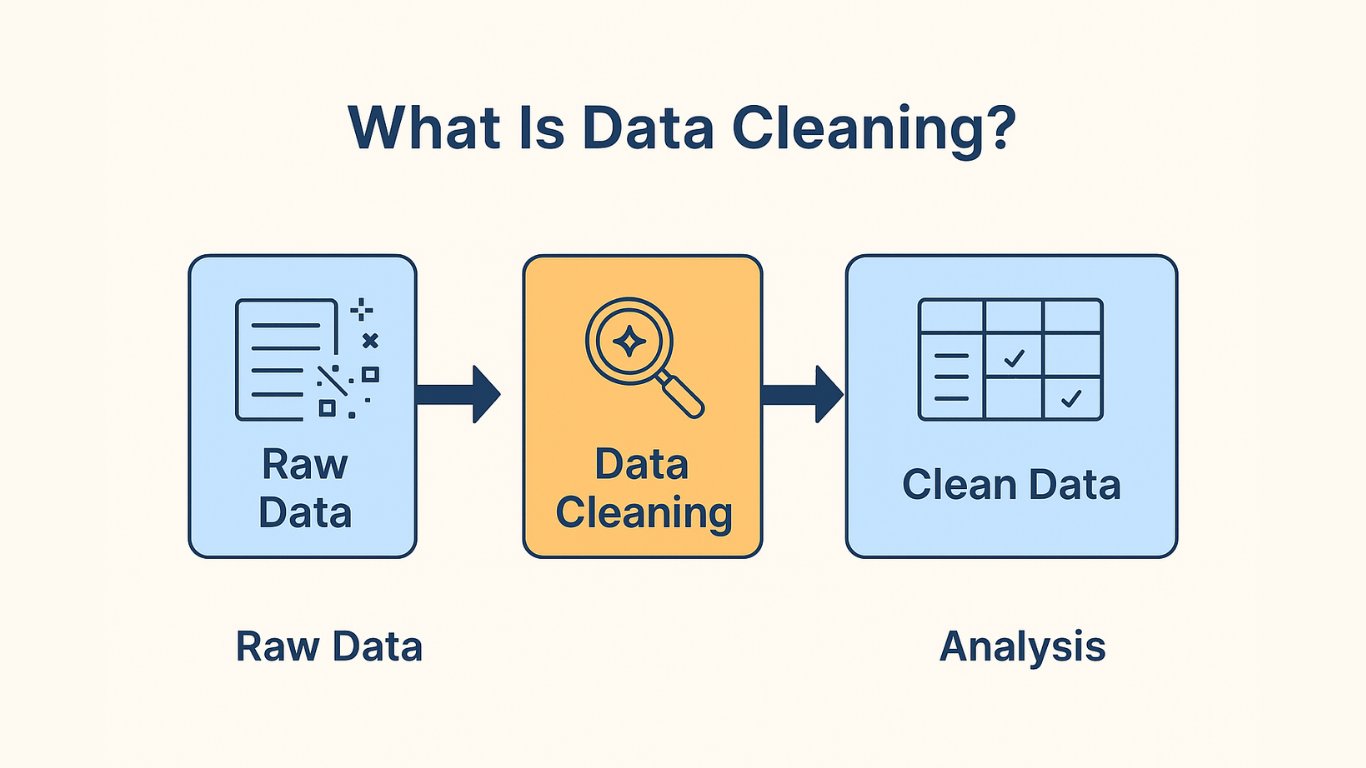
Data cleaning is the step where analysts take raw, unstructured, or inconsistent data and prepare it for analysis. The objective is not just to correct errors but to shape the data into a structure that analytics tools can understand and interpret effectively.
The process includes:
- Identifying missing values
- Removing duplicates
- Standardizing formats
- Detecting outliers
- Correcting data types
- Validating accuracy
- Ensuring consistency across datasets
In data analytiucs, these tasks cannot be skipped or automated entirely. Even advanced tools require human oversight to ensure data has the correct context. As students learn in Data analytics training and Analytics classes online, data cleaning improves the depth, accuracy, and quality of insights produced.
The second major insight analysts gain is understanding how the Role of Data Cleaning influences the performance of every BI component built afterward from dashboards and KPIs to machine learning models and time-series forecasts.
How Data Cleaning Powers Modern Business Intelligence
Clean data is essential for business intelligence systems to operate effectively. When organizations adopt BI tools, they expect clear insights that guide decisions. But BI is only as strong as the data it processes. Below are key ways clean data strengthens BI outcomes.
1. Clean Data Ensures Accurate Dashboards, Reports, and KPIs
BI dashboards summarize performance across revenue, supply chain, marketing, HR, and operations. But dashboards misrepresent trends when the underlying database contains errors.
For example:
- A duplicate transaction may inflate monthly revenue.
- Incorrect timestamps may distort sales trends.
- Inconsistent units may break calculations.
- Missing values may weaken averages or ratios.
Data analytiucs teams prevent these problems by applying the Role of Data Cleaning early in the pipeline. When dashboards reflect reality, leadership teams gain confidence in data-driven strategies.
2. Clean Data Improves Predictive and Prescriptive Analytics
Predictive analytics requires stable and consistent data patterns. When missing values, errors, or anomalies distort patterns, predictions lose reliability.
Examples include:
- Churn prediction models failing because demographic data is incomplete
- Fraud detection models missing key behaviors due to inconsistent timestamps
- Sales forecasting models producing incorrect curves due to outliers
Every student in a Data analyst course online learns that predictive accuracy depends on data quality. This is why the Role of Data Cleaning is emphasized throughout data analytiucs workflows.
3. Clean Data Reduces Operating Costs Significantly
Poor-quality data leads to:
- Repeated manual corrections
- Wrong business decisions
- Loss of time and resources
- Delayed reporting cycles
Gartner reports that businesses lose an average of $15 million per year due to bad data. Clean data saves operational cost and time, helping teams use BI tools more efficiently.
Organizations increasingly invest in data analytiucs training programs to avoid such losses and encourage data-driven culture.
4. Clean Data Helps Businesses Understand Customer Behavior Accurately
Customer analytics powers marketing, engagement, retention, and product development strategies. But customer behavior data often arrives from multiple channels such as:
- Website
- Mobile app
- Social media
- CRM
- Email interactions
These sources generate inconsistent or incomplete data unless properly cleaned. By applying the Role of Data Cleaning, companies build accurate customer profiles and target segments precisely using data analytiucs tools.
5. Clean Data Strengthens Decision-Making Across All Departments
Whether it’s finance, HR, operations, healthcare, logistics, or retail every department relies on consistent reporting. Clean data gives organizations confidence in:
- Budget decisions
- Hiring strategies
- Performance evaluation
- Inventory planning
- Market forecasting
Students in Analytics classes online learn that BI workflows break instantly when data inconsistencies remain unresolved.
Core Data Cleaning Techniques Every Analyst Must Master
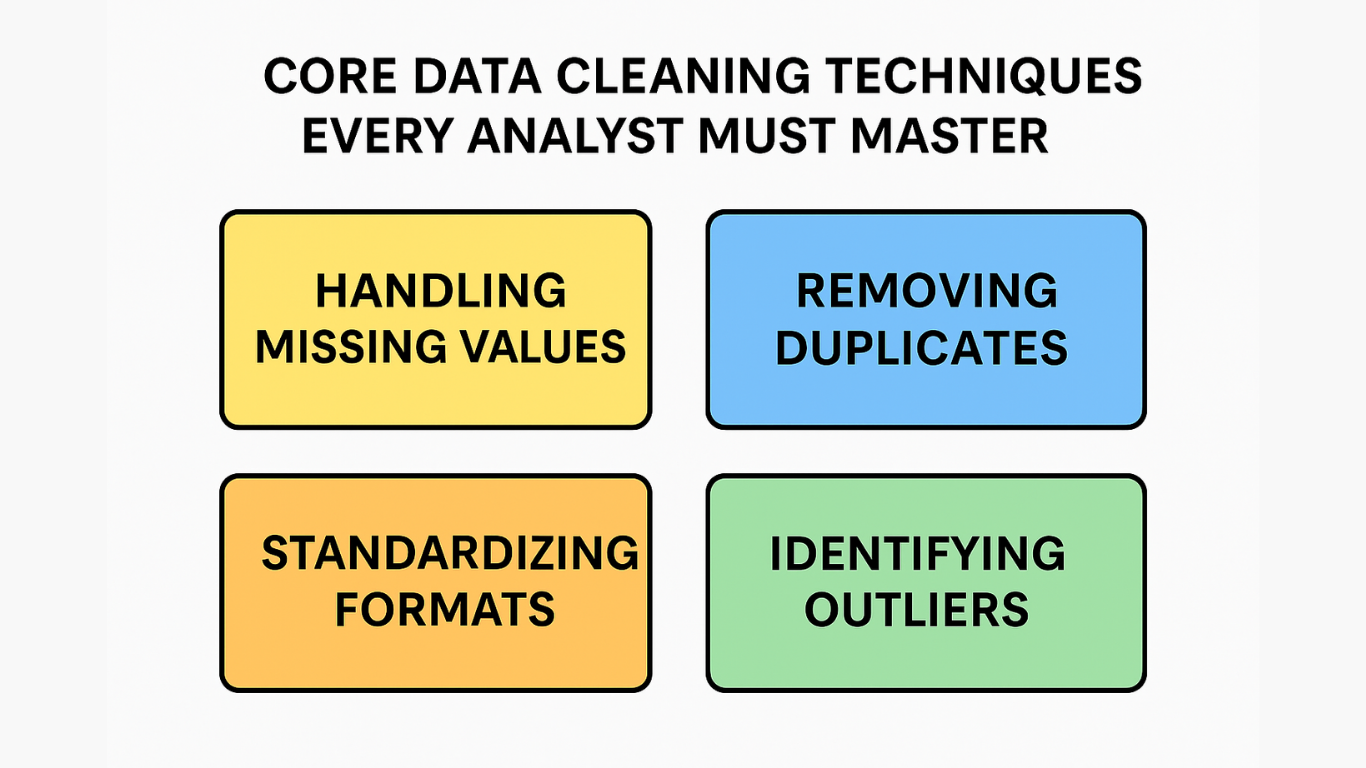
Professional Data Analytics certification courses teach several techniques that ensure data is accurate and analysis-ready.
1. Handling Missing Values
Missing values appear frequently and must be treated carefully. Analysts may:
- Use median or mean for numerical fields
- Use mode for categorical fields
- Apply forward fill for time-series
- Remove rows with excessive missing data
- Predict missing entries using models
2. Removing Duplicates
Duplicates can inflate trends and distort aggregation.
3. Standardizing Formats
Formats such as phone numbers, dates, and currency must follow uniform patterns.
4. Identifying Outliers
Outliers can distort BI metrics. Analysts use statistical methods to detect abnormal values.
5. Data Transformation
Transformation includes normalization, encoding, aggregation, and binning—all of which shape data for BI tools.
These techniques sit at the center of the Role of Data Cleaning, ensuring data analytiucs models operate smoothly.
The BI Workflow and Where Cleaning Fits In
A simple BI pipeline looks like this:
Raw Data → Data Cleaning → Data Transformation → Data Modeling → BI Dashboards → Insights → Business Decisions
Data analytics professionals place significant focus on the cleaning step. Without it, every stage afterward collapses.
Industry Case Studies: How Clean Data Improves BI Outcomes
1. Retail Industry
A retailer reduced reporting errors by 30% after cleaning its 12-month sales data.
2. Healthcare Sector
A hospital improved patient diagnosis reporting after fixing inconsistent diagnostic codes.
3. Banking Sector
Fraud detection models became more accurate after timestamp standardization.
These examples reinforce the Role of Data Cleaning as a business-critical task and show how data analytics improves real-world outcomes.
Hands-On Exercise for Learners
Below is a guided example for students practicing data analytics:
Step-by-Step Cleaning Process
- Load data
- Identify null values
- Fill or remove missing values
- Drop duplicates
- Standardize date formats
- Validate ranges
- Export clean dataset
Practicing these steps strengthens understanding of the Role of Data Cleaning and prepares learners for real BI environments.
How Data Cleaning Improves Career Opportunities
Organizations prefer candidates who:
- Understand data analytics deeply
- Clean and prepare data independently
- Spot inconsistencies quickly
- Work confidently with BI platforms
- Understand the Role of Data Cleaning in Analytics
Professionals who develop strong data cleaning skills through Data analyst online classes or Data Analytics course become highly valuable in BI-driven organizations.
Conclusion
Clean data is essential for accurate business intelligence, strong decision-making, and reliable analytics. When analysts understand the Role of Data Cleaning, they produce deeper insights and add greater value to organizations using data analytiucs across every function.
Start your learning journey with H2K Infosys. Enroll in our Data Analytics course and gain hands-on experience that prepares you for real-world BI careers.