Security controls in cybersecurity are safeguards designed to prevent, detect, or respond to threats that could compromise information systems, networks, and data.
They include technical mechanisms, administrative policies, and physical measures that collectively reduce risk by enforcing security requirements and limiting the impact of attacks.
In practice, security controls are implemented across people, processes, and technology to protect confidentiality, integrity, and availability (CIA) of information assets.
What is cybersecurity, and where do security controls fit?
Cybersecurity refers to the practice of protecting digital systems, networks, applications, and data from unauthorized access, disruption, or misuse. Within this broad discipline, security controls are the actionable mechanisms that turn security principles into enforceable protections, a foundational concept emphasized in professional cyber security training and placement pathways. Rather than being abstract concepts, controls are implemented as configurations (for example, access rules or encryption settings), processes (such as incident response procedures), and tools (like firewalls or endpoint protection platforms). Security controls provide the operational layer of cybersecurity.
What are security controls in cybersecurity?
Security controls are specific safeguards or countermeasures that organizations deploy to manage risk.
They are selected based on:
- Threat landscape
- Regulatory requirements
- Business impact
- Technical constraints
A control answers one or more of these questions:
- How do we stop an attack?
- How do we detect suspicious activity?
- How do we limit damage and recover?
How are security controls classified?
Security controls are commonly classified using multiple dimensions. Understanding these classifications helps professionals design balanced security architectures.
What are preventive, detective, and corrective security controls?
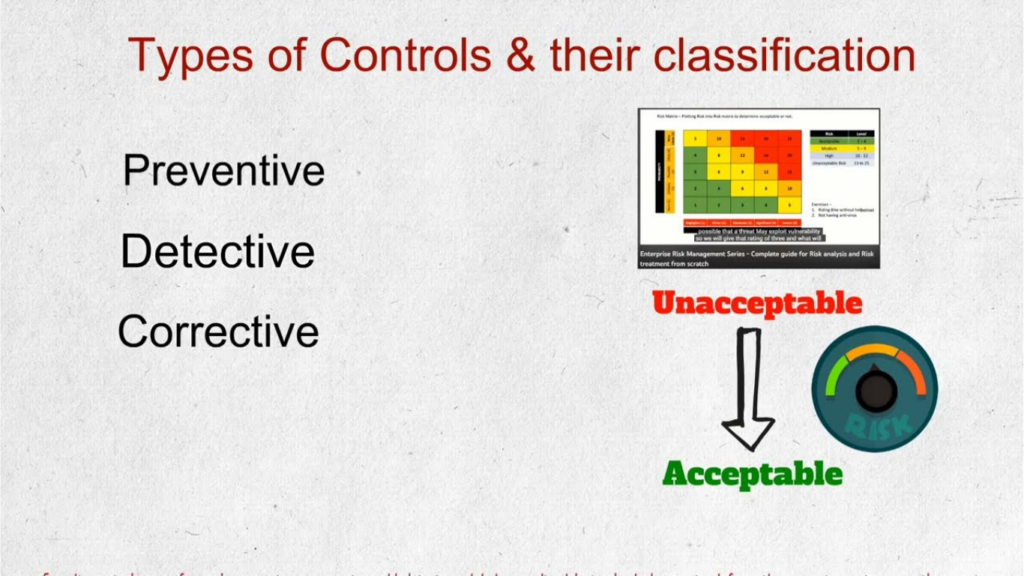
Preventive controls
Preventive controls aim to stop security incidents before they occur.
Common examples:
- Firewalls and network segmentation
- Multi-factor authentication (MFA)
- Secure configuration baselines
- Least-privilege access models
In real projects, preventive controls are prioritized because preventing incidents is typically less costly than responding to them.
Detective controls
Detective controls identify and alert on security events that have already occurred or are in progress.
Examples include:
- Intrusion Detection Systems (IDS)
- Log monitoring and SIEM platforms
- File integrity monitoring
- Anomaly detection in user behavior
Detective controls do not stop attacks directly, but they enable timely response.
Corrective controls
Corrective securoty controls limit damage and restore systems after a security incident.
Examples:
- Incident response playbooks
- Automated isolation of compromised hosts
- Backup restoration procedures
- Patch deployment after vulnerability exploitation
Corrective controls are essential for resilience and recovery.
What are administrative, technical, and physical controls?
Administrative (managerial) controls
These controls focus on policies, procedures, and governance.
Examples:
- Information security policies
- Risk assessments
- Security awareness training
- Vendor security requirements
Administrative controls guide how technology and people should behave.
Technical (logical) controls
Technical controls are implemented using hardware or software.
Examples:
- Encryption
- Endpoint protection
- Network access controls
- Application security testing tools
Most day-to-day cybersecurity work involves managing technical controls.
Physical controls
Physical controls protect facilities and hardware.
Examples:
- Access badges and biometric scanners
- CCTV systems
- Server room locks
- Environmental controls (fire suppression, power backup)
Physical controls support and reinforce technical security.
How do security controls work in real-world IT projects?
In enterprise environments, security controls are rarely deployed in isolation.
They are designed as layers, often described as defense in depth.
Example: securing a web application
A typical enterprise web application may use:
- Preventive: Web Application Firewall (WAF), secure authentication
- Detective: Application logs monitored by SIEM
- Corrective: Automated rollback and incident response workflows
Controls are integrated into development, deployment, and operations pipelines.
Why are security controls important for working professionals?
For IT professionals, understanding security controls is not optional.
Controls affect daily work in:
- System administration
- Software development
- Cloud engineering
- Quality assurance
- Data analytics
Professionals involved in cyber security training and placement often transition from general IT roles by learning how controls are designed, implemented, and validated.
How are controls mapped to risk management?
Risk management connects business objectives with security decisions.
A simplified workflow:
- Identify assets
- Identify threats
- Assess risk
- Select controls
- Monitor and improve
Security controls are chosen to reduce risk to acceptable levels, not to eliminate risk entirely.
How do security controls apply to cloud and DevOps environments?
Modern environments require controls that are:
- Automated
- Scalable
- Integrated into pipelines
Examples:
- Infrastructure-as-Code security scanning
- Identity-based access instead of network-based trust
- Continuous compliance monitoring
Security controls evolve as infrastructure becomes more dynamic.
What tools are commonly used to implement security controls?
| Control Area | Common Tools |
| Network Security | Firewalls, IDS/IPS |
| Identity & Access | IAM platforms, MFA systems |
| Endpoint Security | EDR, antivirus |
| Monitoring | SIEM, log analytics |
| Application Security | SAST, DAST |
| Data Protection | Encryption, DLP |
Professionals in cyber security training and job placement programs typically gain hands-on exposure to several of these categories.
What skills are required to learn Cyber Security Training Online?
Learning cyber security effectively requires a blend of skills:
Technical skills
- Networking fundamentals
- Operating systems (Windows, Linux)
- Cloud concepts
- Basic scripting
Security-specific skills
- Threat modeling
- Log analysis
- Vulnerability assessment
- Incident response workflows
Professional skills
- Documentation
- Risk communication
- Cross-team collaboration
These skills directly support real-world security operations.
How are security controls used in enterprise environments?
In enterprises, security controls must align with:
- Compliance requirements
- Performance constraints
- User experience
- Operational cost
Security teams balance protection with usability by:
- Automating repetitive controls
- Prioritizing high-risk areas
- Regularly reviewing control effectivenes
What job roles use security controls daily?
Security controls are part of many roles, including:
- Security Analyst
- SOC Analyst
- Cloud Security Engineer
- DevSecOps Engineer
- IT Auditor
- Network Administrator
Each role interacts with controls differently, but all rely on them.
What careers are possible after learning Cyber Security Training Online?
Learning cyber security opens pathways to:
- Entry-level security operations roles
- Specialized cloud or application security roles
- Governance, risk, and compliance (GRC) positions
- Incident response and threat hunting careers
Programs aligned with cyber security training and placement typically emphasize applied skills over theory.
What are common challenges when implementing security controls?
Real-world constraints include:
- Legacy systems
- Limited budgets
- Skill shortages
- False positives from monitoring tools
- Resistance to process changes
Understanding these challenges is critical for realistic security design.
What are best practices for managing security controls?
Key best practices include:
- Regular control reviews
- Continuous monitoring
- Automation where possible
- Clear ownership and documentation
- Alignment with business risk
Security controls should evolve with the organization.
Frequently Asked Questions (FAQ)
Are security controls the same as security tools?
No. Tools implement controls, but controls also include policies and procedures.
Do more controls always mean better security?
No. Poorly designed controls can increase complexity and reduce effectiveness.
Are security controls only for large enterprises?
No. Organizations of all sizes implement controls, scaled to their risk profile.
How often should controls be reviewed?
Typically during audits, after incidents, or when systems change.
Can security controls eliminate cyber risk?
No. Controls reduce risk but cannot eliminate it entirely.
Key takeaways
- Security controls are practical safeguards that reduce cyber risk
- Controls are classified by function and implementation type
- Preventive, detective, and corrective controls work together
- Enterprise environments rely on layered, integrated controls
- Understanding controls is foundational for cybersecurity careers
To deepen your practical understanding of security controls, explore hands-on learning through H2K Infosys Cyber Security Training Online.
Structured projects and guided practice help translate control concepts into job-ready cybersecurity skills.