
Cyber Security Training Online programs often feature simulations of real-world cyberattack. H2K Infosys adds hands-on lab work to assist students grasp how real threats act in business settings. In structured cybersecurity training and placement programs, simulations usually mimic real-world cyberattack situations like phishing campaigns, ransomware outbreaks, privilege escalation, and cloud misconfigurations. These activities are meant to help you learn the practical skills you need to find, respond to, and investigate IT security issues in real life.
What does “real-world cyberattack simulation” mean in online cyber security training?
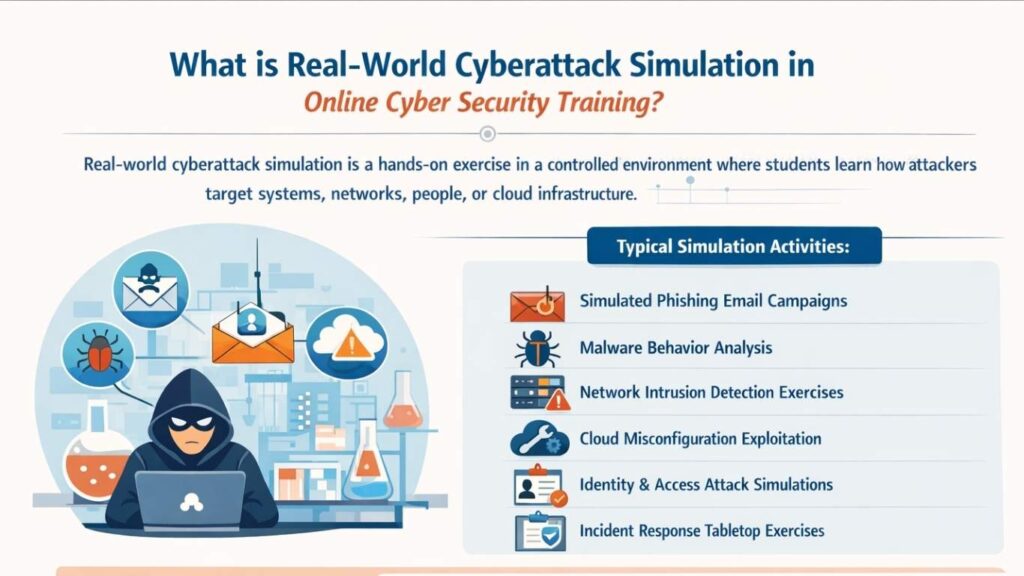
Real-world cyberattack simulation is an exercise in a controlled setting that shows students how attackers go after systems, networks, people, or cloud infrastructure. Students don’t just study theory; they also work with fake malicious traffic, suspicious logs, corrupted endpoints, or weak apps.
These simulations usually include:
- Simulated phishing email campaigns
- Malware behavior analysis
- Network intrusion detection exercises
- Cloud misconfiguration exploitation scenarios
- Identity and access attack simulations
- Incident response tabletop exercises
In professional cyber security training and placement structured learning paths, simulations are often integrated into lab environments where learners use enterprise-grade tools.
How Does Cyber Security Training Online Work in Real-World IT Projects?
Enterprise Cybersecurity Workflow Simulation
Most real-world cyberattack IT security teams follow a standard workflow:
| Phase | Real Enterprise Activity | Training Simulation Equivalent |
| Monitoring | SOC monitors logs and alerts | SIEM dashboard lab exercises |
| Detection | Identify suspicious activity | Threat detection scenario labs |
| Investigation | Analyze attack patterns | Log correlation exercises |
| Containment | Block attack vectors | Firewall and endpoint isolation labs |
| Recovery | Restore affected systems | Incident recovery simulation |
| Reporting | Document incidents | Security reporting practice |
These workflows help learners understand how cyber security training and job placement aligned training prepares them for SOC or security analyst roles.
Why Are Real-World Cyberattack Simulations Important for Working Professionals?
Cybersecurity is an operational discipline. Employers typically expect professionals to understand:
- How real-world cyberattack actually appear in logs
- How alerts are prioritized
- How incidents are documented
- How teams collaborate during security events
Simulations help professionals:
✔ Understand real-world cyberattack mindset
✔ Learn defensive strategies
✔ Practice tool-based investigation
✔ Reduce fear of real incidents
✔ Build decision-making confidence
Many working professionals transitioning into security roles rely on cybersecurity training and placement structured programs to gain this practical exposure.
What Skills Are Required to Learn Cyber Security Training Online?
Core Technical Skills
| Skill Area | Why It Matters |
| Networking Fundamentals | Understanding traffic patterns and real-world cyberattack vectors |
| Operating Systems | Windows and Linux attack surfaces |
| Log Analysis | Detect suspicious behavior |
| Cloud Security Basics | Protect cloud workloads |
| Identity Security | Prevent privilege misuse |
| Security Monitoring | SOC operations readiness |
Security Tools Familiarity
Common tools used in simulation labs:
- SIEM Platforms (Splunk, Sentinel, QRadar)
- EDR Tools (CrowdStrike, Defender for Endpoint)
- Vulnerability Scanners
- Packet Analysis Tools (Wireshark)
- Cloud Security Monitoring Tools
These tools are commonly included in cyber security training and placement oriented programs.
How Is Cyber Security Training Online Used in Enterprise Environments?
Example Enterprise Use Case: Ransomware Attack Detection
Real Enterprise Scenario
- Suspicious file download detected
- Endpoint shows abnormal encryption activity
- SIEM triggers high severity alert
- SOC isolates endpoint
- Forensics team investigates
Training Simulation Equivalent
- Simulated ransomware payload introduced
- Learner monitors endpoint telemetry
- SIEM alert triggered in training dashboard
- Learner performs containment steps
- Incident report created
This type of hands-on training is strongly connected to cyber security training and job placement aligned learning.
What Job Roles Use Cyberattack Simulation Knowledge Daily?
Security Operations Center (SOC) Analyst
- Monitors alerts
- Investigates suspicious activity
- Responds to incidents
Incident Response Analyst
- Handles active breaches
- Performs containment actions
- Conducts root cause analysis
Cloud Security Analyst
- Monitors cloud threats
- Secures IAM configurations
- Detects unusual access patterns
Threat Hunter
- Searches hidden threats
- Analyzes real-world cyberattack behavior
- Builds detection logic
Most of these roles expect hands-on exposure, which is why cybersecurity training and placement focused learning includes simulation labs.
What Careers Are Possible After Learning Cyber Security Training Online?
| Career Role | Typical Entry Path |
| SOC Analyst | Entry-level monitoring role |
| Security Analyst | Investigation and response |
| Cloud Security Associate | Cloud monitoring and protection |
| Vulnerability Analyst | Security testing and scanning |
| Compliance Security Analyst | Policy and regulatory monitoring |
Professionals entering through cyber security training and placement structured programs often start in SOC roles and grow into specialized positions.
How do realistic cyberattack simulations work on a technical level?
Parts of the Simulation Lab
1. Attack Setting
- Tools for simulating real-world cyberattack
- Vulnerable systems
- Cloud environments that aren’t set up right
2. Monitoring the Environment SIEM dashboards
- Monitoring endpoints
- Capture of network traffic
3. Tools for responding
- Simulating firewall rules
- Tools for isolating endpoints
- Simulation of access control
Example in Steps Workflow for Simulation
Step 1: Simulate an Attack
- Fake employee account got a phishing email
Step 2: The Detection Stage
- Email marked by detecting tool
- SIEM logs a login that seems suspicious
Step 3: The Investigation Phase
- Learner connects logs
- Checks for unusual login locations
Step 4: The Response Phase
- Simulated password reset
- Access tokens taken away
Step 5: The Reporting Phase
- Documented timeline of the incident
This procedure is often utilized in training programs for cyber security and job placement.
Common Problems Students Have with Cyberattack Simulation Training
Too Many Logs
Real-world cyberattack settings create a lot of data.
False Positives
Not every alert means an real-world cyberattack is happening.
How hard the tools are
It takes a long time to understand how to use enterprise tools.
Different Attack Patterns
Each real-world cyberattack acts in its own way.
Structured cybersecurity training and placement programs frequently incorporate guided practice to help people get past these problems.
Best Practices for Training in Enterprise Security
- First, learn how to read logs before moving on to more advanced detection.
- Know how a normal system works
- Practice being disciplined with your paperwork
- Learn about Real-world Cyberattack frameworks like MITRE ATT&CK.
- Don’t merely close alerts; focus on the main cause.
Frameworks from the industry that are often used in learning through simulation
The MITRE ATT&CK Framework
Helps you figure out how real-world cyberattack act.
The NIST Incident Response Framework
Gives an organized way to deal with incidents.
Model for Zero Trust Security
The way businesses protect themselves today.
Tools Commonly Used in Simulation Labs
| Tool Type | Example Usage |
| SIEM | Log monitoring and alerting |
| EDR | Endpoint threat detection |
| SOAR | Automated response workflows |
| Cloud Security | Cloud threat monitoring |
| Threat Intelligence | Attack pattern analysis |
How Simulation Training Prepares Professionals for Real Jobs
Simulation training helps learners:
- Reduce onboarding time in real jobs
- Understand team workflows
- Improve communication with security teams
- Learn real documentation formats
- Practice crisis decision making
These are key reasons cyber security training and job placement focused training is structured around practical exercises.
FAQ Section
Are cyberattack simulations safe to practice?
Yes. Training uses isolated lab environments separate from real production systems.
Do beginners need coding knowledge?
Not always. Basic scripting helps but is not mandatory initially.
Are cloud attack simulations included?
Many modern programs include cloud threat scenarios.
Do simulations help in job interviews?
Yes. Many interview questions are scenario-based.
How realistic are these simulations?
Most are based on actual enterprise real-world cyberattack patterns and incident case studies.
Important Points
- Real-world cyberattack simulations are standard in modern cybersecurity training
- Simulations help learners understand real enterprise attack patterns
- Hands-on labs improve detection, investigation, and response skills
- Enterprise tools and workflows are commonly included
- Simulation training supports real job readiness
Explore H2K Infosys Cyber Security Training Online programs to understand real-world simulation-based learning environments.
Enroll to gain hands-on experience aligned with real enterprise cybersecurity workflows and career growth.