Yes. Most structured Cyber Security Training Online programs, including those at H2kinfosys, include foundational to intermediate coverage of major security frameworks such as NIST, ISO 27001, and CIS Controls because they are widely adopted in enterprise security operations. In programs aligned with cyber security training with job placement, learners typically study how these frameworks guide risk management, compliance, security architecture design, and incident response processes used by real-world security teams.
What Is Security Framework Learning in Cyber Security Training Online?
Security frameworks are structured guidelines that help organizations design, implement, and maintain strong cybersecurity programs. Instead of creating security policies from scratch, companies rely on established frameworks to ensure consistency, compliance, and measurable risk reduction.
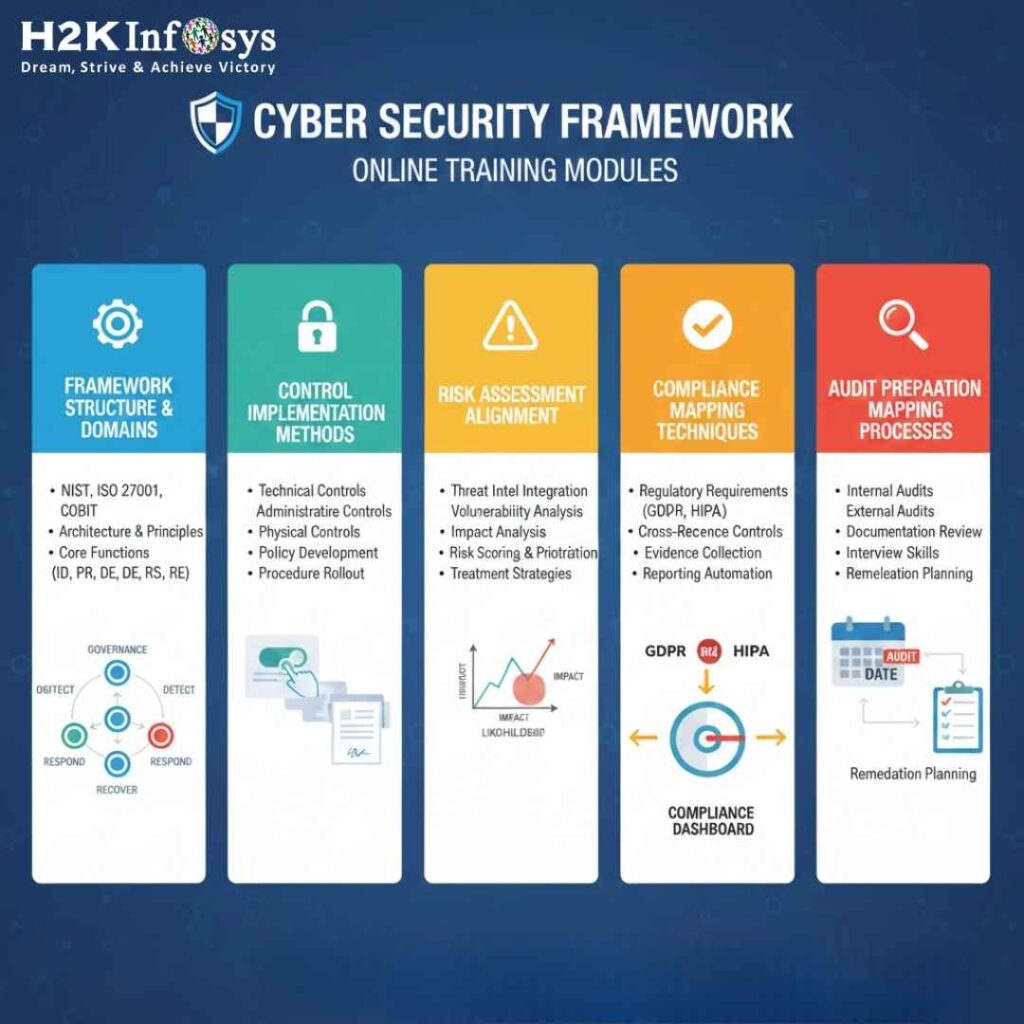
In Cyber Security Training Online, framework learning usually includes:
- Framework structure and domains
- Control implementation methods
- Risk assessment alignment
- Compliance mapping techniques
- Audit preparation processes
These security frameworks are not theoretical documents. They are operational tools used daily by security engineers, compliance analysts, and governance teams.
What do NIST, ISO 27001, and CIS Controls mean?
NIST stands for the National Institute of Standards and Technology.
NIST gives cybersecurity standards that are extensively used in both the public and private sectors.
Parts that are often covered:
- NIST Cybersecurity Framework (CSF)
- NIST Risk Management Framework (RMF)
- NIST 800-53 Security Controls
In the real world:
- contractors for the government
- Compliance with cloud security
- Risk-based security design
ISO 27001
- ISO 27001 is an international standard that guides the creation and upkeep of an Information Security Management System (ISMS).
Key Areas of Learning:
- Method for assessing risk
- The lifespan of a security policy
- Getting ready for an audit
- Model for continuous improvement
Enterprise Use:
- Businesses throughout the world
- Companies that use SaaS
- Banks and other financial entities
CIS Controls (Center for Internet Security)
- CIS Controls are all about taking security steps that are useful and important.
Important Areas Covered:
- Inventory of assets
- Managing vulnerabilities
- Control of access
- Watching for security
Value in the real world:
- security operations teams
- SOC environments
- Small-to-mid enterprise security programs
How Does Cyber Security Training Online Teach These Frameworks in Real Projects?
Most enterprise-focused training programs simulate real workflows instead of only teaching theory.
Example Enterprise Workflow
| Phase | Framework Used | Real Task |
| Risk Assessment | NIST | Identify threats to infrastructure |
| Policy Implementation | ISO 27001 | Create security governance policies |
| Technical Control Deployment | CIS Controls | Implement endpoint security monitoring |
Real Project Scenario Example
Scenario: Cloud Infrastructure Security frameworks Implementation
Step 1: Use NIST framework to identify risk categories
Step 2: Apply ISO 27001 controls for policy documentation
Step 3: Deploy CIS Controls for technical defense layers
This is commonly practiced in programs aligned with:
- cyber security jobs with training
- cyber security sales training (for security solution consultants explaining security frameworks compliance)
Why Are Security Frameworks Important for Working Professionals?
security Frameworks knowledge helps professionals:
- Communicate with auditors
- Pass compliance assessments
- Design secure architectures
- Support regulatory requirements
- Align security with business risk
Enterprise teams rarely operate without frameworks. Even startups adopt lightweight CIS Controls before scaling into NIST or ISO models.
What Skills Do You Need to Take Cyber Security Training Online?
Skills in Technology
- Basic networking
- Basics of operating system security
- Ideas for analyzing logs
- Basic scripting (not required but helps)
Skills for Analysis
- Thinking about risk analysis
- Mapping security controls
- Correctness of documentation
Skills for the Job
- Communication about compliance
- Reporting on security
- Working together with stakeholders
These abilities immediately help people get jobs in fields related to cyber security training via job placement programs.
How Are Security Frameworks Used in Enterprise Environments?
Governance Teams
Use ISO 27001 for:
- Policy governance
- Audit readiness
- Vendor risk assessment
Security Operations Teams
Use CIS Controls for:
- Threat detection
- Endpoint protection
- Access monitoring
Risk & Compliance Teams
Use NIST for:
- Risk scoring
- Control validation
- Security maturity measurement
What Job Roles Use Security Frameworks Daily?
| Role | Framework Usage |
| Security Analyst | Control monitoring, compliance validation |
| SOC Analyst | CIS control implementation monitoring |
| GRC Analyst | ISO policy audits and documentation |
| Security Engineer | NIST-based architecture design |
| Cloud Security Engineer | Framework-aligned cloud hardening |
These roles often appear in job listings targeting cyber security jobs with training pathways.
What Careers Are Possible After Learning Cyber Security Training Online?
Entry-Level
- Security Operations Analyst
- IT Security Support Specialist
- Compliance Associate
Mid-Level
- Security Engineer
- Risk Analyst
- Cloud Security Analyst
Advanced
- Security Architect
- GRC Manager
- Cybersecurity Consultant
How Framework Learning Connects to Security Tools
Framework knowledge is often paired with real tools.
| Tool | Framework Connection |
| SIEM Platforms | CIS monitoring controls |
| Vulnerability Scanners | NIST risk assessment |
| GRC Platforms | ISO compliance tracking |
| Endpoint Security Tools | CIS control enforcement |
Example of Practical Learning: Framework Control Mapping
Task: Make the Employee Endpoint Environment Safe
Step 1: Find the risk => NIST Risk Assessment
Step 2: Write down the rules, like the ISO Access Control Policy.
Step 3: Put control into action → CIS Endpoint Protection
Step 4: Add SIEM tool integration to log monitoring
Common Problems Professionals Have
1. Confusion Overlapping Frameworks
There are a lot of controls that operate with more than one security frameworks. Professionals need to learn how to map things out.
2. Documentation versus Technical Implementation Gap
GRC teams keep track of controls. They are put into place by security engineers. Training typically teaches both sides of the story.
3. Audit stress
Companies must show that their controls work. Collecting evidence is an important skill.
Frequently Asked Questions
Do beginners learn frameworks or only advanced professionals?
Most programs introduce frameworks early because they guide all security work.
Are these frameworks required for cybersecurity jobs?
Many enterprise security roles expect basic familiarity with NIST, ISO, or CIS.
Do frameworks change frequently?
Core structure remains stable, but control updates happen periodically.
Is framework knowledge needed for cloud security roles?
- Yes. Cloud environments still follow compliance frameworks.
Do SOC analysts need framework knowledge?
Yes, especially CIS Controls for monitoring and incident response alignment.
Key Takeaways
- Security frameworks guide real enterprise security operations
- NIST focuses on risk management and control design
- ISO 27001 focuses on governance and policy structure
- CIS Controls focus on practical technical defense implementation
- Framework knowledge supports compliance, architecture, and operations roles
- These frameworks are commonly used across global enterprises
Explore hands-on Cyber Security Training Online programs at H2K Infosys to understand real framework implementation in enterprise environments.
Build practical security skills aligned with modern cyber security jobs with training career paths.