H2K Infosys has seen that cybersecurity jobs like security analyst, ethical hacker, and SOC analyst are more in demand than ever in today’s rapidly changing digital world. But can taking a cybersecurity course really get you these jobs? The short answer is yes, it can, but there’s more to it than merely finishing a course.
If you’re interested in getting a job in cybersecurity with training or maybe looking into cybersecurity training that leads to a job, this article will explain what you can anticipate from a well-organized program. I’ll discuss some lessons I’ve learned from real-life situations and my time in the cybersecurity training field.
Things You Should Know About Cybersecurity Courses
Cybersecurity is one of the fastest-growing fields, especially since there are more cyber dangers around the world. Companies of all sizes require trained people to defend their digital assets against ransomware assaults, phishing scams, and even cybercrimes that are backed by the government. A good training program can definitely give you the information and practical skills you need to work as a security analyst, ethical hacker, or SOC analyst.
But signing up for any cybersecurity course isn’t enough. What is important is if the course is up-to-date with the job market, teaches useful skills, and lets you use what you learn in the actual world. Cybersecurity sales training and cybersecurity training with job placement are two very important parts that can greatly improve your job.
So, let’s break it down: does this training help you find work?
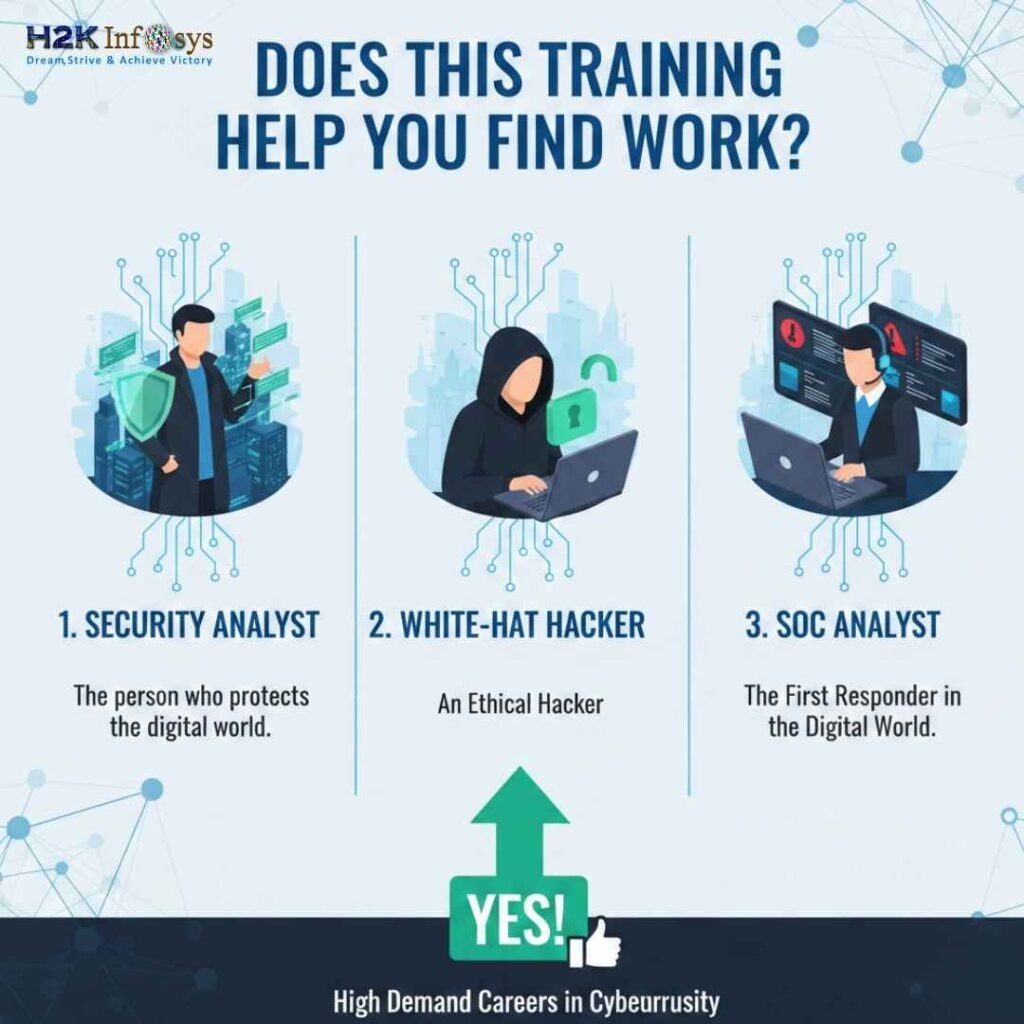
1. The Security Analyst is the person who protects the digital world.
Security analysts are the first line of defense for the digital infrastructure of any business. They watch networks for strange behavior, run firewalls, look into breaches, and develop ways to stop threats before they happen. To get this job, you need to know a lot about the technical side of cybersecurity, such as network security, intrusion detection systems (IDS), and managing vulnerabilities.
A solid cybersecurity course will provide you a lot of information about things like:
Firewalls, VPNs, and IDS/IPS are all examples of network security.
Risk management and threat assessment
Response and Recovery After an Incident
Wireshark, Nmap, and other security tools
For example, one of my coworkers was able to move from a helpdesk job to a security analyst job in less than six months after taking a cybersecurity course that included hands-on training. The course taught her both the theory and the practical tools she needed to keep an eye on and deal with dangers, which provided her the confidence and knowledge she needed to do well in interviews.
2. The White-Hat Hacker is an Ethical Hacker.
Ethical hackers, often called penetration testers, do the same thing that ethical hacker do to get into systems, but for good reasons. They check how strong an organization’s security is by trying to take advantage of weaknesses and finding them before bad ethical hacker may use them.
- Some of the things you learn in courses that lead to ethical hacker careers are:
- Penetration Testing: Finding and taking advantage of system weaknesses.
- Malware Analysis: Learning about bad software and how to stop it.
- Cryptography: Using encryption to keep communications safe.
- Kali Linux, Metasploit, Burp Suite, and other ethical hacker tools.
For example, a friend of mine completed an ethical hacker course that was well-organized and came with a job placement guarantee. He got a job as an ethical hacker with a well-known cybersecurity company just a few months after finishing the course. The course’s hands-on labs were really helpful because they let him try out real-world ethical hacker tools and methods.
3. SOC Analyst: The First Responder in the Digital World
A SOC analyst (Security Operations Center analyst) is an important part of an organization’s cybersecurity operations center. This job includes keeping an eye on security warnings, looking at threat intelligence, and organizing responses to cyber incidents. SOC analysts are like digital first responders; they are the first to identify and respond to possible breaches or suspicious activities.
- To do well as a SOC analyst, you need to know about:
- Tools for managing security information and events (SIEM), such as Splunk and ArcSight.
- Procedures for Finding and Responding to Incidents
- Analysis of Threat Intelligence.
- Monitoring and Reporting Security
For example, one of the students from my recent cybersecurity training program got a job as an intern in a SOC analyst capacity right after finishing the course. He learned how to spot and deal with cybersecurity issues during the course, which included instruction on different SIEM platforms. This made him quite useful throughout his internship, and he was recruited full-time.
Important Things That Will Affect Your Journey
A cybersecurity education will absolutely help you get started, but there are a few important things that will affect how well you do in getting these jobs:
1. Labs and scenarios that are based on real life
Reading about ideas in theory isn’t enough. You need to practice cybersecurity ethical hacker in real life. Courses that have labs where you can practice attacks, set up firewalls, or find network weaknesses are much more useful. These laboratories not only help you understand hard ideas, but they also give you real-world skills that you can use on the job.
2. Help with finding a job
You’re already ahead of the game if your course helps you find a job. A lot of schools work with businesses who are looking for people with cybersecurity skills. Some schools even set up direct meetings with recruiting managers or career fairs just for fresh grads. With this kind of placement help, you can get into a cybersecurity career faster.
3. Certifications: Prove What You Know
Employers want to see proof that you have the expertise to work in cybersecurity. Certifications are a terrific method to show off what you know. Some of the most well-known certifications are:
- CompTIA Security+
- Certified Ethical Hacker (CEH)
- Professional in Information Systems Security (CISSP)
- CISM stands for Certified Information Security Manager.
If you really want to get a high-paying job in cybersecurity ethical hacker, the best thing to do is to take courses that prepare you for these certifications and provide you a lot of training.
A Realistic Look at Cybersecurity Jobs with Training
Let’s be honest: you need a mix of knowledge, skills, and experience to work in cybersecurity. Training can give you a good start, but how well you network in the field and how hard you work to use what you’ve learned will determine how well you do.
For instance, many entry-level cybersecurity jobs don’t simply require a certificate of course completion; they also require the ability to show that you can solve problems in real time. Most cybersecurity jobs with training need candidates to know the tools, technologies, and protocols utilized in the sector. That’s why job placement programs that let you practice interviews and other situations are so helpful.
A former student from our cybersecurity training program got a position as a ethical hacker , SOC analyst after working hard for three months to get ready for the placement. He became good at SIEM tools after the training, and the practice interviews gave him more confidence.
Industry Trends and Job Market Demand
The demand for cybersecurity ethical hackers professionals is only set to increase. According to recent data, the cybersecurity industry is expected to grow by 32% from 2020 to 2030 far faster than the average for all other industries. In particular, roles such as ethical hacker and security analysts are in high demand due to the rapid increase in cyberattacks.
For anyone interested in cybersecurity roles like SOC analyst, security analyst, or ethical hacker, now is a great time to enter the field. Cybersecurity training with job placement programs can give you an edge in a competitive job market.
Conclusion
A cybersecurity ethical hackers education can definitely help you get a job as a security analyst, ethical hacker, or SOC analyst, but that’s not the end of the road. Pick a curriculum that has labs where you can work with your hands, certificates that are useful, and good help finding a career. Stay engaged, receive real-world experience, and join the cybersecurity community through blogs, forums, and social media.
If you’re ready to go on to the next stage and enter the fascinating field of cybersecurity, seek for training programs that are in line with current industry standards, offer career guidance, and give you hands-on experience to prepare you for your first job.