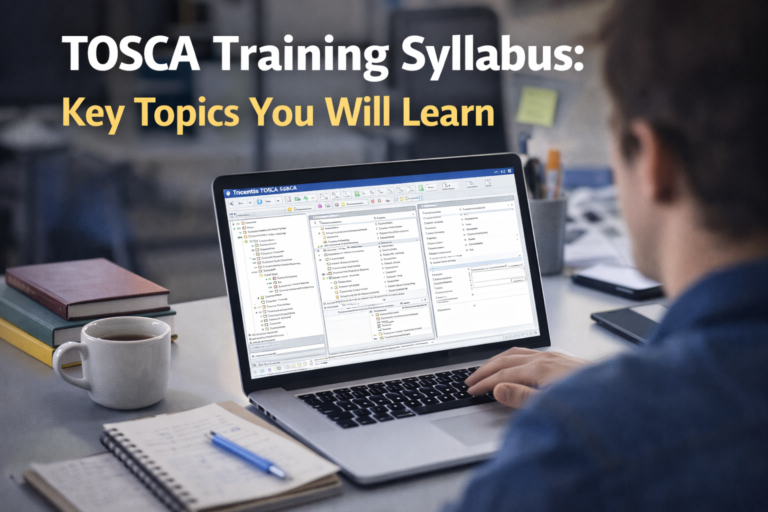
The TOSCA Training program provided by H2K Infosys focuses on the skills needed for an automation career. This guide simplifies the TOSCA Training Syllabus and what it entails. If you’re curious about the TOSCA Training Syllabus and how it relates to enterprise-level automation projects, the answer is yes. enterprise-level automation projects.
I’ve worked with teams that have transitioned from manual regression testing to model-based automation, and the overarching success and difference in that movement was how they grasped the TOSCA Training Syllabus. Everything changes with a strong foundation.
Why You Should Care About TOSCA Training Syllabus in 2026
It is no longer enough to write scripts for automation. Risk-based testing, DevOps, and shorter release cycles have become the focus of today’s enterprise automation. Companies want testers who understand the business perspective in addition to the testing perspective, particularly with the Tricentis TOSCA tool, which dominates codeless automation.
This is precisely the reason the TOSCA Training Syllabus focuses on model-based automation. Rather than teaching you coding-heavy frameworks, it teaches you how to think in reusable components.
During the last few years of working on enterprise projects, particularly in the banking and healthcare sectors, numerous teams have selected TOSCA for their automation needs due to the significant reduction in maintenance required. Honestly, when it comes to maintenance, most automation projects tend to fail.
Core Modules in the TOSCA Training Syllabus
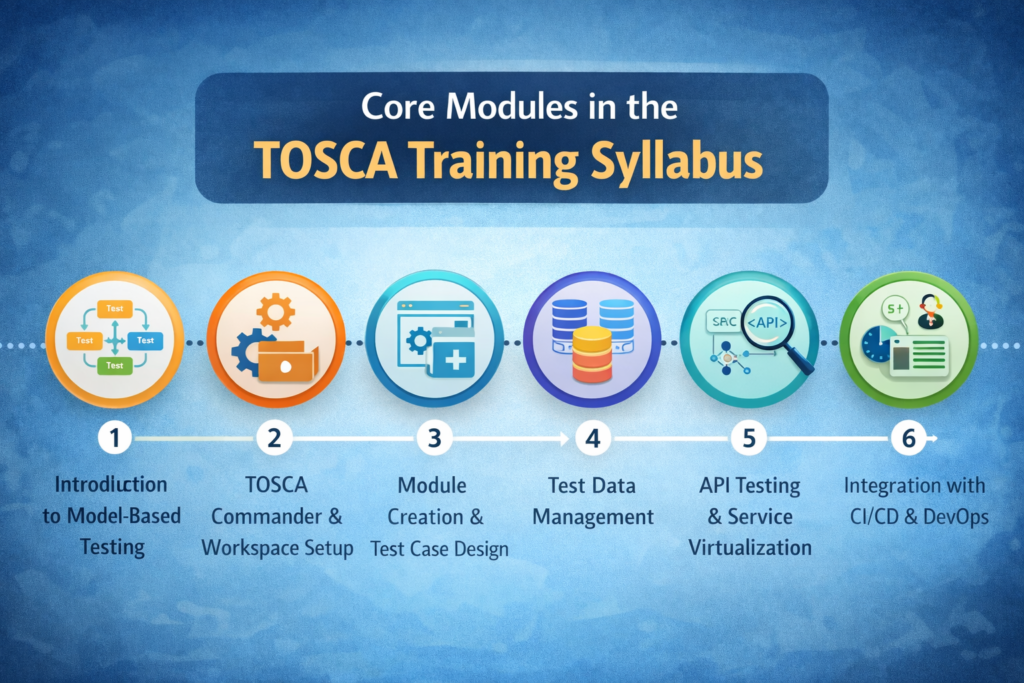
1. Introduction to Model-Based Testing
Your TOSCA Training Syllabus begins with the training model of test automation. You will understand:
- The meaning of model-based automation
- The difference between TOSCA and Selenium/other script-based tools
- The significance of enterprise automation in terms of reusability
This is often the learning point at its peak. Rather than writing code, you will build reusable test modules.
2. TOSCA Commander and Workspace Setup
The TOSCA Training Syllabus now shifts towards practical application. You will be able to:
- Install TOSCA
- Create and manage workspaces
- Comprehend TOSCA Commander
- Manage repositories
Based on my previous experience, this is the point where novices begin to feel a sense of self-assurance. Once you have hands on the interface, it will lose its intimidating aura.
3. Module Creation and Test Case Design
This is the crux of the TOSCA Training Syllabus.
You’ll get to grips with:
- Scanning applications (Web, SAP, API, Desktop)
- Developing reusable modules
- Constructing test cases via drag-and-drop
- Parameters with test data
In actual projects, this is where the real work is. I’ve seen regression cycles shrink from 10 to 3 days due to the smart reuse of modules.
4. Test Data Management
Automation, especially in today’s world, is data-driven. The TOSCA Training Syllabus includes:
- TestCase Design (TCD)
- Business parameterization
- Combinatorial testing
- Management of large datasets
In 2026, due to the integration of AI-driven analytics with testing dashboards, the need for structured test data will be greater than it has ever been.
5. API Testing and Service Virtualization
Many learners believe TOSCA is restricted to UI testing. This is false.
The TOSCA Training Syllabus includes:
- API scanning
- Developing API test cases
- Validation of responses
- Mock services
With microservices architecture becoming the norm, there is a strong demand for skills in API automation.
6. Integration with CI/CD and DevOps
Today’s testers need to have an understanding of pipelines.
In the TOSCA Training Syllabus, you’ll also find:
- Jenkins integration
- Execution lists
- Distributed execution
- Reporting and analytics
In a DevOps pipeline to which I contributed, automated TOSCA test cases were triggered with every code commit. That’s the level of automation we aim for.
7. Risk-Based Testing and Reporting
Risk-based testing is one of the fields where TOSCA shows tremendous potential.
The TOSCA Training Syllabus describes the following:
- Risk Classification
- Requirement Coverage
- Impact Analysis
- Dashboards Reporting
These can be particularly beneficial to regulated industries such as finance and insurance.
How TOSCA Automation Certification Fits Into the Syllabus
Once the TOSCA Training Syllabus is at the midpoint, learners are introduced to the various components of a certification. The training guides you to TOSCA Automation Certification, which includes:
- Preparation for assessment at various levels
- Practice for simulations in real time
- Simulations of enterprise cases
The certification is much more than passing an examination. In recruitment interviews, managers typically ask questions about how to implement concepts in practice. A well-designed TOSCA Training Syllabus prepares you for such talks.
Real World Applications You Will Practice
A well designed TOSCA Training Syllabus does not stop at tool commands, it also includes scenarios like:
- Automating workflows for e-commerce checkouts
- Banking loan approval systems
- The validation of patient healthcare records
- Processing of invoices in SAP
In one project I observed, a retail company automated 80% of their smoke suite within three months using TOSCA modules built during structured training.
What differentiates this Syllabus from generic Automation Courses?
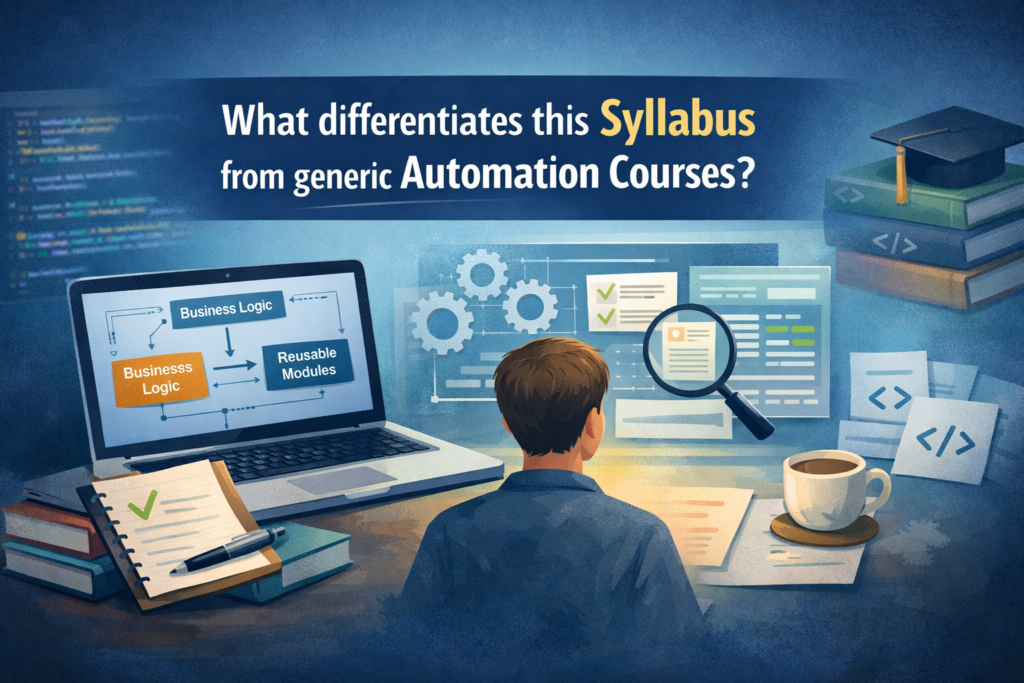
Here’s something I have observed, several automation courses bombard learners with syntax. The TOSCA Training Syllabus is designed keeping in mind business-readable automation.
Instead of memorizing code:
- You design reusable components
- You understand requirement traceability
- You reduce script maintenance
This is the reason why businesses opt for people who are structured on TOSCA Automation Certification paths rather than those who have learned from random tutorials.
What jobs can you expect after completing the TOSCA training syllabus:
- Automation Test Engineer
- QA Analyst
- Test Architect
- DevOps QA Specialist
Due to the rapid digital transformation of businesses across all sectors, the need for Tricentis TOSCA experts continues to be high, especially in large-scale enterprises.
I have witnessed fresh graduates move into automation roles within months when they practiced the TOSCA training syllabus robustly and consistently.
Is the TOSCA Training Syllabus Beginner Friendly?
Yes – provided that it is taught with an emphasis on practicality.
The TOSCA training syllabus is structured in such a way that automation thinking can be taught to someone without extensive coding experience. It is model (and codeless), which lowers the methods and technology involved to a reasonable level.
However, like any tool, most of the learning comes from doing. To a large extent, effort and time spent to simply watch will be in vain; the real learning is in the doing.
Conclusion
The TOSCA Training Syllabus is designed to help you succeed in enterprise level automation. It is aligned with the industry standards and when combined with practical industry standards, it improves solid automation thinking.
The competitive nature of the QA market favors individuals that incorporate a solid TOSCA Training Syllabus, practice real-time problems, and engage in TOSCA Automation Certification. Your chances of success with TOSCA are improved with the incorporation of AI and as TOSCA continues to evolve.
Essentially, a comprehensive TOSCA Training Syllabus teaches you more than a tool; you also gain insight into the workings of modern testing.