
Yes, H2K Infosys does provide advanced cybersecurity courses for people who are just starting out. The program is meant to help novices learn the basics of cybersecurity and then move on to more sophisticated abilities that are employed in the industry today.
And to be honest, this kind of improvement is not just feasible, it’s anticipated. Cybersecurity training nowadays isn’t just for people who already work in IT. Most modern programs, including cyber security training with job placement, are designed to help beginners become professionals who are ready to work through guided, hands-on learning.
Let’s look at this realistically, based on how advanced cybersecurity training works in 2026 and what students really go through.
Why Cybersecurity Training Is Designed for Beginners First
Cybersecurity might sound intimidating at first firewalls, SIEM tools, threat intelligence, penetration testing but here’s the truth most people don’t realize: almost every advanced cybersecurity expert started as a beginner.
Good advanced cybersecurity programs follow a progression model:
Phase 1: Foundation
Phase 2: Intermediate Skills
Phase 3: Advanced Real-World Application
At H2K Infosys, learners typically start with:
- Networking basics
- Operating systems (Windows, Linux fundamentals)
- Security concepts (CIA triad, vulnerabilities, threats)
- Security tools introduction
This foundation is critical. Without understanding how networks and systems work, it’s impossible to secure them.
I’ve seen learners from completely non-technical backgrounds in finance, healthcare, even customer support start here and gradually build strong cybersecurity careers.
How Beginners Learn Advanced Cybersecurity Skills One Step at a Time
The change doesn’t happen right away. It is organized, slow, and useful.
Step 1: Learning the Basics of Cybersecurity
At the beginning, learners focus on getting a handle on:
- What cybersecurity really protects
- How hackers get inside systems
- Basic security measures
- Ideas for managing risk
You learn how to use tools like
- Wireshark, which lets you watch networks.
- Basics of Splunk (log analysis)
- Command line in Linux
It feels strange at first. But after a few weeks, things start to make sense.
A lot of students understand that advanced cybersecurity is more about thinking logically than memorizing things here.
Step 2: Using Security Tools and Simulations in the Real World
After the basics are evident, training goes on to hands-on learning.
Students start using tools that are utilized in real security operations centers (SOC):
- SIEM systems
- Systems for spotting threats
- Tools for monitoring logs
- Workflows for responding to incidents
For instance, a student might look at login attempts from different countries that seem strange and figure out if they are part of a brute force attack or normal behavior.
This hands-on experience is what makes the difference between learning in theory and learning how to do a profession.
And this is why more and more people are looking for cyber security jobs that come with training. Employers like candidates who already know how to use equipment and follow procedures..
Step 3: Get better at cybersecurity and pick a field to work in.
At the advanced level, learners start handling complex scenarios, such as:
- Investigation of incident response
- The principles of malware analysis
- Understanding threat intelligence
- Automating security monitoring
- Assessment of vulnerabilities
This part feels extremely different from learning as a beginning. Instead of just learning about ideas, students actually work on security challenges.
For instance:
You might look into a fake ransomware attack, go through logs, find ways in, and suggest ways to stop it from happening again.
That’s what cybersecurity experts do every day.
Example: How to get from a beginner to a job-ready SOC analyst
I personally saw one scenario where a trainee had no knowledge of advanced cybersecurity. He worked in technical support but wanted to switch to cybersecurity.
This is how his learning progressed:
Month 1–2: Learned the basics of Linux, networking, and cybersecurity.
Month 3–4: Began using SIEM tools and analyzing logs
Month 5–6: Worked on scenarios for responding to incidents
Month 7–8: Applied for jobs as a SOC analyst
He got his first job in advanced cybersecurity just a few months after finishing organized cyber security training that included help finding a job.
More and more people are making this kind of change in 2026.
Why structured learning is the most important thing
When you try to learn about advanced cybersecurity from random YouTube videos or lessons that are all over the place, it might be hard to understand.
- Structured programs offer:
- A clear path to learning
- Progression step per step
- Practice with your hands
- Simulations in the real world
- Help with choosing a career
This path helps newcomers gain confidence over time.
Many people get trapped in theory and never master the skills they need to gain a job if they don’t have structured learning.
The Growing Demand for Cybersecurity Professionals in 2026
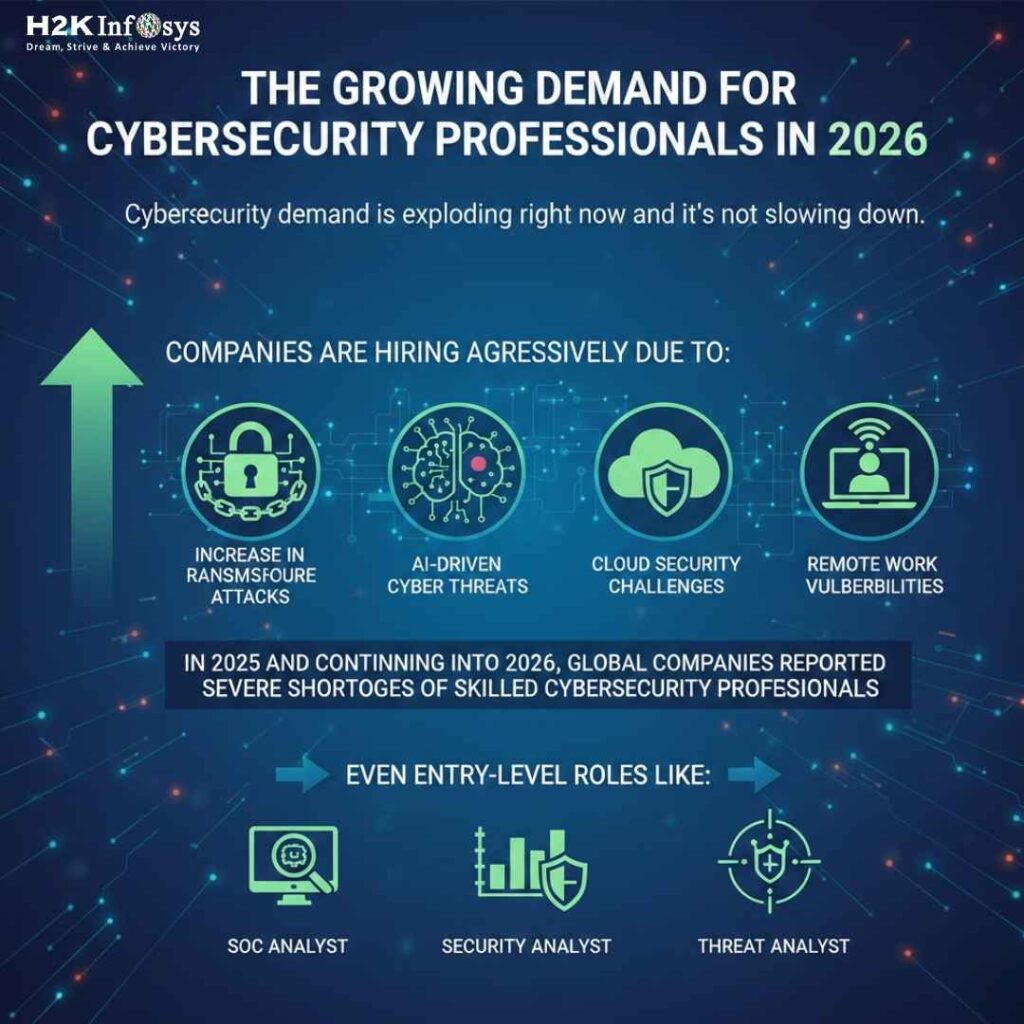
Cybersecurity demand is exploding right now and it’s not slowing down.
Companies are hiring aggressively due to:
- Increase in ransomware attacks
- AI-driven cyber threats
- Cloud security challenges
- Remote work vulnerabilities
In 2025 and continuing into 2026, global companies reported severe shortages of skilled cybersecurity professionals.
Even entry-level roles like:
- SOC Analyst
- Security Analyst
- Threat Analyst
are widely available.
This is why cyber security jobs with training pathways are becoming one of the fastest career entry routes into tech.
How Cyber Security Sales Training Can Help You Get More Jobs
Cyber security sales training is a fascinating area that many novices don’t think about.
Cybersecurity organizations need more than simply technical experts. They also need people who can:
- Talk to businesses about security solutions
- Show off cybersecurity products
- Help customers
This leads to jobs like:
- Security sales engineer
- Consultant on cybersecurity
- Manager of technical accounts
These jobs mix technical and business skills and often pay quite well as you move up in your career.
A lot of students find this career after learning the basics to advanced cybersecurity.
The Importance of Hands-On Projects for Skill Development
The most important thing to do to move from beginner to advanced levels is to practice.
Students usually work on projects like:
- Checking network traffic for dangers
- Looking into strange behavior
- Finding weaknesses
- Responding to fake attacks
These exercises help you feel more sure of yourself.
At some point, students cease thinking of themselves as novices and start thinking like cybersecurity experts.
That change is very big.
Why Beginners Actually Have an Advantage
This might sound surprising, but beginners often progress faster than experienced IT professionals in cybersecurity training.
Why?
Because beginners learn with a fresh mindset.
They follow structured learning without unlearning outdated habits.
advanced Cybersecurity today focuses heavily on modern tools and real-world threat detection, not just traditional IT concepts.
This makes structured cyber security training with job placement ideal for beginners.
What Newbies Worry About and What Really Happens
“Do I need to know how to code?”
No, most entry-level advanced cybersecurity jobs don’t need coding skills right away.
You don’t have to learn basic scripting right away, but you can later.
“Do I need to have worked in IT before?”
No. A lot of students start with no IT experience.
Cybersecurity training teaches you things one step at a time.
“Is cybersecurity too hard for people who are just starting out?”
It’s hard, but with systematic learning, it’s totally doable.
Progress happens little by little.
What Makes H2K Infosys’s Learning Progression Work
There are a number of important things that help people move from beginner to advanced:
- Structured program with steps
- Real-world situations and hands-on laboratories
- Learning by doing with tools
- Help with preparing for a career
- Getting a taste of real cybersecurity workflows
This systematic approach makes sure that students don’t just learn ideas; they also gain practical professional skills.
The Truth About Career Growth in Cybersecurity
You can’t learn about advanced cybersecurity just once. It’s a quest that never ends.
Even seasoned pros are always learning about new tools and ways that threats work.
The most important thing is to develop a firm base first.
After beginners finish their basic and intermediate training, it gets easier and more natural for them to learn advanced things.
Final Thoughts
Entry-level students can comfortably go on to more advanced cybersecurity courses at H2K Infosys because of structured learning, hands-on experience, and training in the real world. With the correct training and support, beginners can learn the skills they need for cybersecurity jobs with training and build long-term careers in the field.
Cybersecurity is one of the few industries where beginners can swiftly go up the ladder if they study the right way. There is a significant need for advanced cybersecurity professionals, and structured training with job placement is a clear way for beginners to become experienced professionals.
That’s fine if you’re beginning from scratch. That’s where everyone in cybersecurity started. The most important thing is to start and move forward one step at a time.