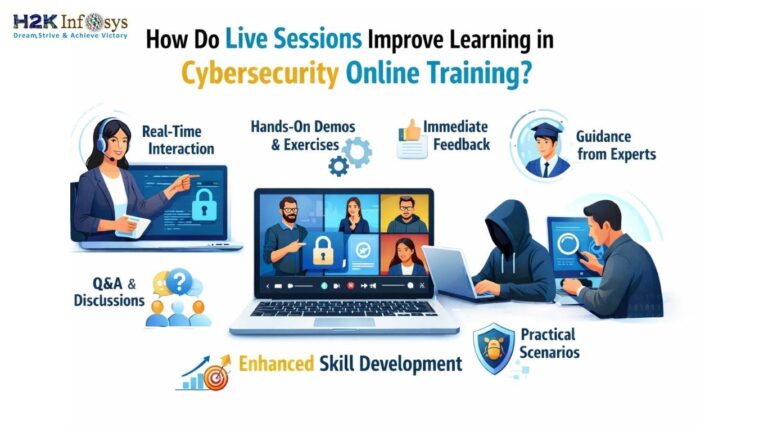
Live sessions improve cybersecurity online training, and h2kinfosys helps bring this to life by turning passive learning into active, real-world problem solving. Instead of just watching videos, learners get to interact with experts, ask questions in real time, and experience how cybersecurity actually works in practice exactly how it happens on the job.
If you’ve ever tried learning cybersecurity purely through recorded lectures, you probably know the feeling. Everything makes sense… until it doesn’t. You understand what a phishing attack is in theory, but when you see a real suspicious email, you hesitate. That gap between theory and real-world decision-making is where live sessions make all the difference.
Let’s break down why they matter so much, especially now, when cyber threats are evolving faster than most static courses can keep up.
1. You Learn How Cybersecurity Actually Works in Real Time
Cybersecurity isn’t a memorization field. It’s a thinking field.
During live sessions, instructors often simulate real attack scenarios like detecting unusual network traffic or analyzing malware behavior. I’ve personally seen sessions where trainers shared their screen and investigated a live ransomware sample. Watching their decision-making process was far more valuable than reading slides about ransomware.
For example, in 2024, there was a surge in ransomware attacks targeting healthcare systems worldwide. Many live training programs immediately integrated those real cases into their sessions, showing learners how attackers gained access and how defenders responded. Recorded courses couldn’t update that fast.
This is especially important for people aiming for cyber security jobs with training, because employers want professionals who can respond to real situations, not just recall definitions.
2. You Can Ask Questions When You’re Actually Confused
This sounds obvious, but it’s huge.
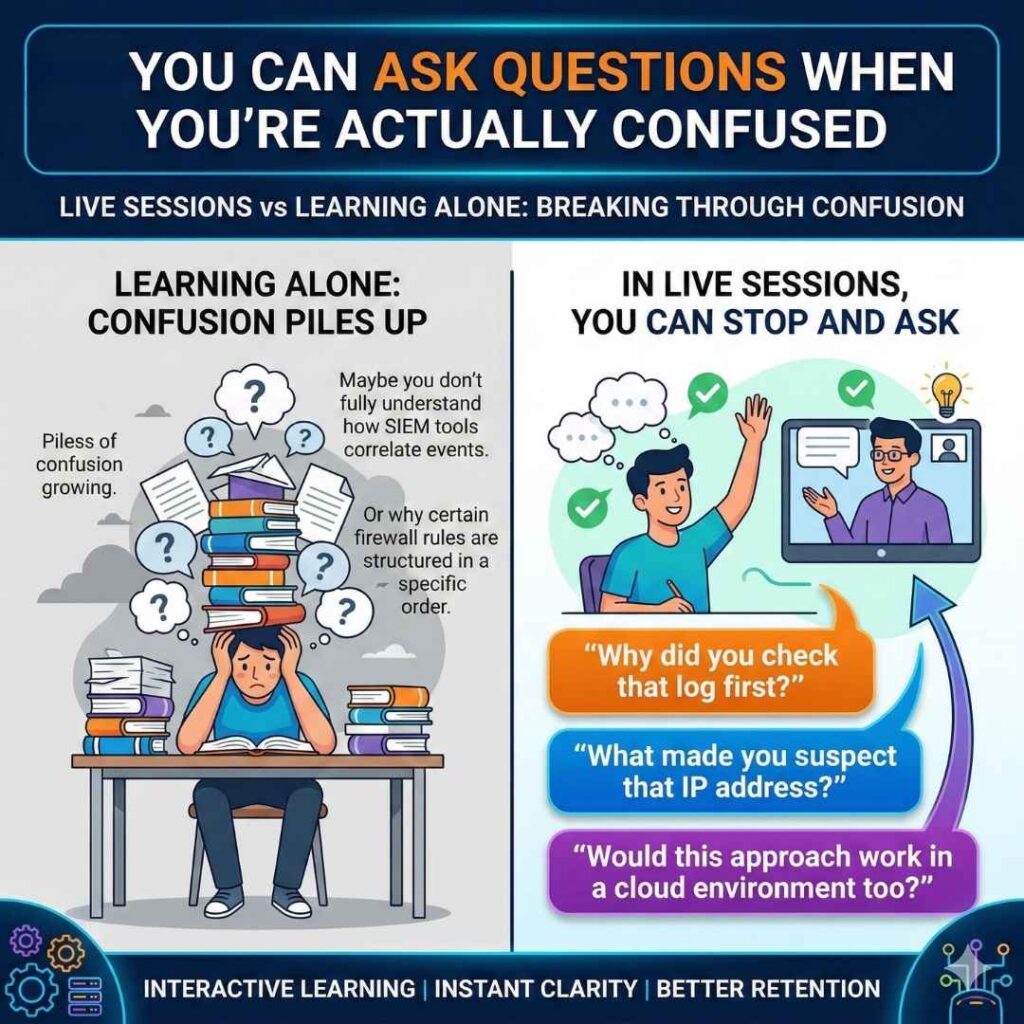
When you’re learning alone, confusion piles up. Maybe you don’t fully understand how SIEM tools correlate events. Or why certain firewall rules are structured in a specific order.
In live sessions, you can stop and ask:
- “Why did you check that log first?”
- “What made you suspect that IP address?”
- “Would this approach work in a cloud environment too?”
These small clarifications prevent misunderstandings that could otherwise stick for months.
And honestly, sometimes other learners ask questions you didn’t even realize you needed answered.
3. You Build the Exact Skills Employers Are Hiring For
There’s been a noticeable shift in hiring trends over the past couple of years. Companies care less about certificates alone and more about hands-on ability.
According to industry hiring patterns in 2025 and early 2026, roles like:
- SOC Analyst
- Threat Analyst
- Security Operations Specialist
- Cybersecurity Sales Engineer
all require practical thinking, not just theoretical knowledge.
Live sessions often include:
- Live threat detection exercises
- Incident response simulations
- Tool demonstrations (Splunk, Wireshark, CrowdStrike, etc.)
This is particularly valuable for learners pursuing cyber security training with job placement, because many programs use live sessions to simulate real workplace environments.
Some even recreate SOC environments where learners monitor alerts, escalate incidents, and document findings just like a real job.
4. You Get Exposure to Industry Tools and Workflows
One thing that surprised me when I first explored cybersecurity training was how different real tools felt compared to textbook explanations.
Live sessions usually involve tools such as:
- SIEM platforms (Splunk, IBM QRadar)
- Endpoint detection tools
- Threat intelligence dashboards
- Packet analysis tools like Wireshark
Watching an instructor navigate these tools live shows:
- What they prioritize
- How they interpret alerts
- How they avoid false positives
These subtle habits matter a lot.
This exposure is especially useful for roles connected to cyber security sales training, where professionals need to understand how security products function in real environments, not just how to sell them.
Sales engineers and security consultants often attend live technical sessions to understand the product deeply so they can explain its value honestly to clients.
5. You Stay Motivated and Consistent
Let’s be honest self-paced courses are easy to abandon.
Life gets busy. Motivation dips. Lessons get postponed.
Live sessions create structure and accountability. You show up because others are showing up too. There’s a shared momentum.
It also feels more human. You’re not just staring at a screen alone you’re part of a group learning together.
That sense of progress is surprisingly powerful.
6. You Learn Directly From Working Professionals
Many live session instructors are active cybersecurity professionals.
They’re not just teachers, they’re SOC analysts, penetration testers, consultants, or threat researchers.
They share things you won’t find in textbooks, like:
- Common beginner mistakes in real jobs
- What hiring managers actually look for
- How incidents unfold behind the scenes
- How to handle pressure during active security incidents
These insights come from experience, not theory.
And honestly, this kind of perspective is invaluable if you’re trying to transition into cybersecurity from another field.
7. You Prepare Better for Real Job Interviews
This is something many learners don’t realize until later.
Cybersecurity interviews increasingly include scenario-based questions, such as:
- “What would you do if you noticed unusual outbound traffic?”
- “How would you investigate a suspected compromised endpoint?”
- “Walk me through your incident response process.”
Live sessions expose you to these situations repeatedly.
Over time, you develop natural confidence not scripted answers.
That confidence shows in interviews.
8. You Build Professional Connections
This is an underrated benefit.
During live sessions, you interact with:
- Instructors
- Mentors
- Other learners
- Industry professionals
These connections sometimes lead to:
- Referrals
- Job recommendations
- Mentorship opportunities
Many people land their first cybersecurity roles through relationships formed during live training.
It happens more often than people think.
9. You Learn Faster Because Mistakes Get Corrected Immediately
When you’re learning alone, you might practice incorrectly without realizing it.
Live instructors catch mistakes instantly.
For example:
- Misinterpreting log entries
- Using inefficient investigation steps
- Missing key threat indicators
Immediate correction accelerates learning dramatically.
This prevents bad habits from forming.
Final Thoughts
Cybersecurity isn’t something you master by watching alone. It’s something you develop through interaction, observation, and real-time practice.
Live sessions bridge the gap between learning and doing. They help you think like a cybersecurity professional, not just study like one.
If your goal is to enter cybersecurity, especially through programs offering cyber security jobs with training or structured cyber security training with job placement, live sessions are one of the most important components to look for.
They don’t just teach concepts. They prepare you for reality.
And in cybersecurity, reality is what matters most.