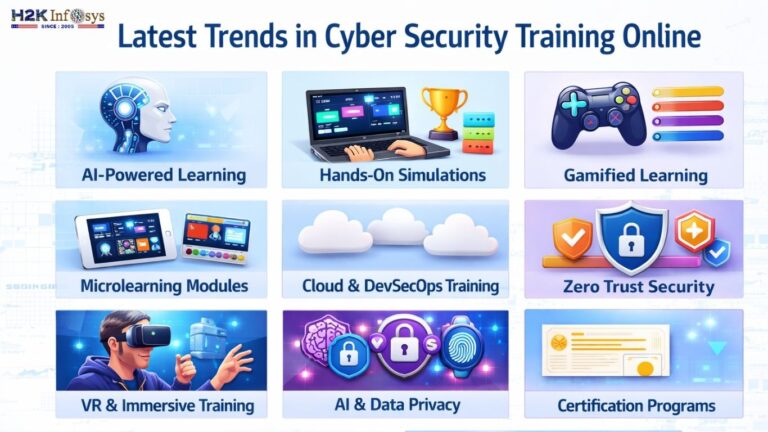
The latest trends in cyber security training that’s available online are shifting heavily towards hands-on training. For instance, H2K Infosys emphasizes the importance of training that’s similar to the actual environment of a SOC (Security Operations Center).
What’s Changing in Cyber Security Training (Right Now)
If you’ve researched cyber security training even just a year ago and compared it to what’s out there now, I think the difference is quite noticeable. The focus has shifted dramatically from “learn the concepts” to “can you actually do the job?”
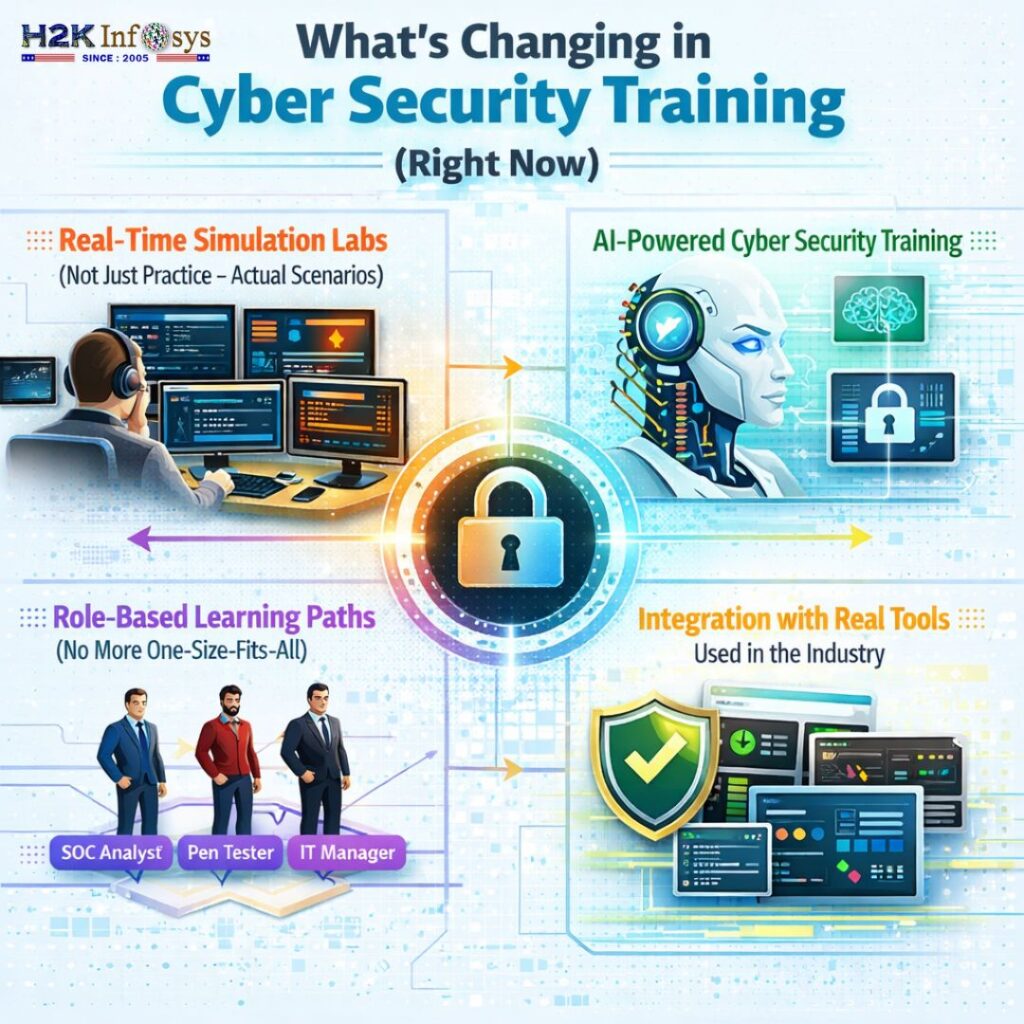
1.Real-Time Simulation Labs (Not Just Practice Actual Scenarios)
One of the big differences I’ve seen in the training world is the rise of real-time attack simulations. Instead of just learning about phishing and malware attacks:
You’ll get to investigate the simulated attacks.
You’ll get to analyze the logs as if you were in a real environment.
You’ll get to respond to the attacks in a timed environment.
It’s not as much of a training feel as it’s more like “you’re already in the industry and this is your first job.” That’s why this trend is closely associated with cyber security jobs with training employers who want people who have already been in the game, even if it’s just in a simulation environment.
2.AI-Powered Cyber Security Training
AI-powered training is changing rapidly. For instance:
You’ll find that the training adjusts the difficulty based on your skill level.
You’ll find that the training suggests scenarios that you haven’t mastered yet.
You’ll find that the training has already included the attacks of an “intelligent hacker.”
The attacks are getting more and more AI-driven, and the training is no exception. I’ve personally noticed how adaptive training makes the learning process less frustrating. I don’t have to do the same beginner questions once I’ve already mastered the skill.
3.Role-Based Learning Paths (No More One-Size-Fits-All)
Up until recently, most training courses were designed to teach you everything: Networking, Ethical Hacking, Compliance, etc.
Now, training is much more role-based:
SOC Analyst training tracks
Penetration Tester training paths
Cloud Security training roles
Governance & Risk (GRC) specialization
This is important because cyber security jobs training is no longer one-size-fits-all. If you want to get a job in cloud security, you’re now trained specifically on AWS misconfigurations, IAM policies, etc.
4.Integration with Real Tools Used in the Industry
Honestly, this is where students have their “aha” moment.
Today’s best training courses integrate real tools such as:
SIEM platforms (for log monitoring)
Endpoint detection tools
Packet analyzers
Vulnerability scanners
When you first use these tools, you’ll think, “Whoa, this is overwhelming!” But that’s exactly what you need to be: Job Ready. Employers hiring for cyber security training expect you to have experience, not just knowledge.
5.Cloud Security & Zero Trust Focus
With most companies moving their infrastructure to the cloud, training is no longer behind:
Today’s best training courses focus heavily on:
Cloud misconfigurations
Identity-based attacks
Zero Trust Architecture
Honestly, this isn’t just a “nice-to-have” anymore. A lot of recent breaches you’ve heard about have to do with cloud misconfigurations, etc.
6.Micro-Certifications & Skill Badges
Rather than taking one exam to get a single certification, learners are now taking multiple, smaller certifications.
For example:
Threat detection badge
Incident response certification
Cloud security mini-cert
This trend works well for people changing careers because it reflects the way hiring actually works. You prove your skills incrementally instead of all at once with a single test.
7.Job-Oriented Training with Placement Support
And this is where it gets more practical than ever.
Many cyber security training online programs now include:
Resume building for security jobs
Mock interviews with scenarios
Internship-style project-based training
I have seen people struggle not because they lacked knowledge but because they could not explain their skills in an interview. New training programs are attempting to bridge this knowledge/gap problem.
8.Community-Based Learning (Underrated but Powerful)
Something else that does not get talked about enough in the community:
Modern training programs now include:
Discord/Slack communities
Peer hacking challenges
Live mentor sessions
When stuck on a problem at 2 AM (and this happens more than people want to admit), having a community around you can make all the difference in the world.
9.Continuous Learning Mindset (Because Threats Never Stop)
Something else people do not always understand when they first get into the world of cyber security training:
Training programs are no longer just training; they are emphasizing:
Ongoing lab training
Continual threat updates
Constant skillset improvements
Because this is what ultimately determines success in cyber security training and not just getting training.
Final Thoughts (From Real Life Experience)
If I had to simplify the entire thing and tell people what I think they should know:
Training programs for cyber security training jobs have become much more realistic. Less theory, more control room. And this is a good thing. Why? Because when someone enters the world of cyber security jobs with this training, they are no longer starting at zero; they have already been in the situation and have already had to make decisions and use the tools they are training with. If you are currently trying to choose a training program, do not just look at the training programs and the information they are teaching. Look for:
Hands-on training
Real-world scenarios
Exposure to tools
Alignment with your career
Because this is where the real training lies.