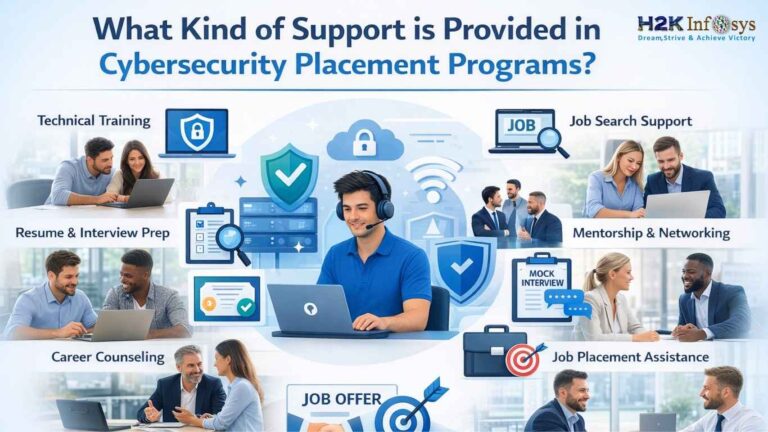
Cybersecurity placement programs in the USA offer hands-on lab access, resume/interview preparation guidance, real-world project experience, and job placement services that often bridge the gap between learning and getting hired in an information security job.
What Support Do You Actually Get in Cybersecurity Placement Programs?
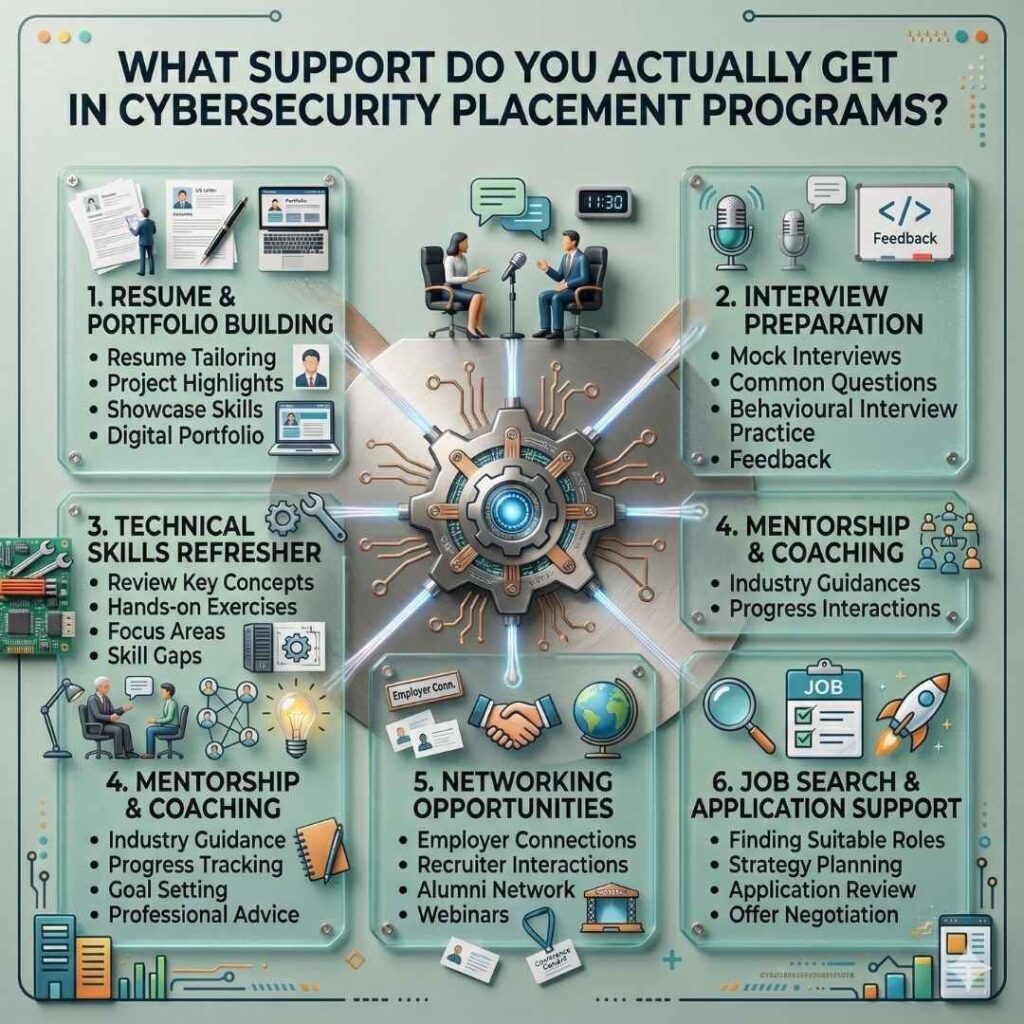
So you’ve been looking into various cyber security training with job placement services. You’ve probably noticed that all of them promise to “help you get hired.” However, there is definitely a big difference in the amount of support you get in each of these programs. And honestly, this is where most people go wrong.
So what do you really get in these cybersecurity placement programs in terms of support?
Let’s dive in.
1.Real-World Hands-On Labs (Not Just Theory)
This is usually the first major difference you notice.
Cybersecurity placement programs offer real-world hands-on labs that simulate real-world job environments such as those found in a Security Operations Center (SOC). You don’t just learn theory; you get to:
Investigate alerts
Use SIEM tools
Respond to various simulated cyber attacks
One of my students once told me that they only realized they “finally got it” after completing a mock scenario of a ransomware attack. This is how you learn.
Cybersecurity placement and job training programs that offer jobs in cyber security increasingly offer these hands-on labs because that’s what most employers expect these days: candidates who already know how these tools work.
2.Resume Building That Actually Represents Your Skills
One thing that most beginners don’t even realize is that resume building in information security is quite different from resume building in general IT.
cybersecurity Placement programs offer resume guidance that helps you:
And add quantified results (e.g., “analyzed 200+ security alerts”)
Make your resume match the requirements of the US market
Some programs even help you craft different resumes for different applications. Yeah, I know, sounds crazy, but trust me, it helps.
3.Mock Interviews (Technical and Behavioral)
This is often underrated.
Good programs will give you mock interviews that feel uncomfortably realistic. Expect to get grilled on:
Technical questions (log analysis, threat detection, basic networking)
Scenario-based questions (“what if this happened?”)
Behavioral questions (teamwork, communication)
And honestly, most people will suck at this at first. That’s normal.
I’ve witnessed dramatic improvement in people’s responses after only 2-3 mock interviews. Like, a complete 180.
4.Direct Job Placement Assistance
Now this is where cybersecurity training and job placement programs either succeed or completely fail.
Good programs will give you access to:
Dedicated recruiters or teams
Referrals to actual job openings
Help applying to dozens (or even hundreds) of job openings
Some programs will even help you stay on track, e.g., “apply to these 10 jobs today, tweak this bullet point, follow up here.”
It’s not passive learning. You will be expected to contribute to your own success, but you won’t be left to do it all yourself.
5.Networking and Industry Exposure
Much of cybersecurity placement hiring is based on networking.
Programs focused on cybersecurity placement will often give you access to:
Guest lectures from industry experts
Alumni networks
Internal job boards
Referrals to actual industry folks
I’ve personally witnessed people get interviews simply because they were referred to a job opening through one of these programs. That’s not easy to find on your own.
6.Ongoing Mentorship (This One Matters More Than You Think)
This is where the subtle difference lies between average and high-quality programs.
Mentors assist me in:
Understanding where I am stuck
Learning paths based on my background
Preparation for specific roles (SOC Analyst, Security Analyst, etc.)
Programs like H2K Infosys are often mentioned by learners for having structured mentorship within their training, which is something many new programs are now attempting to offer.
7.Support That Continues After You Get a Job
Another thing I found surprising the first time I read this section.
A few programs don’t stop once I am placed and instead assist me in:
Transitions into my first role
Understanding expectations within my workplace
Dealing with real-time issues within my role
Considering how rapidly cybersecurity placement is evolving (especially with AI-based threats emerging in 2025-2026), such support is now becoming all the more valuable.
A Quick Reality Check (Most People Need This)
While having one of the best programs in place is important, it is no guarantee of a job on its own.
I still need to:
Practice regularly
Apply what I have learned
Be patient through rejections
Placement support is where many programs can be considered multipliers for your efforts.
Final Thoughts
While many people believe that having one of the best training programs in cybersecurity is all that is necessary to secure a role within the industry, I believe that is where most people go wrong. The actual value that a cybersecurity placement program offers is not necessarily within the training but within the surrounding environment that is provided to assist learners within their journey. When choosing which program to enroll in, don’t ask:
“What is taught within this program?”
Instead, ask:
“How do you assist me after I am done with training?”
“Do I get actual interview practice?”
“What actual support is offered for me to get placed?”