
Introduction
In today’s rapidly evolving digital landscape, cybersecurity has become one of the most in-demand career paths in the United States. Many learners exploring Cyber security training programs, including platforms like H2kinfosys, often ask one key question: how important is networking knowledge for Cybersecurity? The answer is simple, networking knowledge for Cybersecurity is absolutely essential for anyone who wants to succeed in this field
Understanding the Link Between Networking and Cybersecurity
Before diving deeper, it’s important to understand what networking actually means. Networking involves connecting systems, devices, and servers to communicate and share data. Cybersecurity is all about protecting those connections.
Without strong networking knowledge for Cybersecurity, it becomes very difficult to understand how systems communicate and where vulnerabilities might exist. Every cyberattack, whether small or large, typically exploits some weakness in a network.
That’s why networking knowledge for Cybersecurity is considered the backbone of any successful security professional’s skill set.
Why Networking Knowledge Is Critical in Cybersecurity Training
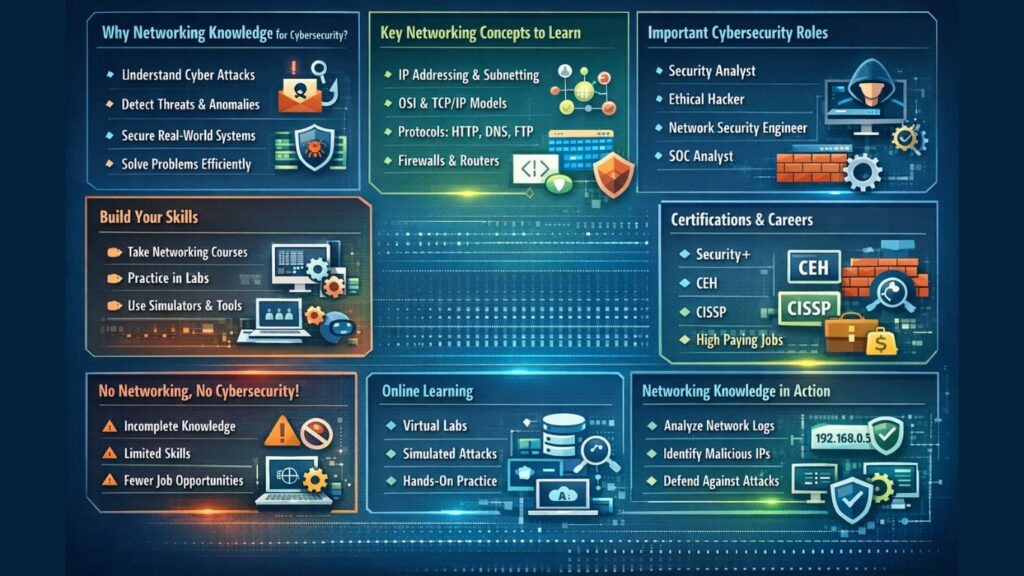
1. Helps You Understand How Cyber Attacks Work
Most cyberattacks occur over networks. Attackers use techniques like phishing, spoofing, and denial-of-service attacks to exploit systems.
If you lack networking knowledge for Cybersecurity, you won’t fully understand:
- How data flows across systems
- Where attackers intercept communication
- How vulnerabilities are exploited
Strong networking knowledge for Cybersecurity allows you to think like an attacker and defend systems more effectively.
2. Essential for Monitoring and Threat Detection
Cybersecurity professionals spend a lot of time analyzing network traffic. Tools like intrusion detection systems and packet analyzers rely heavily on networking fundamentals.
When you have networking knowledge for Cybersecurity, you can:
- Identify unusual traffic patterns
- Detect malicious activity
- Analyze logs and alerts accurately
Many Online courses for cybersecurity emphasize this because networking knowledge for Cybersecurity is necessary to use these tools effectively.
3. Required for Key Cybersecurity Roles
If you aim to become a security analyst, ethical hacker, or network security engineer, networking is unavoidable.
Each of these roles depends heavily on networking knowledge for Cybersecurity:
- Ethical hackers simulate attacks on networks
- Analysts monitor and protect network traffic
- Engineers design secure infrastructures
Without networking knowledge for Cybersecurity, performing these roles efficiently becomes extremely difficult.
4. Helps Secure Real-World Environments
In real-world scenarios, cybersecurity professionals deal with complex infrastructures, including cloud systems and enterprise networks.
To protect these systems, networking knowledge for Cybersecurity helps you understand:
- Firewalls and access control
- VPN configurations
- Network segmentation
Most cyber security training programs in the USA include hands-on labs because networking knowledge for Cybersecurity is best learned through practice.
5. Strengthens Problem-Solving Skills
Cybersecurity is not just about tools, it’s about thinking critically and solving problems.
With networking knowledge for Cybersecurity, you can:
- Trace the origin of cyberattacks
- Identify weak points in systems
- Implement effective solutions
This makes networking knowledge for Cybersecurity a key factor in becoming a skilled professional.
Key Networking Concepts You Must Learn
If you are enrolling in online courses for cybersecurity, make sure the curriculum includes:
- OSI and TCP/IP models
- IP addressing and subnetting
- Common protocols like HTTP, DNS, and FTP
- Network devices such as routers and firewalls
Mastering these topics builds strong networking knowledge for Cybersecurity and prepares you for advanced security concepts.
Role of Networking in Cybersecurity Certifications
Top certifications in the USA require networking fundamentals. Certifications like Security+, CEH, and CISSP all include network-based topics.
Without networking knowledge for Cyber security, these certifications can be challenging to achieve. That’s why most cyber security training programs ensure students build this foundation first.
Importance in Online Cybersecurity Learning
With the rise of online courses for cybersecurity, learners now rely heavily on virtual labs and simulations.
Networking knowledge for Cybersecurity helps learners:
- Understand lab environments
- Simulate attacks and defenses
- Apply theoretical concepts in real scenarios
Without networking knowledge for Cyber security, online training becomes harder to follow and less effective.
Can You Learn Cybersecurity Without Networking?
Some beginners try to skip networking and jump straight into cybersecurity tools. This approach rarely works.
Cybersecurity without networking knowledge for Cybersecurity is incomplete. You may learn tools, but you won’t understand how or why they work.
Employers in the USA expect candidates to have networking knowledge for Cyber security because it proves they understand the fundamentals.
Real-World Application of Networking Knowledge
Imagine a company facing a cyberattack. A cybersecurity professional must:
- Analyze network logs
- Identify malicious IP addresses
- Secure the system
Each of these steps requires networking knowledge for Cyber security. Without it, responding to incidents becomes nearly impossible.
How to Build Networking Skills for Cybersecurity
If you’re starting your journey, follow these steps:
Start with Basics
Learn how networks function and how devices communicate.
Take Structured Courses
Enroll in cyber security training programs that include networking modules.
Practice Hands-On
Use labs and simulators to strengthen networking knowledge for Cyber security.
Keep Learning
Stay updated with new technologies like cloud networking and Zero Trust models.
Benefits of Networking Knowledge in Cybersecurity Careers
Developing networking knowledge for Cyber security offers many advantages:
- Better job opportunities in the USA
- Higher salary potential
- Stronger technical confidence
- Faster career growth
Employers value professionals who possess networking knowledge for Cyber security because they can handle real-world challenges effectively.
Future of Networking in Cybersecurity
The future of cybersecurity is closely tied to networking. With trends like cloud computing, IoT, and AI-driven security, networking knowledge for Cyber security will become even more important.
Modern cyber security training programs are already adapting to this shift by focusing heavily on networking fundamentals.
FAQ’s
Why is networking knowledge important for cybersecurity training?
Networking knowledge helps cybersecurity students understand how devices communicate, how data moves across networks, and where security threats can occur. It is essential for detecting vulnerabilities, analyzing attacks, and protecting digital systems.
Do I need advanced networking skills before starting cybersecurity training?
No. Most cybersecurity training programs in the USA begin with basic networking concepts. However, understanding topics such as IP addresses, ports, protocols, routers, firewalls, and network architecture can make the training easier.
Which networking topics are most useful for cybersecurity students?
Important topics include TCP/IP, DNS, HTTP and HTTPS, network protocols, subnetting, firewalls, VPNs, wireless networks, routing, switching, and network traffic analysis.
Can I get a cybersecurity job without strong networking knowledge?
It is possible to enter some cybersecurity roles with limited networking knowledge, but strong networking fundamentals improve employment opportunities. Roles such as security analyst, penetration tester, network security engineer, and incident responder require significant networking expertise.
How does networking knowledge improve cybersecurity career prospects in the USA?
Networking skills help candidates perform security monitoring, vulnerability assessment, incident investigation, and threat detection. Employers in the USA often prefer cybersecurity professionals who can understand both network infrastructure and security controls.
Conclusion
To sum up, networking knowledge for Cyber security is not just important, it is essential. It forms the foundation of all cybersecurity concepts and practices. Whether you are enrolling in Online courses for cybersecurity or pursuing certifications, building strong networking knowledge for Cyber security will significantly improve your chances of success. If you truly want to build a successful career in cybersecurity, start by mastering networking knowledge for Cyber security, because everything else builds on top of it.