
Introduction
Many professionals feel stuck in roles that offer limited growth. You may work in support, sales, operations, or even as a fresher with no clear direction. You see job posts for Business Analysts, and you wonder if you can move into that field without experience. The answer is yes.
The demand for Business Analysts continues to grow across industries such as IT, healthcare, finance, and retail. Companies need professionals who can understand business needs and translate them into clear requirements. This demand creates an opportunity for anyone who wants to switch to a business analyst career, even without prior experience.
This guide explains each step in detail. It shows how you can build skills, gain practical exposure, and prepare for real job roles. It also explains how business analyst training and certifications help you start your journey with confidence.
Why Choose a Business Analyst Career?

Before you switch to a business analyst career, you need to understand why this role is valuable.
High Demand Across Industries
Organizations rely on data and structured processes. They need professionals who can:
- Identify problems
- Gather requirements
- Improve workflows
- Support decision making
Reports show steady growth in Business Analyst roles due to digital transformation and data driven strategies.
Strong Salary Potential
Business Analysts often earn competitive salaries. Even entry level roles offer good compensation compared to many other domains.
Flexible Career Path
When you switch to a business analyst career, you gain options such as:
- Senior Business Analyst
- Product Owner
- Data Analyst
- Project Manager
Who Can Switch to a Business Analyst Career?
You do not need a technical background to switch to a business analyst career.
Suitable Backgrounds
You can transition from:
- Customer support roles
- Sales and marketing
- Finance and accounting
- Fresh graduates from any stream
- IT professionals in testing or development
Key Insight
Employers value skills more than job titles. If you can analyze problems and communicate clearly, you already have a strong base to switch to a business analyst career.
Core Skills You Need to Learn
To switch to a business analyst career, you must build a mix of technical and business skills.
1. Requirement Gathering
You must learn how to collect business needs from stakeholders.
Key techniques include:
- Interviews
- Surveys
- Workshops
- Observation
2. Documentation Skills
You must write clear documents such as:
- Business Requirement Document (BRD)
- Functional Requirement Document (FRD)
- User Stories
Example User Story
As a user, I want to reset my password so that I can access my account again.
3. Data Analysis Basics
You need basic knowledge of:
- Excel
- Data visualization
- SQL basics
4. Communication Skills
You must explain ideas clearly to both technical and non technical teams.
5. Problem Solving
You must identify issues and propose solutions.
Step by Step Guide to Switch to a Business Analyst Career
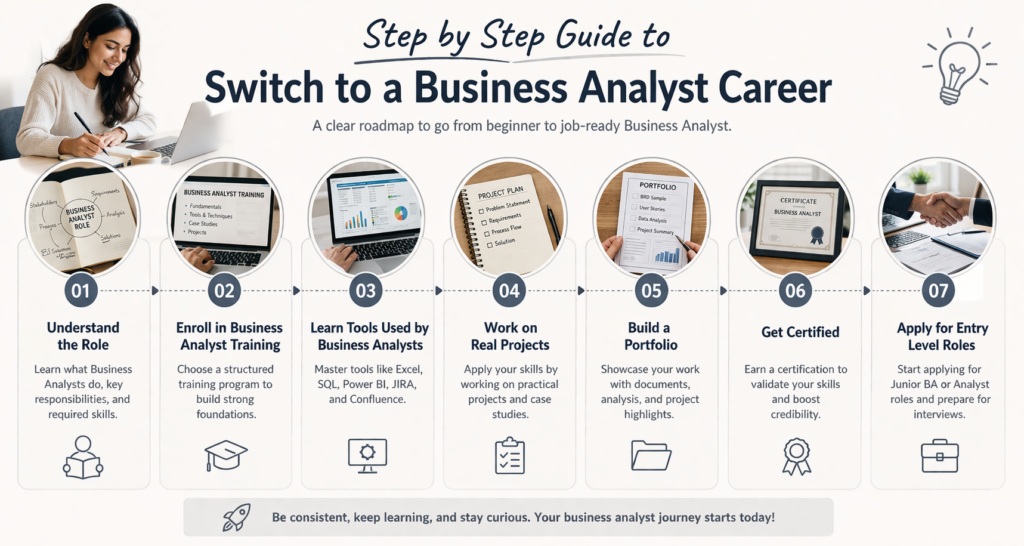
Step 1: Understand the Role
Start by learning what Business Analysts do daily.
Tasks include:
- Meeting stakeholders
- Writing requirements
- Working with developers
- Testing solutions
This step builds clarity before you switch to a business analyst career.
Step 2: Enroll in Business Analyst Training
Structured business analyst training helps you learn:
- Business analysis fundamentals
- Tools and techniques
- Real world case studies
Look for training that includes:
- Hands on exercises
- Project work
- Mock scenarios
Business analyst training and placement programs often provide practical exposure, which is useful for beginners.
Step 3: Learn Tools Used by Business Analysts
You must learn commonly used tools such as:
- Microsoft Excel
- SQL
- Power BI or Tableau
- JIRA
- Confluence
Simple SQL Example
SELECT customer_name, order_amount
FROM orders
WHERE order_amount > 500;
This query helps you extract high value orders from a dataset.
Step 4: Work on Real Projects
Practical experience is important when you switch to a business analyst career.
You can:
- Create mock projects
- Analyze case studies
- Build sample documents
Example Project Idea
Project: Online Shopping App
Tasks:
- Define user requirements
- Create user stories
- Design process flow
Step 5: Build a Portfolio
A portfolio proves your skills to employers.
Include:
- BRD samples
- User stories
- Data analysis reports
- Project summaries
Step 6: Get Certified
Certifications validate your knowledge.
You should research business analyst certification cost before choosing one.
Common benefits:
- Improves credibility
- Helps in job applications
- Shows commitment to learning
Step 7: Apply for Entry Level Roles
After training and practice, apply for roles such as:
- Junior Business Analyst
- Business Analyst Intern
- Associate Analyst
This step completes your journey to switch to a business analyst career.
Business Analyst Training: What to Expect
Business analyst training plays a key role in your transition.
Topics Covered
- SDLC basics
- Agile methodology
- Requirement gathering
- Documentation techniques
- Data analysis
Training Outcome
After training, you should:
- Understand real workflows
- Write requirement documents
- Use analysis tools
Business analyst training and placement programs often include mock interviews and resume support.
Business Analyst Certification Cost: What You Should Know
Understanding business analyst certification cost helps you plan your investment.
Cost Factors
- Certification level
- Training provider
- Exam fees
General Range
Costs can vary from basic certifications to advanced ones. You should compare options based on:
- Course content
- Industry recognition
- Practical value
When you switch to a business analyst career, certification acts as proof of your skills.
Real World Example of Career Transition
Case Study
A customer support executive wanted to switch to a business analyst career.
Steps taken:
- Learned Excel and SQL
- Completed business analyst training
- Created sample projects
- Earned certification
- Applied for entry level roles
Result:
The candidate secured a Junior Business Analyst role within six months.
Common Challenges and How to Overcome Them
Challenge 1: No Experience
Solution:
- Build projects
- Practice real scenarios
Challenge 2: Lack of Technical Skills
Solution:
- Start with basics
- Practice daily
Challenge 3: Interview Fear
Solution:
- Prepare common questions
- Practice mock interviews
Interview Preparation Tips
To successfully switch to a business analyst career, you must prepare for interviews.
Common Questions
- What is a Business Analyst?
- What is SDLC?
- Explain Agile methodology
- How do you gather requirements?
Tip
Use simple and clear answers. Focus on examples.
Tools and Techniques Diagram
Basic Business Analysis Flow
Stakeholder Input → Requirement Gathering → Documentation → Development → Testing → Delivery
This flow shows how Business Analysts connect business needs with technical teams.
Daily Responsibilities of a Business Analyst
When you switch to a business analyst career, your daily tasks may include:
- Meeting stakeholders
- Writing user stories
- Reviewing requirements
- Supporting testing teams
- Analyzing data
Benefits of Business Analyst Training and Placement Programs
These programs help beginners by offering:
- Structured learning
- Practical projects
- Resume building
- Interview preparation
Business analyst training and placement support reduces the gap between learning and employment.
Mistakes to Avoid
When you switch to a business analyst career, avoid these mistakes:
- Skipping fundamentals
- Ignoring practical practice
- Applying without preparation
- Not building a portfolio
Future Scope of Business Analysts
The future remains strong due to:
- Data driven decisions
- Digital transformation
- Business process automation
When you switch to a business analyst career, you enter a field with long term growth.
Key Takeaways
- You can switch to a business analyst career without prior experience
- Business analyst training builds essential skills
- Practical projects improve your chances of getting hired
- Certification adds credibility but requires cost planning
- Consistent practice leads to success
Conclusion
You can switch to a business analyst career with the right skills, training, and consistent effort. Start learning today and build your path step by step.