
From what I’ve seen and honestly, after talking to quite a few people who’ve gone through the whole “learn cybersecurity, get a job” journey, the strongest cybersecurity training with job placement options in the U.S. usually fall into three broad buckets. Somewhere in the middle of exploring these options, names like H2K Infosys tend to come up quite a bit, especially when people are comparing hands-on programs with placement support. Not all of them are equal, though. Not even close.
1. Job-focused online training institutes (the practical route)
If you’re switching careers or starting from scratch, this route tends to make the most sense.
Programs similar to H2K Infosys are a pretty good example of how this approach works in real life. They don’t just throw theory at you and hope it sticks. Instead, they structure everything around actual job roles SOC Analyst, Security Analyst, that kind of thing. And somewhere along the way, you start noticing a shift. Cybersecurity training with job placement stops feeling like “studying” and starts feeling like… well, doing the job.
You’re not just reading about attacks, you’re analyzing logs, working inside SIEM tools, trying to figure out what went wrong in a simulated breach. That hands-on part? That’s where things usually click.
A few things that really stand out in these programs:
- Live sessions with instructors (not just pre-recorded videos you forget halfway through)
- Hands-on labs using tools like Splunk and Wireshark
- Resume prep, mock interviews, the whole drill
- Actual placement support which, honestly, is where many programs fall short
I’ve seen people struggle for weeks with concepts, then suddenly it all makes sense once they start working on real scenarios. It’s kind of a turning point.
2. University-affiliated bootcamps (structured, but… expensive)
You’ve probably seen these bootcamps tied to big names like University of California or Columbia University. They look solid on paper, and to be fair, some of them are.
But here’s something people don’t always say out loud.
They’re great at delivering structured content. The curriculum is usually well-organized, and the brand name adds a bit of weight. But when it comes to actual job placement? It’s often more… general support than hands-on guidance.
What that usually means:
- You get career resources, but not deeply personalized help
- You’re still doing most of the job search heavy lifting
- It can feel overwhelming if you don’t already have an IT background
If you’ve got some experience, these can work. If you’re brand new, though, it might feel like being dropped into the deep end a bit too quickly.
3. Certification-driven training (helpful, but not enough on its own)
Certifications are valuable. No question about that.
Things like:
- CompTIA Security+
- Certified Ethical Hacker (CEH)
- CISSP
They absolutely help build credibility. But here’s the part that catches people off guard: they don’t automatically translate into a job.
I’ve come across people who collected multiple certifications and still struggled in interviews. Why? Because they couldn’t demonstrate real-world skills. That’s why the better cybersecurity training with job placement programs don’t treat certifications as the end goal; they blend them with labs, projects, and actual job prep.
What actually makes a program “the best”?
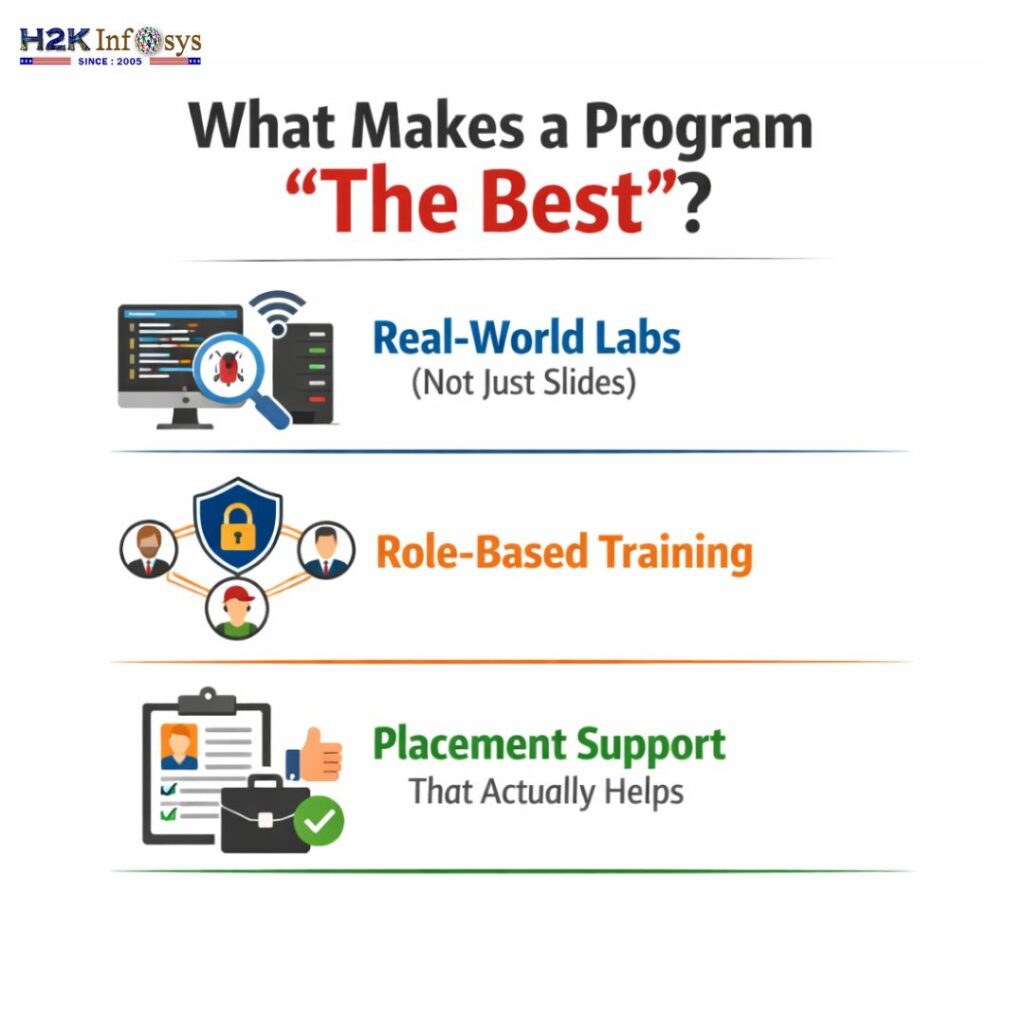
This is where things usually get vague online. So let’s keep it real.
A good programlike, actually good, should check a few non-negotiable boxes.
✔ Real-world labs (not just slides)
If you’re not actively practicing things like:
- Log analysis
- Threat detection
- Incident response
…then it’s going to be hard to convince an employer you’re ready. Theory only gets you so far.
✔ Role-based training
This one’s big.
Training should line up with real job roles:
- SOC Analyst
- Incident Responder
- Security Analyst
Otherwise, you end up knowing a little bit of everything but not enough to confidently say, “Yeah, I can do this job.”
✔ Placement support that actually helps
And not just in a “here’s a checklist, good luck” kind of way.
Real support looks more like:
- Resume formatting tailored to the U.S. market
- LinkedIn profile optimization
- Mock interviews with real-world scenarios
- Some level of recruiter or employer connection
A lot of programs say they offer placement help. In reality, it’s sometimes just a webinar and a few documents.
A quick reality check (because someone has to say it)
Even the best cybersecurity training with job placement won’t hand you a job.
Yeah… I know that’s not what ads promise.
But here’s how it usually plays out:
- The training gives you structure and skills
- The placement support gives you direction
- You still have to put in the effort practice, apply, interview, repeat
The people who make it through are usually the ones who treat the process like a full-time commitment, not a side task.
What’s trending in the U.S. cybersecurity training with job placement market right now?
This part’s actually important, because training should match demand, not just look good on paper.
Right now, there’s solid demand for:
- SOC Analysts (a common entry point)
- Cloud security roles (especially AWS and Azure)
- Threat detection and response specialists
With the increase in ransomware attacks and even AI-driven threats, companies are leaning more toward candidates who can do the work, not just talk about it. That’s a big reason why hands-on cybersecurity training and job placement programs are getting more attention lately.
Final thoughts (just keeping it honest)
If I had to simplify everything into one piece of advice:
Go for a hands-on, job-role-focused program that includes real placement support something along the lines of H2K Infosys and commit to it fully. That combination tends to work better than chasing multiple certificates without practical experience.
And one small thing: try not to get pulled in by big promises like “guaranteed jobs.” Instead, focus on:
- Skills you can actually demonstrate
- Projects you can confidently talk about
- Showing up prepared in interviews
That’s usually what makes the difference in the end.