Introduction
In today’s digital world, cybersecurity is becoming one of the most reliable and future-proof career paths. As more businesses move online, the need for people who can protect systems and data keeps growing. H2K Infosys offers practical, industry-focused training to meet this need. Choosing the right Cybersecurity Career Path for students can help new graduates find long-term success, stability, and career growth. It’s important to know how to get started and move forward in this field.
A lot of beginners are signing up for structured online cyber security classes these days to learn both the basics and skills they can use in the real world. Students can get a strong foundation, hands-on experience, and be ready for entry-level jobs with the right Cyber security training courses. A career in cybersecurity isn’t just about getting a job; it’s also about entering a field that is always changing and rewards people who keep learning. You can have a successful and rewarding career in cybersecurity if you take the right steps and work hard at it.
Why Cybersecurity is a Great Career Choice
There are a number of reasons why more and more students are choosing Cybersecurity Career Path for Students as their favorite job.
First, there is a growing need for cybersecurity experts all over the world. Every business that uses computers needs to be safe from cyber threats. This makes the Cybersecurity Career Path for Students very stable and safe for the future.
Second, even entry-level jobs in cybersecurity pay well. As you move up in your Cybersecurity Career Path for Students, you can make a lot more money with more experience and certifications.
Third, there are a lot of different jobs you can do. The Cybersecurity Career Path for Students gives you a lot of choices to look into, whether you’re interested in technical work, analysis, or management.
Step 1: Build a Strong Foundation
The first thing students need to do to start a career in cybersecurity is learn the basics of IT.
You should learn the basics of networking, like TCP/IP, DNS, and HTTP. It’s also important to know how to use operating systems like Windows and Linux. Having some basic programming skills, especially in Python, can help you.
If you don’t know these basics, it will be hard to move up in the Cybersecurity Career Path for Students. A lot of people who are just starting out use online classes in cyber security to learn these ideas in a structured way.
Step 2: Explore Different Career Roles
One of the most exciting aspects of the Cybersecurity Career Path for Students is the variety of career options available.
Security Analyst
This is one of the most common entry-level roles. A security analyst monitors systems, detects threats, and responds to incidents. It is an ideal starting point in the Cybersecurity Career Path for Students.
Ethical Hacker
Ethical hackers test systems by identifying vulnerabilities. This role is perfect for students who enjoy problem-solving and technical challenges within the Cybersecurity Career Path for Students.
SOC Analyst
A SOC analyst works in a Security Operations Center, monitoring real-time alerts and managing incidents. It is a structured and beginner-friendly role in the Cybersecurity Career Path for Students.
Cloud Security Specialist
With the rise of cloud computing, this role is becoming increasingly important. It focuses on securing cloud platforms like AWS and Azure.
GRC Analyst
Governance, Risk, and Compliance roles are less technical and focus on policies and regulations. This is another valuable option within the Cybersecurity Career Path for Students.
Step 3: Gain Hands-On Experience
Students need hands-on experience to build a successful Cybersecurity Career Path. Employers like candidates who have done things in the real world instead of just reading about them.
Students ought to engage in virtual laboratories, cybersecurity simulations, and Capture The Flag competitions. These activities help you learn how to solve problems and understand how things work in real life.
Taking cyber security training courses can give you access to guided labs and projects. This makes it easier to learn by doing.
Step 4: Earn Certifications
Certifications are very important for proving your skills and making your Cybersecurity Career Path for Students stronger.
The CompTIA Security+, Certified Ethical Hacker, and Google Cybersecurity Certificate are all certifications that are easy for beginners to get. These certifications show that you know what you’re talking about and make it more likely that you’ll get hired.
As you move forward, you can get more advanced certifications like CISSP or OSCP to make your Cybersecurity Career Path for Students even better.
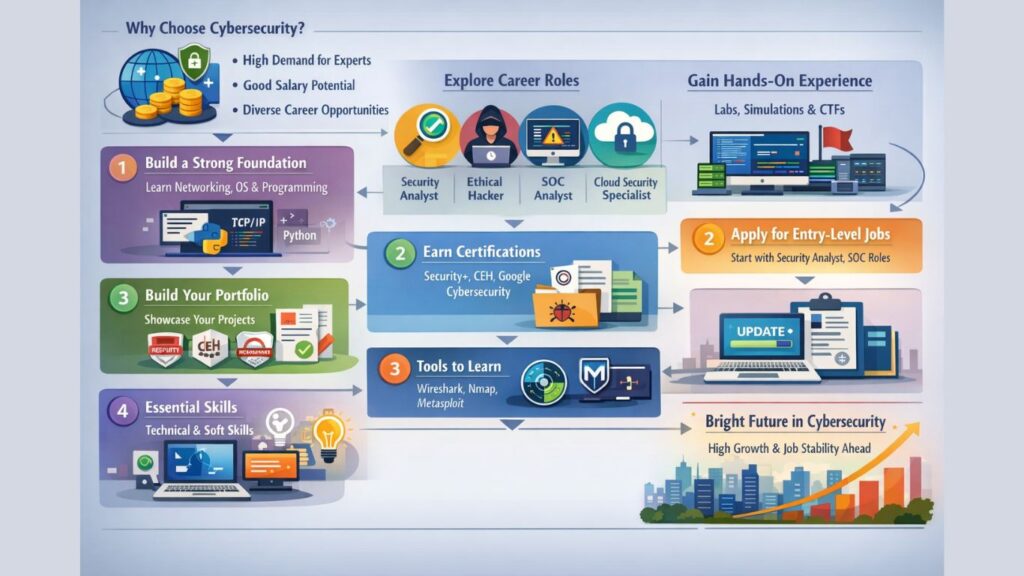
Step 5: Build a Strong Portfolio
A portfolio is a valuable tool for students who want to work in cybersecurity. It shows potential employers what you can do and how you do it.
You can include things like vulnerability assessments, penetration testing reports, and security audits. Having a GitHub profile with your work on it can also be helpful.
A strong portfolio can help you stand out from other people who want to work in cybersecurity.
Step 6: Apply for Entry-Level Jobs
You can start looking for jobs once you have the basics down, some certifications, and some real-world experience.
A security analyst, SOC analyst, or IT support with a security focus are all common entry-level jobs. These jobs are great places for students to start their careers in cybersecurity.
You should customize your resume to show off your skills, certifications, and projects. This makes it more likely that you’ll get your first job.
Step 7: Continuous Learning
Cybersecurity is always changing, so you need to keep learning to be successful in the long run.
You should keep up with the latest trends, tools, and threats if you want to move up in your Cybersecurity Career Path for Students. It can help to read cybersecurity blogs, go to webinars, and join professional groups.
By always learning new things, you can keep your Cybersecurity Career Path for Students up to date and competitive.
Essential Skills for Cybersecurity
You need both technical and soft skills to do well in the Cybersecurity Career Path for Students.
Networking, operating systems, cybersecurity tools, and scripting are all examples of technical skills. These skills are the most important ones for your career.
Soft skills like talking to people, thinking critically, and solving problems are just as important. They help you work well with others and deal with tough situations.
Tools You Should Learn
Learning how to use the right tools is a big part of the Cybersecurity Career Path for Students.
Wireshark is a tool for analyzing networks, Nmap is a tool for scanning, Metasploit is a tool for penetration testing, and Splunk is a tool for monitoring security.
Knowing how to use these tools makes you more skilled and ready for work.
Common Mistakes to Avoid
While pursuing a Cybersecurity Career Path for Students, beginners often make certain mistakes.
One common mistake is trying to learn everything at once. It is better to focus on one area and gradually expand your knowledge.
Another mistake is ignoring practical experience. Hands-on learning is critical for success.
Skipping networking basics and not building a portfolio are also common issues that can slow down your Cybersecurity Career Path for Students.
Recommended Learning Roadmap
A structured roadmap can help you stay on course.
For the first two months, focus on basic networking and operating systems. Learn the basics of cybersecurity in the next step. Then pick a field of study and work on projects and getting certifications.
Your Cybersecurity Career Path for Students will be more organized and effective if you follow a roadmap.
Future Scope of Cybersecurity
The Cybersecurity Career Path for Students has a very bright future.
Cyber threats are getting more advanced as artificial intelligence, cloud computing, and remote work become more common. This makes the need for skilled workers even greater.
Companies are putting a lot of money into cybersecurity, making it one of the safest and most rewarding jobs.
Importance of Structured Training
Following a structured learning path can help you get into cybersecurity much faster, especially if you’re a student. Online cybersecurity classes give you access to expert help, hands-on practice, and real-world projects that make ideas easier to understand, so you don’t have to figure everything out on your own.
This method helps you stay on track and focused better than studying on your own. Many cybersecurity training courses also help you get certifications that are recognized in the field and even help you find a job, which can be a big help when you’re just starting out.
Most of the time, training institutes base their programs on what employers need right now. This means that you’re not just learning theory; you’re also gaining skills that employers want. Over time, this helps you feel more sure of yourself and makes it easier to get a job.
Frequently Asked Questions
Who can enroll in these AI courses?
These courses are suitable for students, professionals, entrepreneurs, and beginners who want to develop practical AI skills.
Do I need programming experience?
Not necessarily. Many beginner-level courses require no coding experience, while advanced courses may require knowledge of Python or machine learning.
Are the AI courses completely online?
Yes. You can access the course materials and learn from home using a computer or mobile device with an internet connection.
What topics are covered in these courses?
Topics may include generative AI, machine learning, prompt engineering, data science, AI automation, and responsible AI.
Will I receive a certificate?
Most courses provide a certificate after you complete the required lessons, assessments, or projects. Certificate availability depends on the course provider.
Conclusion
It might seem hard to start a career in cybersecurity as a student, but it’s totally possible if you have the right attitude and plan. The most important thing is to build a strong base, practice often, and keep getting better at what you do. You don’t have to know everything right away. Start small and work your way up. There are many job opportunities in cybersecurity, and the pay is good and the job is stable for a long time. Depending on what you like, you could become a security analyst, an ethical hacker, or even a cloud security expert.
Choosing the right training programs and taking Online classes cybersecurity can make things go much more smoothly. Employers value practical knowledge and real-world experience the most, and these things help you get them. Stick with it, keep learning, and don’t be afraid to take the first step. You can have a successful and rewarding future in cybersecurity if you work hard and do things the right way.