Yeah it can be genuinely helpful, especially if you’re trying to break into Data analytics jobs or switching careers. The reason is pretty simple: it leans more toward practical, job-ready skills rather than just theory you forget a week later.
Why This Question Keeps Coming Up
If you’ve spent even a little time looking into Data analytics training, you’ve probably noticed how crowded things are. There’s a course for everything. Some promise “guaranteed Data analytics jobs,” others hand out certificates, and then you’ve got popular ones like the Google Data Analytics Course popping up everywhere.
Naturally, you start wondering which one actually gets me hired?
I’ve seen people stack up certifications like badges and still struggle in interviews. Not because they’re lazy or incapable. It’s usually because they learned concepts… but not how those concepts show up in real work.
That gap? That’s where structured programs like H2K Infosys tend to step in.
The Reality of Data Analytics Jobs in 2026
Here’s something worth saying upfront data analytics jobs today aren’t just about tools.
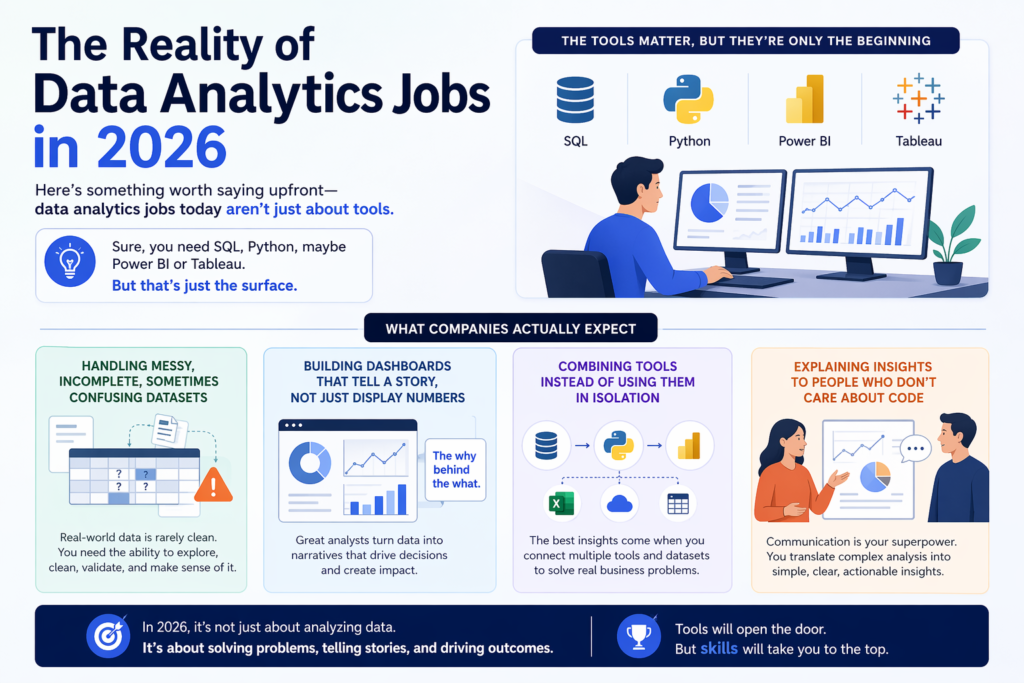
Sure, you need SQL, Python, maybe Power BI or Tableau. But that’s just the surface.
What companies actually expect:
- Handling messy, incomplete, sometimes confusing datasets
- Building dashboards that tell a story, not just display numbers
- Combining tools instead of using them in isolation
- Explaining insights to people who don’t care about code
No one’s really asking, “Did you finish a course?” anymore.
It’s more like: “Walk me through how you’d solve this problem using data.”
And honestly, that’s where a lot of learners get stuck. The type of data analytics training you choose starts to matter a lot more at that point.
Where a Lot of Courses Miss the Mark
Take the Google Data Analytics Course. It’s solid, no question. Great for beginners, especially if you’re just figuring things out.
But… there are a few things people don’t always talk about:
- It’s mostly self-paced, so if you’re stuck, you’re on your own
- The projects feel a bit too guided (almost like following instructions step by step)
- There’s not much emphasis on interviews or job placement
So yeah, you learn. But when it comes time to apply for data analytics jobs, it can feel like you’re missing something and that feeling is real.
What Makes H2K Infosys Training Different?
Now, this is where things shift a bit.
The H2K Infosys training provider doesn’t just focus on “learning tools.” It’s more about learning how those tools are actually used at work. That’s a subtle difference, but it changes everything.
1. Real-Time Projects (Not Just Practice)
Instead of textbook-style exercises, their data analytics training includes:
- Simulated live projects
- Business-style datasets (not clean, perfect ones)
- Problem-solving scenarios that feel… well, real
And if you’ve ever sat in an interview trying to explain a project, you’ll know how much this matters.
2. Connecting the Dots Between Tools

One thing I’ve noticed people often learn SQL, Python, and visualization tools separately. But in real Data analytics jobs, they’re all connected.
H2K Infosys tries to bring that together:
- SQL → pulling the data
- Python → cleaning and transforming it
- Power BI / Tableau → presenting it
- Excel → quick checks and reporting
That flow is exactly what recruiters expect in data analytics jobs now.
3. Job Readiness (This Part Is Big)
A lot of courses stop at teaching.
This one goes further:
- Resume guidance based on real job descriptions
- Mock interviews that reflect current hiring patterns
- Help with explaining your own projects clearly
And if you’ve ever blanked out in an interview despite knowing the answer… yeah, you get why this matters.
A Small Real-Life Observation
I remember someone I know smart, dedicated finished the Google Data Analytics Course. They understood concepts really well.
But during an interview, they were asked something simple:
“How would you clean inconsistent sales data?”
They hesitated. Not because they didn’t know but because they hadn’t done it in a real context.
Later, after going through structured data analytics training with hands-on projects (similar to H2K Infosys), something clicked.
They stopped thinking:
- “What tool should I use?”
And started thinking:
- “What’s the problem here, and how do I solve it?”
That shift made a noticeable difference when applying for data analytics jobs.
So, How Does H2K Infosys Certification Actually Help?
Let’s keep this practical.
✔ Confidence With Real Problems
You’re not memorizing steps you’re figuring things out, which is closer to actual work.
✔ Stronger Resume
Instead of just listing a course, you can talk about:
- Projects you worked on
- Tools you used
- What impact your work had
That’s what stands out in data analytics jobs.
✔ Better Interview Preparation
You get used to:
- Explaining your thought process
- Walking someone through your dashboard
- Handling scenario-based questions
Is It Better Than the Google Data Analytics Course?
Not exactly “better” just built for a different purpose.
- Google Data Analytics Course → good for getting started
- H2K Infosys training provider → more focused on getting job-ready
Some people actually do both, which makes sense:
Start with Google → build basics
Then move into hands-on data analytics training → prepare for Data analytics jobs
That combination works pretty well, from what I’ve seen.
What Recruiters Really Care About
Here’s the honest part most hiring managers don’t obsess over which certificate you have.
They’re looking for things like:
- Can you write efficient SQL queries?
- Can you clean messy data in Python?
- Can you build dashboards that actually make sense?
That’s it.
H2K Infosys certification helps because it’s aligned with these expectations. That’s why people with hands-on data analytics training often perform better in interviews.
Mentorship (Underrated, Honestly)
Learning alone sounds great… until you get stuck.
You try things, search online, maybe fix it or maybe waste hours going in circles.
With structured programs like H2K Infosys:
- You get help when you’re stuck
- Someone reviews your work
- You know what to improve next
It’s not flashy, but it’s incredibly useful. Sometimes that’s what keeps people going.
What’s Changing in Data Analytics Jobs
Things are evolving pretty quickly.
If your data analytics training doesn’t touch on these, it might feel outdated:
- AI-assisted analytics tools
- Data storytelling (this is becoming huge)
- Cloud-based platforms
- Automated reporting
H2K Infosys has been adapting to these trends, which is good because the gap between “learning” and “industry” is getting wider.
Is It Worth It for Beginners?
Yeah especially if you:
- Have zero background in analytics
- Prefer structured learning over figuring everything out alone
- Want some direction toward job placement
The hands-on approach makes it easier to move into data analytics jobs without feeling completely lost.
What About Career Switchers?
If anything, it’s even more helpful here.
People moving from:
- Non-tech roles
- Manual reporting jobs
- Operations or support
Usually need practical exposure more than theory.
That’s where structured data analytics training like what H2K Infosys offers really helps bridge the gap.
A Quick Reality Check
No course guarantees a job. Not H2K Infosys. Not Google. None.
You still have to:
- Practice consistently
- Build projects
- Apply (a lot, honestly)
But the right data analytics training can make things smoother and a bit faster.
Final Thoughts
So, is H2K Infosys certification useful for data analytics jobs?
Yes but not just because it’s a certificate.
It helps because:
- You actually work on real-world problems
- You get prepared for interviews
- You learn what companies expect
If your goal is to get hired, not just “complete a course,” then choosing a practical Data analytics course—like what H2K Infosys training provider offers can make a real difference.
And if I had to put it simply:
If you can confidently explain your work in an interview, you’re on the right track.