If you’re getting ready for a Data Analyst interview, expect a mix of technical questions, business scenarios, SQL exercises, Excel tasks, and discussions about how you actually work with data in real situations. Companies today aren’t just looking for someone who knows tools they want a Data Analyst who can explain insights clearly, think logically, and help teams make smarter decisions using data.
And honestly, interview patterns have changed a lot over the last few years.
Earlier, recruiters focused heavily on formulas, definitions, and theory-based questions. Now, especially in 2026, companies care much more about practical thinking. They want analysts who can solve real business problems, communicate with non-technical teams, and work comfortably with messy, imperfect data. You can really see this shift happening across healthcare, retail, fintech, and even AI-driven startups.
Why Companies Ask So Many Different Types of Questions
Most hiring managers are basically trying to figure out three things:
- Can this person work with data accurately?
- Can they explain findings in a simple, understandable way?
- Can they solve business problems without hiding behind technical jargon?
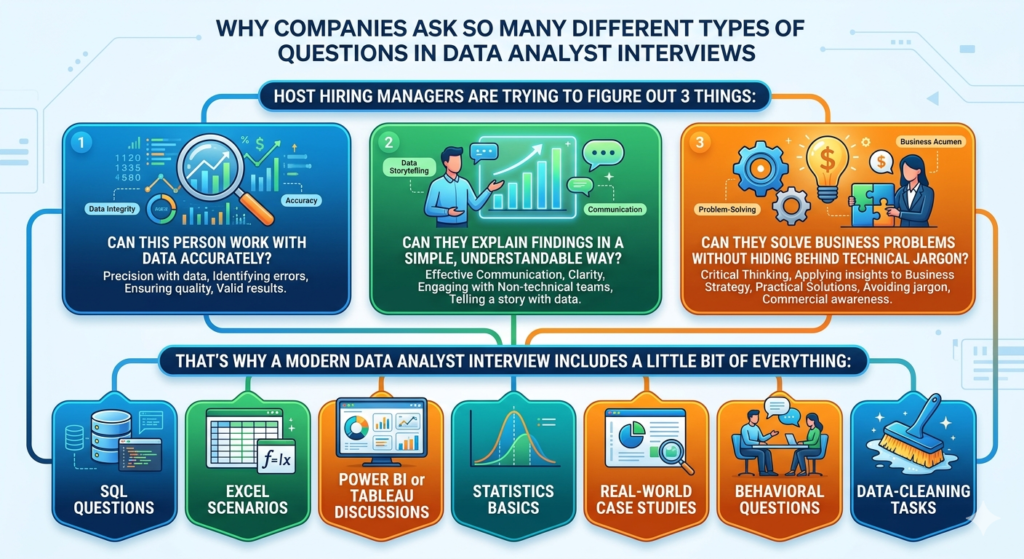
That’s why a modern Data Analyst interview usually includes a little bit of everything:
- SQL questions
- Excel scenarios
- Power BI or Tableau discussions
- Statistics basics
- Real-world case studies
- Behavioral questions
- Data-cleaning tasks
One thing many beginners underestimate is communication. Someone can be technically strong and still struggle in interviews because they can’t explain their thought process clearly. Interviewers notice that very quickly.
SQL Questions Still Dominate Most Interviews
SQL remains one of the biggest filters in almost every Data Analyst interview.
You’ll probably hear questions like:
- What’s the difference between
WHEREandHAVING? - Explain different types of JOINs.
- How would you identify duplicate records?
- What are window functions?
- Write a query to calculate monthly sales growth.
But these days, recruiters often care less about textbook answers and more about whether you can solve practical problems.
Sometimes they’ll give you a small dataset during the interview and ask you to work through a scenario live. Something like:
“We have customer data with duplicate transactions. How would you clean it and identify repeat purchases?”
That type of question has become incredibly common.
A lot of learners in Data analytics training programs like H2K Infosys mention that hands-on SQL practice helps far more than simply memorizing syntax. And honestly, that reflects the way interviews work now. Real projects teach problem-solving better than theory alone.
Excel Matters More Than People Think
There’s this assumption among beginners that Excel is outdated because everyone talks about AI, automation, and advanced analytics tools now.
But the reality? Excel is still everywhere.
In many companies, a Data Analyst spends a surprising amount of time inside spreadsheets before the data even reaches dashboards or reporting systems.
Interviewers commonly ask things like:
- How do you use VLOOKUP or XLOOKUP?
- What are Pivot Tables?
- Explain conditional formatting.
- How would you clean messy Excel data?
- What’s the difference between COUNT and COUNTA?
I remember hearing a recruiter say during a webinar that candidates who confidently explain Excel-based reporting often perform better than candidates who only know advanced theory. That stuck with me because it’s surprisingly true.
Business Case Study Questions Are Becoming More Important
This is usually where interviews start feeling more realistic.
A company might ask:
- Why did sales suddenly drop last quarter?
- How would you improve customer retention?
- Which KPIs would you track for an eCommerce business?
- How would you identify fraudulent transactions?
There’s rarely one “perfect” answer here.
Interviewers mainly want to see:
- Logical thinking
- Structured analysis
- Ability to ask smart follow-up questions
- Awareness of business impact
A lot of beginners panic during case-study rounds because they think they need an instant expert-level answer. But honestly, interviewers usually care more about your thinking process than your final conclusion.
That’s probably why project-based learning has become such a big part of modern Data analytics training.
Statistics Questions Usually Stay Practical
For most Data Analyst roles, companies aren’t expecting deep mathematical expertise unless the position is highly specialized.
Still, you should comfortably understand:
- Mean, median, and mode
- Standard deviation
- Correlation vs causation
- Probability basics
- Sampling methods
- Hypothesis testing fundamentals
What’s interesting is that recruiters often disguise statistics questions as business discussions.
For example:
“If website traffic increases but conversions stay flat, what might that indicate?”
Technically, that’s a statistics-thinking question hidden inside a business scenario.
Power BI and Dashboard Questions
Visualization skills matter more now because businesses want dashboards that non-technical teams can understand quickly.
You might get questions like:
- How do you build dashboards?
- What makes a dashboard effective?
- Explain basic DAX concepts.
- How do you handle missing data in reports?
- Which chart would you use for trend analysis?
One thing that’s changed recently: companies care less about flashy dashboards and more about storytelling.
A simple dashboard that clearly explains business performance is usually more valuable than something overloaded with complex visuals.
That practical exposure helps a lot during interviews. Many learners in H2K Infosys Training Programs often mention that working on realistic reporting scenarios gave them much more confidence than watching theory-heavy recorded sessions.
Behavioral Questions Catch Many Candidates Off Guard
This part surprises a lot of people.
Recruiters may ask:
- Tell me about a difficult problem you solved.
- Describe a time when data was incomplete.
- How do you handle deadlines?
- Have you ever made a mistake in analysis?
Because at the end of the day, companies hire people not just technical skills.
A strong Data Analyst also needs patience, communication skills, and the ability to stay calm when things get messy.
And honestly, candidates who openly discuss mistakes often come across as more genuine than candidates trying too hard to sound perfect.
Google Data Analytics Course vs Practical Industry Training
A lot of beginners start with the Google Data Analytics Professional Certificate because it introduces analytics concepts in a beginner-friendly way.
It’s useful for:
- Learning foundational concepts
- Understanding basic SQL
- Exploring visualization tools
- Building early confidence
But many learners eventually realize that theory alone doesn’t fully prepare them for Data analyst interviews.
That’s where structured Data analytics training becomes valuable. Programs like those from H2K Infosys focus more heavily on:
- Real-world projects
- Mock interviews
- Resume preparation
- SQL problem-solving
- Power BI reporting
- Business case studies
And there’s a big difference between “knowing concepts” and explaining them confidently during a live interview while someone’s evaluating you in real time. Those are two completely different experiences.
How Data Analyst Interviews Are Changing in 2026
The role itself is evolving pretty fast because AI tools are automating repetitive reporting work.
Companies now expect analysts to:
- Interpret AI-generated insights
- Validate data accuracy
- Ask smarter business questions
- Communicate findings clearly
- Understand automation workflows
So Data analyst interviews are moving away from memorization and shifting more toward practical thinking.
Some companies even give mini assignments where candidates analyze datasets using AI-assisted tools and explain their conclusions to stakeholders. That trend has become especially common in fintech and healthcare analytics roles this year.
How to Prepare Effectively

The best preparation strategy usually looks something like this:
- Practice SQL consistently
- Work on real datasets
- Build dashboard projects
- Review statistics basics
- Prepare behavioral responses
- Practice explaining your thought process aloud
One small thing that genuinely helps: talk through your reasoning while solving problems. Interviewers often evaluate communication just as much as technical accuracy.
And don’t ignore mock data analyst interviews. A lot of learners improve dramatically once they start practicing under realistic interview conditions instead of studying passively.
Why Many Aspiring Analysts Choose H2K Infosys
Plenty of training providers teach concepts. Fewer actually prepare learners for real Data analyst interviews.
H2K Infosys Data Analytics Training focuses more on practical exposure through:
- Real-world analytics projects
- SQL and Excel exercises
- Power BI reporting practice
- Resume-building support
- Mock interview sessions
- Industry-focused case studies
That hands-on structure helps many aspiring Data Analyst professionals feel more comfortable during actual hiring rounds.
And honestly, confidence matters more than people realize. Interviewers can usually tell when someone has genuinely worked with datasets versus someone who has only watched tutorials online.
Final Thoughts
Preparing for a Data Analyst interview today is much less about memorizing definitions and much more about showing practical thinking, communication skills, and business understanding.
The strongest candidates are usually the ones who:
- Practice with real data
- Understand business problems
- Explain insights clearly
- Stay updated with industry trends
- Build hands-on project experience
Starting with a course like the Google Data Analytics program can give you a solid foundation. But combining that with practical Data analytics training, mock interviews, and real project work often makes a much bigger difference once you step into actual Data analyst interviews.
And in 2026, that practical edge is becoming more important than ever.