
Introduction
In the modern digital age, careers in Cybersecurity have massively increased. Cybersecurity is an area of specialized knowledge that nearly all organizations will require significant staff. At h2kinfosys, we assist learners in building the skills needed to succeed in this evolving economy. Through practical, project-based learning, and target-oriented guidance and mentorship, we prepare our learners for fulfilling careers.
Given the tremendous and growing need for enhanced security, it is not surprising that learners are pursuing High-Demand Entry-Level Cybersecurity Jobs. Thanks to advanced cybersecurity support and placement assistance, learners are now entering a field with incredible growth opportunity and prospects for career changers. Cybersecurity courses focus on providing learners with appropriate skills, practical experience, and readiness to pass an industry certification while offering placement assistance. Job preparation for SOC Analysts and Cloud Security Associates is ideal for High Demand Entry-Level Cybersecurity Jobs.
This blog lists the top High Demand Entry-Level Cyber security Jobs with training available after professional training, the skills that potential employers expect, the monetary rewards and great potential for ascending in the career path, and the value of correct training to speed up and enhance your career success.
Why Cybersecurity Careers Are Growing Rapidly
It is impossible for organizations today to not engage in cybersecurity. Almost all businesses today rely on cloud computing, ecommerce, the internet for remote work, and business applications. Due to the veritable explosion of cybercrime worldwide, businesses are investing heavily in cybersecurity.
The need for High-Demand Entry-Level Cybersecurity Jobs remains high because of:
- A rapidly changing cyber threat landscape
- The need to legally safeguard customer data
- A proliferation of legislation mandating cybersecurity requirements
The increasing security issues posed by remote work and especially by cloud computing
All of these means an increasing number of cybersecurity training and placement programs is gaining more employer interest in hiring participants.
Why Expert Training Matters for Cybersecurity Careers
Cybersecurity is a very hands-on field. Employers like candidates that have knowledge of practical skills as compared to those that just have knowledge through theory.
With professional training programs and placement programs for cybersecurity, students will be able to:
Learn the basics of cybersecurity
- Gain practical skills
- Use the real tools of the trade
- Work on real cybersecurity problems
- Get ready for certification exams
- Gain skills for better interviews
An excellent cybersecurity training program with placement support includes:
Basics of networking
- Basics of the Linux system
- Detecting threats
- Monitoring security
- SIEM tools
- Cloud security
- How to respond to security incidents
- Introduction to ethical hacking
Such skills prepare students for highly rated High-Demand Entry-Level Cybersecurity Jobs across a variety of industries.
1. Security Operations Center (SOC) Analyst
SOC Analyst jobs are sought after as entry level positions in the cybersecurity field. SOC analysts protect organizational systems by monitoring security alerts and investigating suspicious activities.
Main Responsibilities
- SIEM dashboards monitoring
- Security incidents investigations
- Logs analysis
- Critical threats escalation
- Security reports preparation
- Incident response teams support
Essential Skills
- Networking basics and Linux fundamentals
- Threat monitoring and analysis
- SIEM platform knowledge
Common Tools
- Splunk
- QRadar
- Wireshark
- ArcSight
- Microsoft Sentinel
Due to the SOC Analyst position being one of the best entry level positions in cybersecurity, many cybersecurity training programs and placement programs focus heavy on SOC Analyst preparation.
2. Cybersecurity Analyst
For those looking to enter the technology sector, Cybersecurity Analyst roles are rapidly expanding as High-Demand Entry-Level Cybersecurity Jobs.
Cybersecurity Analysts identify weaknesses and failures in an organization’s security and cyber defenses, and provide support in the oversight of cyber risks.
Main Responsibilities
- Regularly check and examine network usage
- Perform vulnerability evaluations
- Assess and recommend improvements to security features
- Assist in meeting compliance requirements
Skills Required
- Endpoint security
- Security assessment frameworks
- Foundational firewall security
- Imperative firewall security
A professional cybersecurity course with placement support trains students to get ready for Cybersecurity Analyst positions.
3. Information Security Analyst
Information Security Analysts design security protocols to safeguard important business data.
This position is on the list of the High-Demand Entry-Level Cybersecurity Jobs due to its stability, as all companies have private data to protect.
Job Responsibilities
- Create security policies
- Safeguard private data
- Evaluate security protocols
- Oversee access controls
- Assist with compliance
Industries Hiring
- Healthcare
- Finance
- Government
- Insurance
- Retail
- Technology
Cybersecurity training with placement programs prepare students for both the technical and compliance aspects of security.
4. Junior Penetration Tester
An entry-level role as a junior penetration tester involves using ethical hacking skills to perform penetration testing and find vulnerabilities that cybercriminals might exploit.
This role is perfect for juniors who want to kickstart their High-Demand Entry-Level Cybersecurity Jobs careers by learning and developing ethical hacking skills.
What You’ll Do
- Perform scans to find vulnerabilities
- Test the security of web applications
- Find weaknesses in IT systems
- Write reports from penetration tests
- Create security recommendations
Tools You’ll Use
- Kali Linux
- Metasploit
- Burp Suite
- Nmap
- Nessus
Skills You’ll Have
- Networking
- Linux OS
- Web security
- Assessing vulnerabilities
- Basic ethical hacking skills
Entry-level penetration testing skills are in High-Demand Entry-Level Cybersecurity Jobs. A cyber security course with practical insights and an internship can help gain the skills and land the role.
5. Incident Response Analyst
Incident response analysts investigate and manage cybersecurity incidents.
This is one of the critical High-Demand Entry-Level Cybersecurity Jobs because organizations need professionals who can quickly respond to attacks.
Responsibilities
- Investigate cyber incidents
- Contain security threats
- Analyze malware activity
- Recover compromised systems
- Document incidents
Important Skills
- Threat analysis
- Malware investigation
- SIEM monitoring
- Communication skills
- Digital forensics basics
Professional cybersecurity training and placement programs often include real-world incident response simulations.
6. Vulnerability Management Analyst
Vulnerability analysts help organizations identify and fix security weaknesses.
These High-Demand Entry-Level Cybersecurity Jobs are ideal for candidates who enjoy technical analysis and problem-solving.
Responsibilities
- Conduct vulnerability scans
- Prioritize security risks
- Track remediation activities
- Generate security reports
Common Tools
- Nessus
- Qualys
- OpenVAS
- Rapid7
Skills Needed
- Risk management
- Patch management
- Security scanning
- Reporting skills
7. Network Security Administrator
Network Security Administrators secure enterprise networks against cyber threats.
This role remains one of the most valuable High-Demand Entry-Level Cybersecurity Jobs because networks are central to business operations.
Responsibilities
- Configure firewalls
- Monitor network traffic
- Manage VPNs
- Secure routers and switches
- Troubleshoot network issues
Essential Skills
- TCP/IP networking
- Firewall management
- VPN technologies
- IDS/IPS systems
- Cisco fundamentals
Students who complete cybersecurity training and placement programs with networking modules often qualify for these roles.
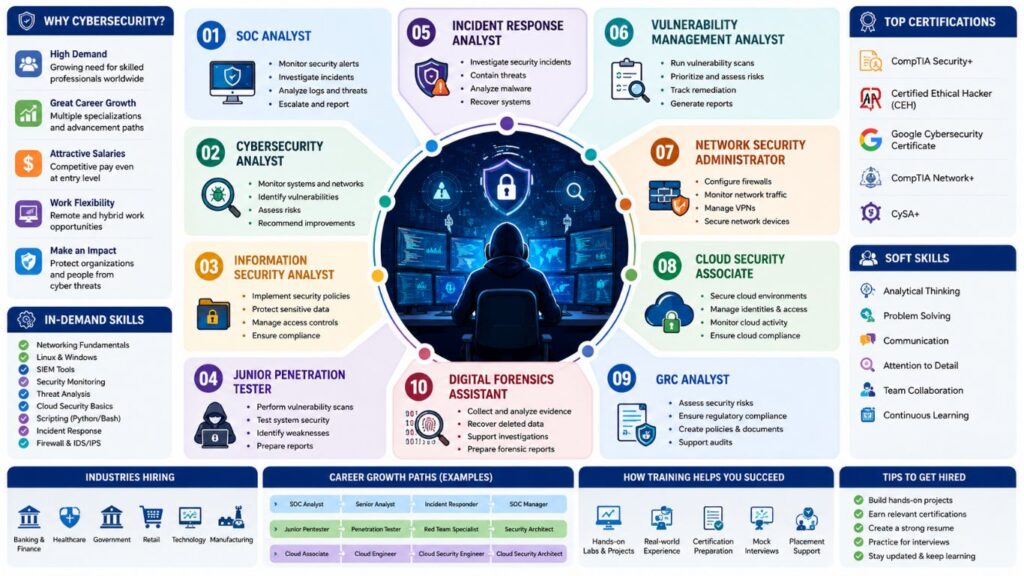
8. Cloud Security Associate
Cloud security is becoming one of the fastest-growing areas in cybersecurity.
Cloud Security Associate positions are now considered top High-Demand Entry-Level Cybersecurity Jobs because organizations increasingly rely on cloud platforms.
Responsibilities
- Protect cloud environments
- Configure access controls
- Monitor cloud activity
- Support cloud compliance
- Secure cloud applications
Platforms Used
- AWS
- Microsoft Azure
- Google Cloud Platform
Skills Needed
- Cloud networking
- IAM concepts
- Data protection
- Cloud monitoring
A cyber security course with placement that includes cloud security can significantly improve career opportunities in High-Demand Entry-Level Cybersecurity Jobs.
9. Governance, Risk, and Compliance (GRC) Analyst
GRC analysts help organizations manage cybersecurity risk and maintain regulatory compliance.
These High-Demand Entry-Level Cybersecurity Jobs are ideal for candidates interested in documentation, auditing, and policy implementation.
Responsibilities
- Conduct risk assessments
- Support compliance audits
- Develop security documentation
- Review security policies
- Ensure regulatory compliance
Popular Frameworks
- NIST
- ISO 27001
- HIPAA
- PCI DSS
- GDPR
Cybersecurity training and placement programs often teach these frameworks to prepare learners for compliance-focused careers.
10. Digital Forensics Assistant
Digital forensics professionals investigate cybercrime evidence and security incidents.
This role is becoming one of the more specialized High-Demand Entry-Level Cybersecurity Jobs for detail-oriented learners.
Responsibilities
- Analyze digital evidence
- Recover deleted data
- Support investigations
- Prepare forensic reports
Common Tools
- FTK
- EnCase
- Autopsy
Skills Needed
- File system analysis
- Investigation techniques
- Forensic procedures
- Attention to detail
Many advanced cyber security course with placement programs include introductory digital forensics modules.
Technical Skills Employers Expect
To succeed in High-Demand Entry-Level Cybersecurity Jobs, candidates must build strong foundational knowledge.
Networking Fundamentals
Understanding TCP/IP, DNS, VPNs, and routing is essential.
Operating Systems
Knowledge of Linux and Windows systems is highly valuable.
SIEM Platforms
Security monitoring tools are commonly used in SOC environments.
Basic Scripting
Python, Bash, or PowerShell skills can improve employability.
Cloud Basics
Cloud security knowledge is increasingly important.
Cybersecurity training and placement programs help learners develop these critical technical skills through hands-on labs.
Soft Skills Needed for Cybersecurity Success
Technical knowledge alone is not enough for success in High-Demand Entry-Level Cybersecurity Jobs.
Communication Skills
Professionals must explain security issues clearly.
Analytical Thinking
Cybersecurity requires strong investigation and problem-solving abilities.
Attention to Detail
Small mistakes can create major vulnerabilities.
Team Collaboration
Security professionals often work with IT, management, and compliance teams.
Continuous Learning
Cybersecurity evolves constantly, requiring ongoing education.
A strong cyber security course with placement support often includes soft skill development and interview coaching.
Certifications That Improve Hiring Opportunities
Certifications help validate your skills and improve your resume visibility.
Recommended Beginner Certifications
CompTIA Security+
One of the best starting certifications for cybersecurity careers.
Certified Ethical Hacker (CEH)
Useful for penetration testing and ethical hacking roles.
Google Cybersecurity Certificate
Good option for beginners entering the field.
CompTIA Network+
Strengthens networking knowledge.
CySA+
Helpful for SOC and analyst roles.
Most cybersecurity training and placement programs align coursework with certification preparation.
Importance of Hands-On Projects
Practical experience is extremely important when applying for High-Demand Entry-Level Cybersecurity Jobs.
Employers value candidates who can demonstrate real skills through:
- Security labs
- Home SOC environments
- Threat simulations
- Vulnerability assessments
- Network monitoring projects
- SIEM implementations
Example Beginner Projects
- Configure firewall rules
- Set up a SIEM dashboard
- Conduct vulnerability scans
- Build a virtual SOC lab
- Monitor network traffic
A quality cyber security course with placement support usually includes project-based learning.
How Cybersecurity Training and Placement Programs Help
Many aspiring cybersecurity professionals struggle with:
- Lack of experience
- Interview preparation
- Technical confidence
- Resume building
- Understanding security tools
Professional cybersecurity training and placement programs solve these problems through structured learning.
Benefits of Placement-Focused Training
Real-Time Projects
Students gain practical industry experience.
Expert Mentors
Industry professionals guide learners effectively.
Resume Assistance
Students learn how to create strong cybersecurity resumes.
Mock Interviews
Practice interviews improve confidence.
Career Guidance
Placement teams help students find suitable opportunities.
A cyber security course with placement support can significantly improve job readiness.
Industries Hiring Cybersecurity Professionals
There is demand for High-Demand Entry-Level Cybersecurity Jobs across nearly every industry.
Banking and Finance
Protect financial transactions and customer accounts.
Healthcare
Secure patient data and hospital systems.
Government
Protect national infrastructure and citizen information.
Retail
Prevent payment system attacks and fraud.
Technology Companies
Secure cloud applications and enterprise systems.
This widespread demand makes cybersecurity training and placement programs highly valuable for career seekers.
Remote Cybersecurity Opportunities
Remote work opportunities continue growing in cybersecurity.
Common Remote Roles
- SOC Analyst
- Security Analyst
- Compliance Analyst
- Vulnerability Analyst
- Cloud Security Associate
Many High-Demand Entry-Level Cybersecurity Jobs now offer hybrid or fully remote work environments.
How to Choose the Right Cyber Security Course with Placement
Selecting the right training program is extremely important.
Important Factors to Consider
Hands-On Labs
Practical learning matters more than theory alone.
Industry-Relevant Curriculum
Courses should include modern tools and technologies.
Experienced Trainers
Industry mentors provide better career guidance.
Placement Assistance
Interview preparation and resume support are valuable.
Real-World Projects
Project experience improves employability.
Certification Preparation
Aligned certification training improves hiring chances.
A quality cybersecurity training and placement program should prepare students for real-world cybersecurity careers.
Final Thoughts
For beginners, graduates and career changers and also for those currently employed in other fields, zeroing in on Cybersecurity as your new career focus and specialization would be one of the most rewarding and beneficial career choices. There is currently a universal quest of companies employing people with the requisite training and skills to do Cyber Defense as a Task. The existence of High-Demand Entry-Level Cybersecurity Jobs opportunities today is an unprecedented occurrence.
Employment opportunities for entry level practitioners to the Cybersecurity Domain are numerous, and some of them are: SOC Analyst, Cybersecurity Analyst, Incident Response Analyst, Junior Penetration Tester, Cloud Security Associate, and GRC Analyst.
Actually having the best chances of achieving High-Demand Entry-Level Cybersecurity Jobs is a function of having skills that are applicable to the demand as well as a background of hands-on experience and appropriate security clearance as well as proper interviewing prep that is all focused on the training and supporting Cybersecurity. The career path is clear and as long as the desire is present, even those with a low level of formal educational training can have a sustainable career in Cybersecurity.
Attending a certified Cyber security training courses with assignment support is a good approach for capturing the necessary technical skills and requisite confidence required to secure that job and begin a career in Cybersecurity.