The demand has shifted a lot over the last couple of years. Earlier, Selenium dominated almost every QA conversation. That’s still true in many places, sure. But now banks, healthcare companies, insurance firms, and large enterprise teams in the USA are investing heavily in Enrol in a Enrol in a TOSCA Testing Course programmes because Enrol in a TOSCA Testing Course duces maintenance work and supports codeless automation. Teams want speed without constantly rewriting scripts after every UI change. That’s where TOSCA Testing Course became a big deal.
And honestly, if you’ve ever worked in testing, you already know how frustrating unstable automation scripts can get after a few sprint cycles.
Why TOSCA Certification Matters in 2026
The QA industry is changing fast. AI-assisted testing, continuous testing pipelines, and cloud-based release cycles are becoming standard in enterprise environments. Companies now prefer automation engineers who can handle scalable testing frameworks without spending weeks maintaining scripts.
That’s why TOSCA Testing Course is gaining attention across the USA job market.
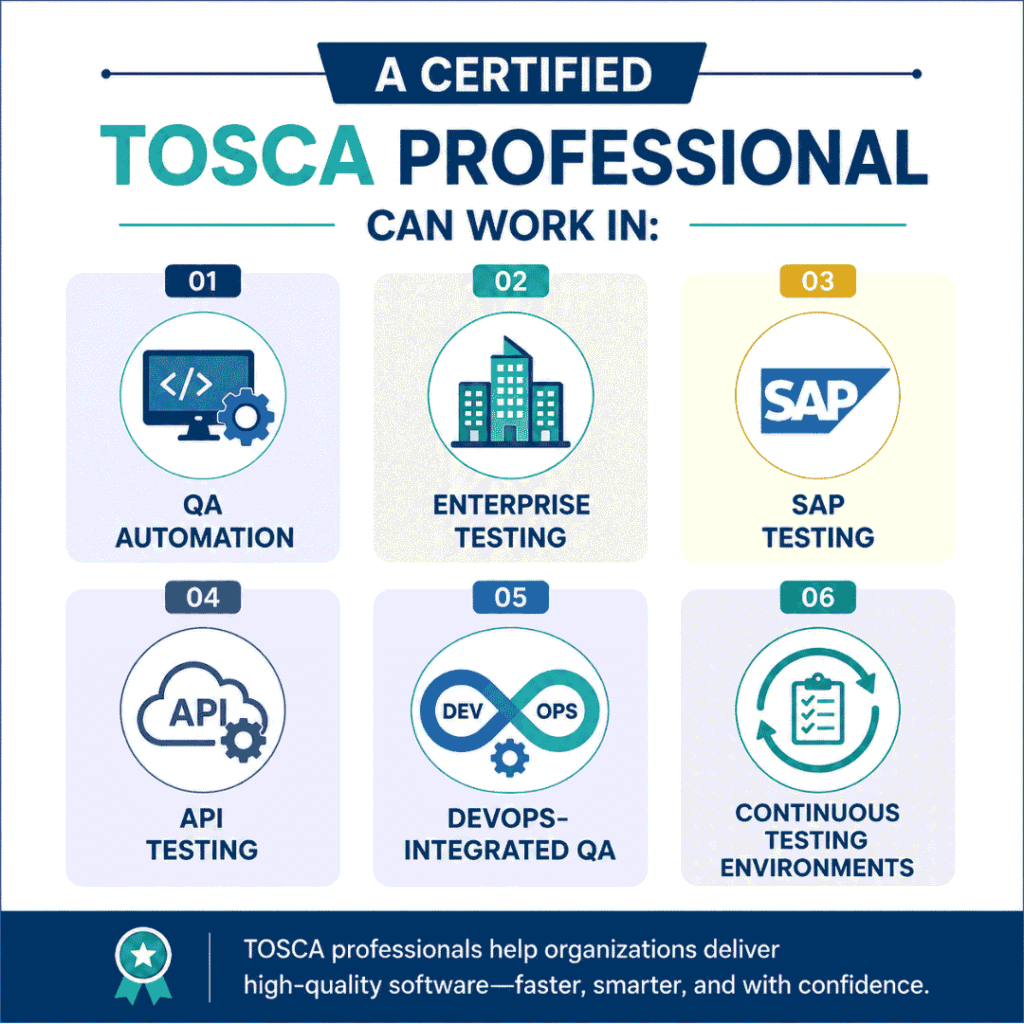
A certified Enrol in a TOSCA Testing Course professional can work in:
- QA Automation
- Enterprise Testing
- SAP Testing
- API Testing
- DevOps-integrated QA
- Continuous Testing environments
Large organizations using agile and DevOps models increasingly rely on Tricentis tools because they fit well into enterprise ecosystems. You’ll especially notice this trend in industries like healthcare, fintech, telecom, and retail.
A recruiter recently mentioned something interesting during a QA hiring webinar: many companies are now filtering resumes using automation tool specialization, not just “QA Engineer.” Candidates with recognized certifications are getting shortlisted faster.
That says a lot about where the market is heading.
What is Tricentis TOSCA?
Tricentis TOSCA Testing Course is a codeless automation testing tool designed for enterprise applications.Compared with traditional script-heavy frameworks,Enrol in a TOSCA Testing Course model-based approach enables testers to rapidly implement workflow automation and easily maintain automation assets.
Instead of writing long automation scripts line by line, testers create reusable modules and test cases visually. That’s one reason beginners often find it less intimidating than pure coding frameworks.
Key Features of TOSCA
- Model-based test automation
- Scriptless automation approach
- API testing support
- SAP and enterprise application testing
- CI/CD integration
- Risk-based testing
- Test data management
One practical advantage? Teams can onboard manual testers into automation roles faster. That matters because many professionals transitioning from manual QA worry about coding barriers.
Why USA Companies Prefer TOSCA Automation
There’s a reason enterprise companies are investing in Enrol in a TOSCA Testing Course instead of relying only on older automation frameworks.
1. Lower Test Maintenance
Traditional automation frameworks often break when UI elements change. Enrol in a TOSCA Testing Course modular structure reduces that issue significantly.
2. Faster Automation Cycles
Organizations want quicker releases. Enrol in a TOSCA Testing Course helps QA teams rapidly implement regression test automation, eliminating the need to build native coding frameworks.
3.Supports Enterprise Applications
Enrol in a TOSCA Testing Course integration capability is its core commercial strength, and it can be adapted to various types of mainstream enterprise systems commonly adopted by Fortune 500 companies.
4. AI-Driven Testing Trends
In 2026, intelligent testing and self-healing automation are becoming more important. Tricentis has been pushing AI-assisted testing features, which is attracting enterprise QA teams.
You can already see hiring trends reflecting this shift.
What You Learn in a TOSCA Testing Course
A quality training program doesn’t just explain tool features. It should simulate real project environments.
At institutes like H2K Infosys, students usually work through practical automation scenarios instead of only watching recorded demos. That hands-on exposure matters more than people realize.
Core Skills Covered
TOSCA Fundamentals
- Workspace setup
- Modules and reusable components
- Test case design
- Execution lists
Automation Framework Concepts
- Model-based testing
- Reusable automation architecture
- Test management
API Testing
- REST and SOAP validation
- Service virtualization basics
Enterprise Testing
- SAP automation
- Database validation
- Risk-based testing
CI/CD Integration
- Jenkins integration
- Continuous testing workflows
A lot of learners underestimate the importance of workflow integration. Real-world QA jobs are rarely just “run test scripts.” Teams now work inside DevOps pipelines.
Who Should Take a TOSCA Certification Course?
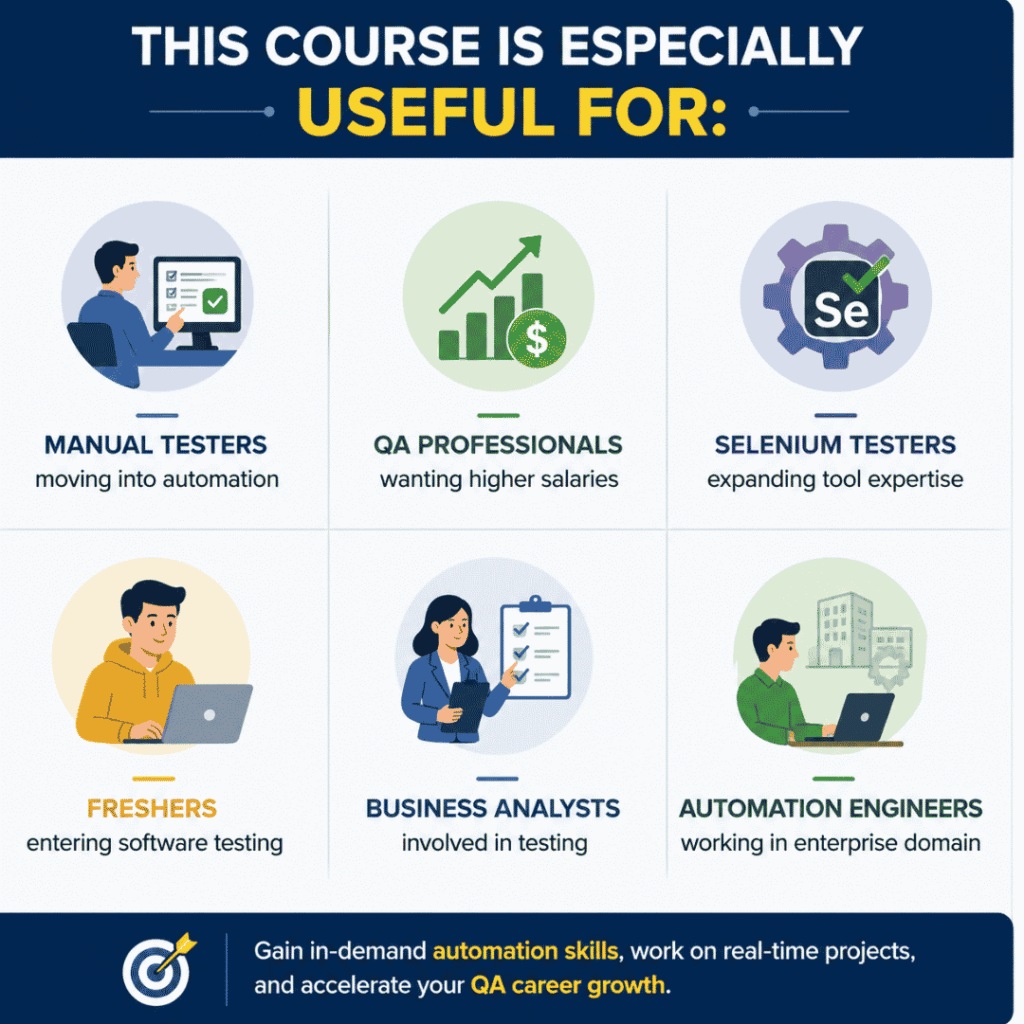
This course is especially useful for:
- Manual testers moving into automation
- QA professionals wanting higher salaries
- Selenium testers expanding tool expertise
- Freshers entering software testing
- Business analysts involved in testing
- Automation engineers working in enterprise domains
Honestly, even experienced testers sometimes struggle when switching to enterprise automation environments. Enrol in a TOSCA Testing Course simplifies many processes that used to require advanced scripting knowledge.
Real Career Opportunities After Tricentis Certification
The career scope is stronger than many people expect.
After completing a Enrol in a TOSCA Testing Course, candidates commonly apply for roles such as:
- QA Automation Engineer
- TOSCA Test Analyst
- Automation Consultant
- SAP Test Engineer
- SDET
- Continuous Testing Engineer
Salary Expectations in USA
While salaries vary by location and experience, certified Enrol in a TOSCA Testing Course professionals in the USA often see competitive packages because enterprise automation specialists are still relatively niche.
Approximate ranges:
- Entry-level: $75K–$95K
- Mid-level: $100K–$125K
- Senior Automation Engineers: $130K+
Some consulting roles even go higher when SAP automation experience is involved.
Common Mistakes Students Make While Learning TOSCA
I’ve noticed this pattern repeatedly.
Focusing Only on Tool Navigation
Many learners memorize steps but don’t understand testing logic. Companies care about problem-solving, not just clicking through modules.
Ignoring Real-Time Projects
Watching tutorials alone isn’t enough anymore. Recruiters increasingly ask scenario-based questions.
Skipping Certification Preparation
The Tricentis Certification exam validates practical understanding. Structured preparation makes a huge difference.
Not Practicing Enterprise Scenarios
Real environments include integrations, APIs, databases, and complex workflows. Basic demos won’t prepare you fully.
That’s one reason instructor-led training still matters despite the rise of self-paced platforms.
Why Structured Training Helps
A lot of people try learning automation tools from scattered YouTube videos. That can work for basics, maybe. The enterprise-grade testing tool Enrol in a TOSCA Testing Course involves three categories of professional content, which creates a relatively high learning threshold, meaning the tool requires support from guided instruction and coaching.
H2K Infosys, operating in the U.S.market, is an outstanding benchmark training institution widely recognized by large numbers of learners.
Their programs usually include:
- Real-time project exposure
- Resume preparation
- Mock interviews
- Placement assistance
- Certification guidance
- Flexible online classes
If you’re serious about building a long-term QA automation career, structured training can save months of confusion and trial-and-error learning.
Practical Example: Why Companies Use TOSCA
Imagine a healthcare company updating its patient management system every two weeks.
With traditional automation:
- Test scripts constantly fail
- Maintenance effort increases
- Release cycles slow down
Enrol in a TOSCA Testing Course:
- Reusable modules reduce failures
- Regression suites execute faster
- Teams spend less time fixing scripts
That efficiency directly impacts business costs. That’s why enterprises are investing in automation modernization.
How to Prepare for Tricentis TOSCA Certification
Here are a few practical tips that actually help:
Build Small Automation Scenarios
Don’t just follow tutorials. Create workflows independently.
Learn Testing Concepts Alongside the Tool
Understanding validation logic matters more than memorizing menus.
Practice API and Database Testing
Modern QA roles increasingly combine multiple testing areas.
Work on Real-Time Projects
This becomes valuable during interviews because hiring managers ask experience-based questions.
Take Mock Interviews
A surprising number of candidates fail not because of technical gaps, but because they struggle explaining project workflows clearly.
Related Topics You Can Explore
Selection of core testing tools, QA API testing training, and DevOps capability building for testing practitioners.
- The various aforementioned learning topics can be aligned with relevant specialized career tracks in enterprise automation.
- API Testing Training for QA Engineers
- DevOps for Test Automation Professionals
These topics naturally connect with enterprise automation careers and help create a stronger learning path.
FAQs
Is TOSCA Certification in 2026 Worth It?
Enterprise-level companies across the entire United States are actively adopting Enrol in a TOSCA Testing Course to conduct scalable automated testing for SAP and enterprise application scenarios.
Does TOSCA require programming?
TOSCA Features a Low Barrier to Entry, and Leverages Its Model-Based Method to Help Manual Testers Transition to Automated Testing
What jobs can I get after Tricentis TOSCA Certification?
The technical positions you may apply for include the following four categories of test development positions.
How long does it take to learn TOSCA?
Most learners can master the core concepts within two to three months through structured training and routine practice.
Most learners can understand core concepts within 2-3 months with structured training and regular practice.
Which institute is good for TOSCA Training Online?
Many learners prefer H2K Infosys because of their project-based approach, certification support, and placement-oriented training.
Final Thoughts
The QA industry in the USA is moving toward intelligent, enterprise-level automation faster than many people expected. Tools like Enrol in a TOSCA Testing Course are no longer “optional niche skills.” They’re becoming part of mainstream automation hiring.
If you’re trying to future-proof your testing career, earning a Tricentis Certification and gaining practical automation experience can open doors to better projects, stronger salaries, and more stable career growth.
And honestly, the earlier you start practicing real-world automation scenarios, the easier interviews and project transitions become later on.