Introduction
Honestly? For a lot of people, yes. The right Courses on Data Analytics can absolutely be worth the money, especially now, when companies in almost every industry are hiring people who know how to work with data. But not every course delivers real value, and that’s where people sometimes feel burned.
Some programs look impressive on the surface, then turn out to be hours of outdated slides and theory nobody uses at work anymore. On the other hand, strong Courses on Data Analytics usually focus on practical skills: SQL, dashboards, reporting, business thinking, and actual projects you can show employers later.
And that matters more in 2026 than it did even a couple of years ago.
Businesses are drowning in data right now. The problem isn’t collecting information anymore, it’s finding people who can actually make sense of it.
Why Data Analytics Courses Became So Popular
A few years ago, Courses on Data Analytics mostly felt like a “tech industry thing.” Now it’s everywhere.
Retail companies track customer behavior. Hospitals analyze patient data. Banks monitor fraud patterns. Even small businesses now rely on dashboards to make decisions.
I noticed this recently while helping someone review analyst job postings. Roles that once required computer science degrees are now open to people with practical skills and project experience instead.
That’s a pretty big shift.
A good Courses on Data Analytics can help someone move from a completely unrelated background into analytics because companies increasingly care about what you can do, not just what degree you have hanging on the wall.
What You Actually Learn in Data Analytics Certification Courses
A lot of beginners assume analytics training is mostly charts and spreadsheets.
It’s more hands-on than that.
Most quality data analytics certification courses teach skills like:
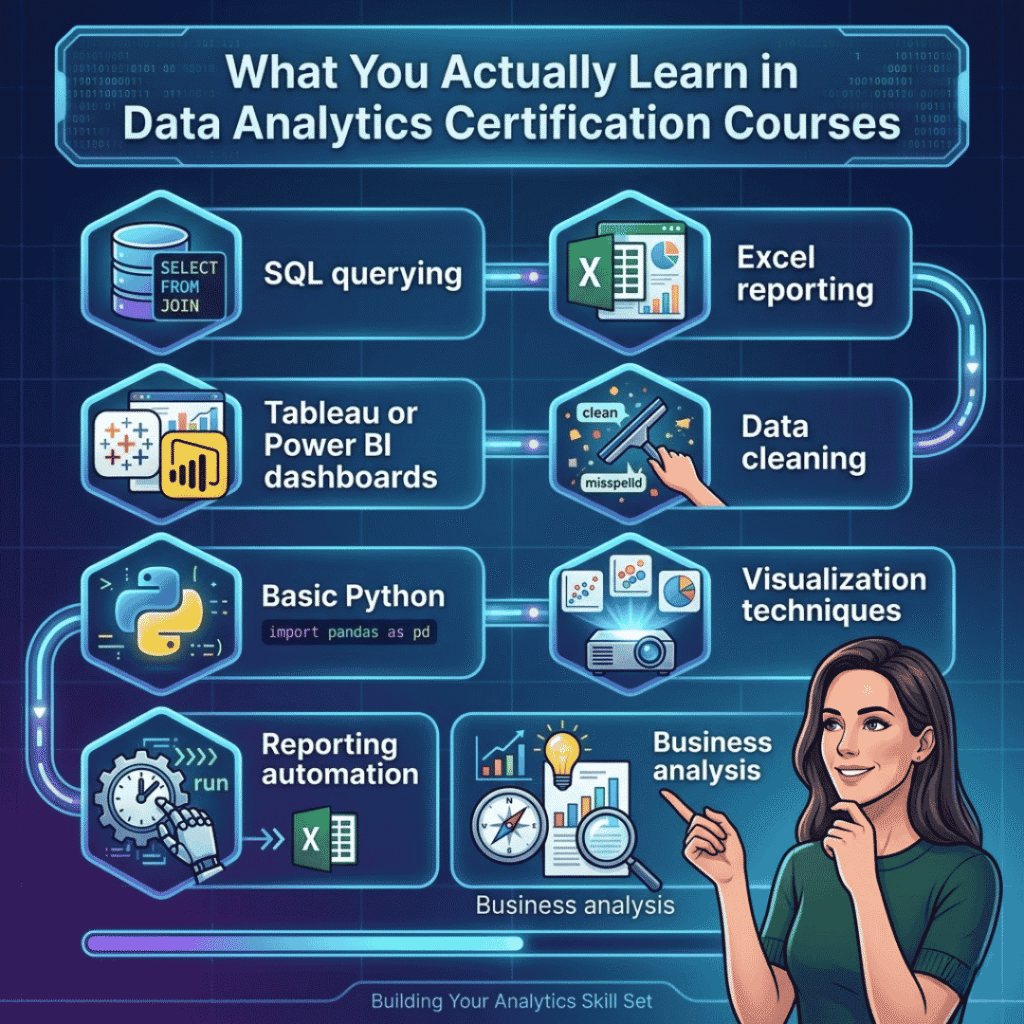
- SQL querying
- Excel reporting
- Tableau or Power BI dashboards
- Data cleaning
- Basic Python
- Visualization techniques
- Reporting automation
- Business analysis
The interesting part is that the tools themselves are only half the job.
Companies really want analysts who can answer questions like:
- Why did sales drop?
- Why are customers leaving?
- Which marketing campaign worked best?
- What products should we stop selling?
That’s where analytical thinking becomes important.
And honestly, that part takes practice.
The Biggest Difference Between Good Courses and Bad Ones
This part gets overlooked constantly.
A weak course teaches definitions.
A strong course teaches problem-solving.
There’s a huge difference between memorizing SQL syntax and actually using SQL to analyze business data under deadlines.
That’s why practical projects matter so much now.
The better Courses on Data Analytics usually include:
- Real datasets
- Dashboard projects
- Business case studies
- Portfolio assignments
- Mock interviews
- Resume preparation
Without projects, it becomes harder to prove your skills during interviews.
Recruiters want evidence that you can actually work with messy data, not just pass quizzes.
Why So Many People Struggle Learning Analytics Alone
There’s no shortage of free tutorials online anymore.
YouTube alone has thousands.
But free learning often becomes chaotic after a while.
You start with Excel videos. Then somebody says SQL matters more. Then another person says, “Learn Python first. Then LinkedIn posts start talking about AI analytics and machine learning. You find yourself suddenly learning five different things, yet finishing none of them.
That happens more often than people admit.
Structured Courses on Data Analytics help because they organize the learning path properly.
Instead of randomly jumping between tools, students follow a roadmap that builds skills step by step.
That structure can save months of confusion.
Real Skills Matter More Than the Certificate
This is probably the most important thing people should know before spending money.
The certificate itself won’t magically create job offers.
Employers care more about whether you can:
- Analyze business data
- Build reports
- Explain findings clearly
- Use SQL confidently
- Create dashboards
- Solve practical problems
That’s why project-based learning matters so much.
Training providers like H2K Infosys tend to focus heavily on hands-on assignments and real-world analytics scenarios instead of only theoretical content. That approach usually helps learners feel more comfortable during interviews because they’ve already practiced business-style projects before applying for jobs.
And honestly, confidence becomes a huge factor during hiring.
Career Opportunities After Completing a Course for Data Analytics
One reason analytics keeps attracting career changers is its flexibility.
People move into analytics from:
- Finance
- Retail
- Customer support
- Healthcare
- Operations
- Marketing
- Education backgrounds
Common roles include:
- Data Analyst
- Reporting Analyst
- Business Analyst
- BI Analyst
- Operations Analyst
- Marketing Analyst
What’s particularly striking lately is how many industries now rely heavily on analytics teams. Even companies that barely used reporting tools five years ago are investing in dashboards and business intelligence platforms now.
The demand feels much broader than before.
AI Changed Analytics, But It Didn’t Replace Analysts
There’s been nonstop discussion online about AI replacing data jobs.
Reality feels less dramatic.
AI tools now help automate dashboards, generate summaries, and speed up reporting. But businesses still need humans who understand context.
A dashboard might show declining revenue.
An analyst explains why it happened.
That difference still matters.
Actually, many modern Courses on Data Analytics now include exposure to AI-assisted reporting tools because companies expect analysts to work alongside automation rather than avoid it completely.
Common Mistakes People Make Before Joining Analytics Courses
Some mistakes happen over and over.
Choosing Courses Based Only on Price
Cheap courses sometimes skip projects, mentorship, or practical training completely.
Focusing Only on Watching Videos
Analytics requires practice. Watching tutorials alone usually isn’t enough.
Trying to Learn Advanced Topics Too Early
A lot of beginners rush into machine learning before understanding SQL or reporting basics.
That usually creates frustration fast.
Ignoring Portfolio Work
Projects matter more than people think. Even small dashboards or reporting case studies help during interviews.
What Makes a Data Analytics Course Actually Valuable?
A strong Course for data Analytics usually offers:
- Practical assignments
- Real business projects
- SQL training
- Dashboard creation
- Career support
- Resume guidance
- Interview preparation
- Industry-relevant workflows
One thing many learners realize too late is that support matters. Having instructors or mentors available during difficult topics can make learning much less overwhelming.
Programs from H2K Infosys focus quite a bit on practical analytics workflows and job-oriented preparation, which tends to help beginners transition into real analyst responsibilities more smoothly.
So… Are Courses on Data Analytics Worth It?
For serious learners, usually yes.
Especially if the course helps you build:
- Practical experience
- A portfolio
- Business problem-solving skills
- Confidence with analytics tools
- Interview readiness
The people who benefit most are usually the ones who consistently practice after training instead of treating the course like a passive video series.
That part matters more than many expect.
Because analytics isn’t really a “memorize once and you’re done” kind of field. The tools evolve constantly. AI tools keep changing workflows. Reporting systems get smarter every year.
There’s always something new happening.
Related Topics You Can Also Explore
To build stronger analytics knowledge, you can also explore:
- SQL Interview Questions for Data Analysts
- Tableau vs Power BI for Beginners
- How to Become a Data Analyst Without a Technical Degree
These topics connect naturally and help create a stronger foundation if you’re planning a long-term analytics career.
FAQs
Are Courses on Data Analytics worth it in 2026?
Yes, especially programs focused on projects, business scenarios, and practical skills rather than only theory.
Can beginners learn data analytics online?
Absolutely. Many people transition into analytics from non-technical backgrounds through structured learning.
Which analytics skill is most important?
SQL remains one of the most important technical skills, along with dashboards, Excel, and business analysis.
How long does it take to become job-ready?
For most learners, around 4–8 months of steady practice and project work is realistic.
Do employers care about Courses on Data Analytics?
Yes particularly courses that include hands-on projects and practical experience relevant to business environments.
Final Thoughts
The best Courses on Data Analytics are usually worth the investment when they focus on practical skills instead of just certificates.
That’s really what separates useful training from forgettable online content.
Businesses need analysts who can solve problems, explain trends, and help teams make smarter decisions using data. Those skills are still in demand, even with AI tools becoming more common inside workplaces.
If you’re serious about building a career in analytics, structured learning can definitely help reduce confusion and speed up the process, especially when the program includes projects, mentorship, and interview preparation.
And for beginners looking for hands-on training with business-focused projects and career support, programs from H2K Infosys are a practical place to start exploring the field more seriously.