
A lot of beginners finishing cyber security training and placement programs in 2026 are actually starting with salaries somewhere between $65,000 and even $110,000 in the US, which honestly surprises many people entering tech. The demand has stayed pretty steady because companies are still battling ransomware issues, phishing scams, and cloud security gaps almost nonstop. From what I’ve seen, students who spend more time on practical labs usually perform better in interviews than those who only study theory. Somewhere in the middle of that learning curve, institutes like H2K Infosys have gained attention for offering hands-on projects and placement guidance that help freshers feel more job-ready in real workplace environments today.
Why Beginner Cyber Security training and placement Salaries Are Rising
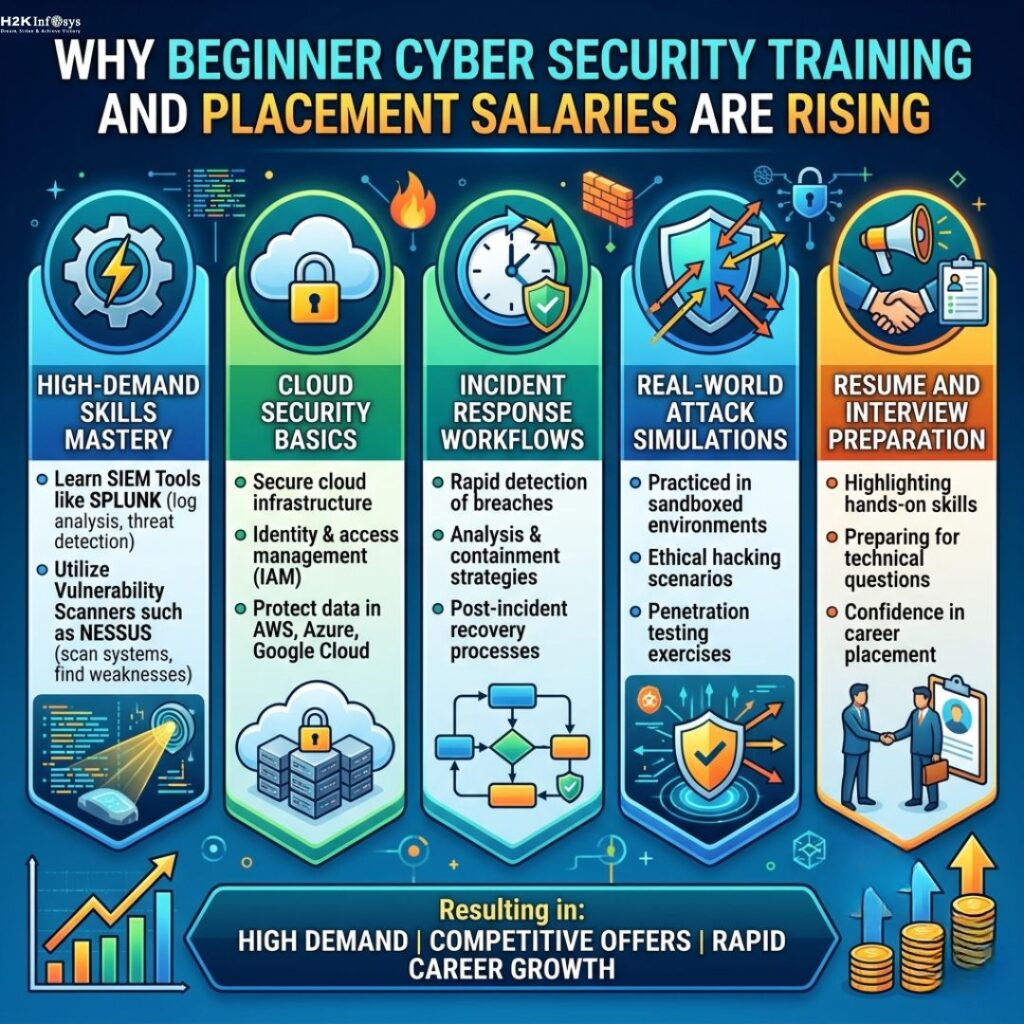
A few years ago, most companies wanted only experienced professionals. Now? Things are changing. Organizations are struggling to fill SOC analyst, cloud security, IAM, and vulnerability management roles. Even mid-sized companies now understand they cannot ignore security anymore.
I was reading industry hiring reports earlier this year, and one thing kept showing up repeatedly: employers care more about practical capability than just degrees. Someone who can actually investigate logs in Splunk or identify suspicious traffic in Wireshark immediately stands out.
That is where strong cyber security training with job placement programs make a real difference.
Instead of learning only definitions and theory, learners now need:
- SIEM tools like Splunk
- Vulnerability scanners such as Nessus
- Cloud security basics
- Incident response workflows
- Real-world attack simulations
- Resume and interview preparation
Honestly, this is why some beginners get stuck at lower salary ranges while others cross six figures surprisingly fast.
Average Cyber Security Salary for Freshers in 2026
Here’s a realistic breakdown based on current hiring trends in the U.S. market:
| Job Role | Beginner Salary Range |
| SOC Analyst | $65,000 – $85,000 |
| Cyber Security Analyst | $75,000 – $95,000 |
| IAM Analyst | $70,000 – $90,000 |
| Cloud Security Associate | $85,000 – $110,000 |
| Vulnerability Analyst | $72,000 – $92,000 |
| Security Operations Associate | $68,000 – $88,000 |
Now, of course, location matters. Someone working in Texas, Virginia, or remote cloud-security positions may earn differently than someone starting in a smaller regional company. Certifications also influence compensation a lot more than people expect.
I’ve seen learners with strong hands-on exposure and certifications like Security+, CEH, or AWS Security Specialty receive noticeably better offers compared to candidates who only completed video-based training.
What Actually Helps Beginners Get Higher Salary Packages?
This is the part many blogs skip.
Employers are no longer impressed by “completed online course” lines alone. Hiring managers want proof you can work in real environments. That’s why many recruiters now ask scenario-based questions during interviews.
For example:
- “How would you investigate a suspicious login attempt?”
- “What steps would you take during a phishing incident?”
- “How do you prioritize vulnerabilities?”
Candidates from good cyber security jobs with training programs usually answer confidently because they practiced in labs already.
One thing I’ve personally observed with students from programs like H2K Infosys is that mock interviews and project-based training help reduce that beginner hesitation. A lot of freshers know concepts but freeze during interviews because they never practiced explaining security incidents out loud.
That soft-skill confidence matters more than people realize.
Why H2K Infosys Stands Out for Beginners
There are thousands of cyber security training and placement courses online now. Some are honestly just recorded videos with zero career guidance. That becomes a problem when students finish training and still don’t know how to face interviews.
H2K Infosys leans heavily into practical implementation, which is probably why many learners choose it for cyber security training and placement support.
Their approach usually includes:
- Real-time project exposure
- Hands-on SIEM and security tools
- Resume optimization
- Mock interviews
- Placement assistance
- Industry-focused mentoring
And this matters because employers increasingly prefer candidates who already understand enterprise workflows. Even beginner analysts are expected to know ticketing systems, log monitoring, escalation procedures, and cloud basics.
A candidate who has worked through simulated attack scenarios simply interviews better. That’s the reality.
Real-World Example of Salary Growth
One learner I came across online started as a SOC Analyst around $72,000 after completing structured security training and internship-style projects. Within roughly 18 months, after gaining experience with cloud monitoring and incident response, the salary moved close to $105,000.
That kind of jump is becoming more common in cyber security training and placement compared to many traditional IT paths.
The interesting thing is that security careers tend to scale quickly once experience builds. Your first job may be entry-level, but the second role often pays dramatically more.
Remote Cyber Security Jobs Are Changing Salaries Too
Another noticeable trend in 2026 is remote hiring.
Companies are now comfortable hiring remote analysts for monitoring, compliance reviews, threat detection, and IAM operations. This opens opportunities for beginners who previously struggled because they didn’t live near major tech hubs.
Remote roles also created stronger competition though. Recruiters now compare candidates globally, which means practical skills matter even more.
That’s another reason structured cyber security training and placement support becomes valuable. Guidance on LinkedIn optimization, interview preparation, and project portfolios can genuinely affect salary outcomes.
Certifications That Boost Entry-Level Salary
Some certifications still carry strong value for freshers:
- CompTIA Security+
- Certified Ethical Hacker (CEH)
- AWS Security Specialty
- Microsoft SC-200
- Splunk Core Certified User
- Cisco CyberOps Associate
But here’s something people rarely mention: certifications alone do not guarantee higher salaries anymore.
A candidate with certifications plus practical lab experience almost always performs better during technical interviews.
Is Cyber Security Worth It Financially for Beginners?
In my opinion, yes especially for people willing to practice consistently.
Cyber security remains one of the few IT domains where beginners can still enter without a computer science degree and grow into high-paying roles relatively quickly. The industry changes fast, though. People who continuously learn cloud security, AI-driven threat detection, and automation tools are seeing the strongest salary growth right now.
The demand is not slowing either. Financial firms, healthcare organizations, SaaS companies, and even government contractors are actively hiring security professionals because cyber threats keep evolving.
That urgency directly impacts salaries.
Final Thoughts
Beginners completing solid cyber security training and job placement programs can realistically expect starting salaries between $65,000 and $110,000 depending on skills, certifications, and project exposure. The biggest difference-maker today is practical experience.
Programs like H2K Infosys help bridge that gap by combining technical labs, interview coaching, cyber security training and placement support instead of offering only theoretical lessons. And honestly, in the current market, that hands-on preparation is often what separates candidates who get callbacks from those who keep endlessly applying online.