Introduction
A Course for Data Analytics is a great chance to build up a successful career in the USA. Organisations across healthcare, finance, retail, technology and manufacturing are turning to data-driven decisions more and more, creating a high demand for professionals with strong analytics skills. The right training programme will equip you with practical skills, earn you recognised credentials and get you the experience employers are looking for.
If you’ve been wondering whether it’s worth investing in data analytics training and placement programs, the short answer is yes, if you pick a course that combines technical skills, real-world projects, certification prep, and career support.
Why Data Analytics Is Growing So Fast in the USA
Data is one of the most valuable business assets. Every customer contact, online sale, financial transaction and health care record generates data which organisations use to make decisions.
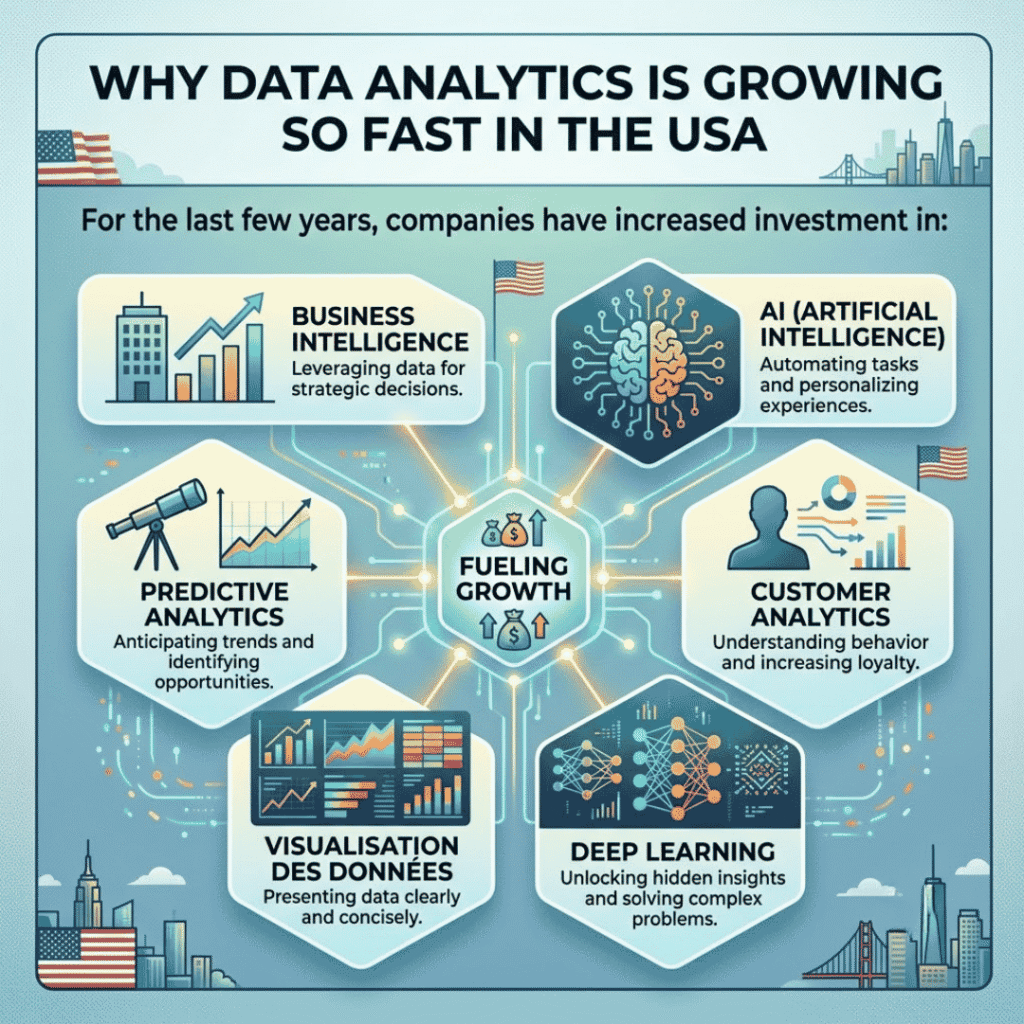
For the last few years, companies have increased investment in:
- Business Intelligence
- AI (Artificial Intelligence)
- Predictive Analytics
- Customer Analytics
- Visualisation des données
- Deep Learning
So businesses need professionals who can convert raw data into meaningful insights.
In practice, companies don’t want people who can just create spreadsheets. They are looking for analysts who can spot trends, solve business problems and clearly communicate their findings to stakeholders.
That’s where a well-structured Course for Data Analytics comes in handy.
What a Data Analytics Course Will Teach You
Lots of beginners think that Course for Data Analytics is just about numbers. In fact, it blends business insight, technology, and problem-solving.
A good course will typically include:
Data Analysis 101
You will learn how organisations collect data, organise it, and interpret it.
Some common topics include:
- Data cleansing
- Transformation of data
- Explore data
- Statistical analysis
- Data Quality Management
SQL for Data Analysis
SQL remains one of the most sought-after skills in analytics job postings.
You’ll discover that:
- Query databases
- Scrape Business Data
- Generate reports
- Analyse customer behaviour
Advanced Excel & Reporting
Even with newer tools, Excel is still widely used in all industries.
Important concepts are:
- Pivot tables
- Dashboards
- Modelling data
- Formulas Avanzadas
Visualisation Tools
Today companies want analysts to visualise findings.
Common tools include:
- Tablo
- BI Power
- Looker
Visualisation of learning helps decision makers to understand data more quickly.
Analytics with Python
Analysts now consider Python to be one of their most valuable skills.
You’ll be working with:
- pandas
- numpy
- Matplotlib
- Workflows for data automation
Real World Project
This is where a lot of students get their confidence.
For example, you might think about:
- E-Commerce Sales Information
- Trends in patient data in healthcare
- Patterns of bank transactions
- Impact of marketing campaigns
Such projects often become portfolio pieces in job interviews.
How Data Analytics Training and Placement Programs Transform Lives
One thing I’ve seen in hiring trends is that a lot of candidates take online tutorials and then have trouble in the interview because they don’t have the practical experience.
And this is why Course for Data Analytics programs gained so much popularity.
Such programs usually include:
Systematic Learning
Students navigate a guided roadmap instead of jumping around between random YouTube videos.
Projects in Industry
Employers want practical experience.
Working on practical datasets makes it easier to talk about real-world scenarios during interviews.
Developing Resumes
Many candidates miss opportunities because their resumes don’t reflect relevant skills.
Assistance programs for placements:
- Optimising your resume
- Projects Spotlight
- Have Certifications Well
Practice Interviews
Interview preparation can greatly increase confidence.
Students learn how to answer questions connected to:
- SQL
- Tableau
- Scenarios for business
- Data interpretation
Job Placement Support
Some training providers have employer networks and provide career guidance, referrals and interview opportunities.
Is the USA a Good Market for Data Analysts?
The USA continues to be one of the best job markets for analytics professionals.
Industries that are actively hiring are:
- Technology
- Banks
- Insurance
- Health care
- Retail
- Logistics
- Telecommunications
Typical job titles include:
- Data Analyst
- Business Analyst
- Analyst, Reportage
- Business Intelligence Analyst
- Analyst, Product
- Analyst, Operations
- Marketing Analyst
Many organisations are also creating hybrid analytics roles that blend business intelligence and AI-driven insights.
Can a Beginner Break into Data Analytics?
Absolutely.
One of the biggest misconceptions is that you need a computer science degree to be a data analyst.
The fact of the matter is, many successful analysts have backgrounds like:
- Finance
- Accounting
- Marketing
- Health care
- Engineering
- Educations
- Client Services
It’s about understanding what tools to learn and how to solve business problems with data.
A comprehensive Data Analytics Course effectively bridges that gap.
Reasons to Take a Data Analytics Certification Course
More and more employers are looking for certifications as proof of practical knowledge.
Certifications will not get you a job by themselves, but they can help add to your profile.
Data analytics certification courses include popular ones like:
- Oracle SQL Certification
- Tableau Certification
- Certification in Power BI
- Python Analytics Certification
- Programs in Business Analytics
Certifications help show:
- Technical competence
- Willingness to learn
- Industry ready
They also lend credibility to candidates coming from non-technical careers.
Real World Example
Take a marketing professional who wants to switch to analytics.
If they don’t have any analytics skills, they could be restricted to reporting on the outcomes of a campaign.
Following a structured analytics course they will be able to:
- Review the cost of acquiring customers
- Performance of the measurement conversion
- Make dashboards
- Predict the results of the campaign
The end result is typically a stronger career profile and access to higher paying analytical roles.
This sort of transition is becoming more common in the USA job market.
Mistakes Students Commonly Make
Only Theory
Reading about concepts without application rarely gets you job ready.
Prioritise projects always.
Ignore SQL
Students tend to overemphasise visualisation tools and underestimate SQL.
SQL is a must for most employers.
Build No Portfolio
A portfolio shows practical ability.
Two or three well-documented projects even make a difference.
Skipping the Interview Preparation
Technology alone is not enough to know.
Employers want analysts who can communicate insights in a clear way.
What Skills Will You Learn in a Data Analytics Course?
Students usually develop after completing a quality program:
- Skills in cleaning data
- SQL skills
- Build dashboard
- Data visualisation
- Reporting for business intelligence
- Statistical analysis
- Problem solving skills
- Communication with stakeholders
- Rational thinking
These skills are still in demand across many sectors.
Advantages of Learning Data Analytics for Your Career
The benefits go far beyond employment.
Improved Career Prospects
Analytics skills are useful in leadership, operations, marketing, and strategy roles.
Versatility in Different Industries
Analytics skills are more portable across industries than some niche professions.
Skills for the Future
The rapid pace of AI adoption calls for professionals who can analyse and validate data-driven insights.
Competitive Edge
In the data-driven economy of today, candidates with analytics skills often stand out.
How H2K Infosys Can Help You Get Started?
If you’re serious about building a career in analytics, structured training can make that journey a lot easier.
H2K Infosys courses are practical learning, real-time projects, certification preparation and career-oriented support.
Students gain:
- Instructor-led courses
- Hands on projects
- Curriculum in the real-life
- Job placement help
- Interview prep
- Real-world business situations
This blend of technical skills and career support can give you a big leg up for those who are seeking opportunities in the USA.
You Can Also Explore Other Topics
You might also want to explore to gain more expertise:
- How to become a Data Analyst in USA
- SQL Interview Questions for Data Analysts
- Power BI vs Tableau: Which tool to learn first?
- Business Analytics vs Data Analytics
- Best Data Analytics Certifications for Entry Level
These topics build a strong learning path and are complementary for your analytics career journey.
Frequently Asked Questions
Is a Data Analytics Course Worth It in 2026?
Yes. Organizations continue expanding their use of data, AI, and business intelligence, creating strong demand for skilled analytics professionals.
Do I Need to Know How to Code to Enrol in a Data Analytics Course?
No. A lot of beginner-friendly programs start with the basics and slowly teach SQL, Python, and visualisation tools.
How Long Do I Have to Wait Until I’m Job-Ready?
With concentrated training and practical projects, most learners can develop entry-level analytics skills within a few months.
Will Data Analytics Certification Courses Get Me a Job?
Certifications are helpful, but employers also want to see practical projects, technical skills and interview readiness.
What Is the Most Important Skill Employers Look for in Data Analysts?
SQL remains one of the most sought-after skills, with data visualisation, problem solving and business communication following behind.
Concluding Thoughts
A Course for Data Analytics can surely help you succeed in the USA, especially if it provides you with technical training, practical projects, certification preparation and career assistance. As organisations become more data-driven in decision-making, the need for analytics professionals continues to grow.
The best candidates are usually those who go beyond the theory and build real projects, improve their SQL and visualisation skills, and prepare well for interviews. If you want to get into a field that’s in high demand and has strong long-term potential, investing in quality data analytics training and placement support can be one of the smartest career decisions you make.