If you pick the right data analytics program, yes. Most modern programs go beyond recorded lectures and quizzes to include real-world projects, business case studies, cloud-based analytics tools and portfolio-building assignments that closely mirror workplace challenges. One of the best things about learning data analytics in the USA for job seekers and professionals is gaining hands-on industry experience during training.
The demand for data analysts continues to grow in the US across industries. Today, businesses don’t hire candidates just because they have certificates. They want professionals who can clean datasets, create dashboards, analyse trends and communicate insights to aid business decisions. This trend has made practical experience a core part of any quality data analytics program.
Whether you’re a fresh graduate, changing careers, or an experienced professional looking to upskill, choosing a program with real-world experience can greatly enhance your confidence and employability.
Why Industry Experience Counts More Than Ever
Learning concepts such as statistics, SQL, Python or Power BI is important, but employers want to see candidates who understand how these skills can solve real business problems.
Let’s say there are two candidates applying for the same data analytics program position.
The first candidate has taken some online lessons and received a certificate.
The second candidate has the same training but she has also built interactive dashboards, analysed customer sales data, cleaned messy datasets, and presented her findings in business reports.
Most hiring managers will automatically favour the second candidate since they have already demonstrated practical skills.
And for this very reason, industry-specific data analytics program are on the rise in the USA. Employers want candidates who can jump in and get to work, not ones who need to be taught the first few weeks.
The Meaning of “Real-World Industry Experience”
Many students think that the only way to get experience in an industry is to get an internship. Internships are great, but there are plenty of good quality online programs that have a lot of hands on learning that is closer to a real working environment.
These are:
- Hands-on with real-world business datasets
- Industry Case Studies to Solve
- End to end analytics project
- Creating dashboards using Power BI or Tableau
- Writing SQL queries for large databases
- Cleaning Data with Excel and Python
- Presentation of recommendations for business as an outcome of the analysis
- Assembling a Professional Portfolio for Job Interviews
Instead of rote memorisation of concepts, students learn how analytics professionals solve business problems every day.
What You’ll Usually Learn in a Data Analytics Program
The best data analytics program online will teach you the technical and business skills.
Data Collection and Preprocessing
Real world data is messy.
Students will learn to:
- Remove duplicate rows
- Handle missing data
- Make inconsistent formats standard
- Combine multiple datasets
- Data preparation for analysis
These tasks represent a large part of a data analyst’s daily responsibilities.
SQL for Business Analytics
SQL is among the most in-demand skills in data analytics job postings in the United States.
Students learn to:
- Extracting data from databases
- Filter records
- Join several tables
- Generate reports
- Aggregates
- Optimise queries
These are the practical skills that analysts in finance, healthcare, retail, technology, and manufacturing use every day.
Excel for High-Level Analytics
Many people consider Excel a basic skill, but advanced Excel skills are very valuable.
Training in modern analytics consists of:
- PivotTables
- Power Query
- Lookup functions
- Data validation
- Conditional formatting
- Dashboards that interact
Many businesses still rely on Excel for their operational reporting.
Python for Data Analysis Learning
Analytics has made Python one of the most sought-after programming languages.
Students usually learn:
- Pandas
- NumPy
- Data cleaning
- Data visualisation
- Exploratory Data Analysis (EDA)
- Basic Autom.
Rather than just learning syntax, students work with datasets that are similar to those used in business settings.
They might analyse customer purchasing behaviour, identify seasonal sales trends, or predict inventory requirements based on historical data.
Visualisation & Dashboarding
Businesses need insights, not just numbers, delivered clearly.
Most data analyst online courses cover dashboard development using tools like:
- Microsoft Power BI
- Tableau
- Excel Dashboards
Students create reports that can be used by managers and executives in making decisions.
When you have a portfolio with many dashboards, this is often one of the best assets you can have in an interview.
Capstone Project Work
One of the greatest benefits of industry focused programs is the capstone project.
Students don’t just do isolated exercises. They solve an end to end business problem.
A capstone project can include:
- Business goals understanding
- Gathering raw data
- Data set cleaning
- Analysis performed
- Building Visualisations
- Recommendations provided
This is similar to the workflow that professional data analysts are used to.
Many hiring managers will specifically ask candidates to talk about these projects in interviews since they are a demonstration of technical ability and problem solving skills.
Portfolio Development: Your Competitive Edge
Your certificate doesn’t worth more than your portofolio.
Recruiters often check GitHub repos, Power BI dashboards, Tableau projects, SQL scripts, and case studies before scheduling interviews.
A good portfolio demonstrates that you can:
- Address business problems
- Effectively communicate findings
- Use Analytical Thinking
- Familiarise yourself with industry standard tools
This is part of the reason that active learning is becoming more important relative to passive, video-based education.
Can Online Learning Provide Sufficient Real-World Experience?
One of the main concerns of students is whether online education can really replace the experience of the classroom or the workplace.
In the real world, a lot of employers care less about where you learned and more about what you can demonstrate.
If your online data analysis course has:
- Actual datasets
- Projects with guidance
- Assignment portfolios
- mentor responses
- Mock interviews
- Career support
then you are often as well prepared as someone who has done traditional classroom training.
There are plenty of successful analysts in the US who have built rewarding careers after taking a structured online data analytics program and then doing consistent project work.
The Value of Mentorship
Learning by yourself has its merits, but a mentor can speed up the learning process significantly.
Experienced mentors help students:
- Discover the industry’s best practices
- Project quality review
- improvements to dashboards
- SQL queries can be optimised
- Get ready for technical interviews
- Build self-confidence
Constructive feedback can also help students to avoid common mistakes that they may have difficulty spotting themselves.
Common Errors Made by Students
Unknowingly, many learners make avoidable mistakes that slow their career growth.
Some of the most frequent are:
- Theory only
- Portfolio development disregarded
- SQL practice missed
- Not picking up data visualisation
- Avoidance of business communication skills
- Doing courses without building projects
Employers want analysts who can solve problems, not just ace quizzes.
Career Opportunities Upon Finishing a Data Analytics Program
Data analytics skills are needed in almost every industry in the United States.
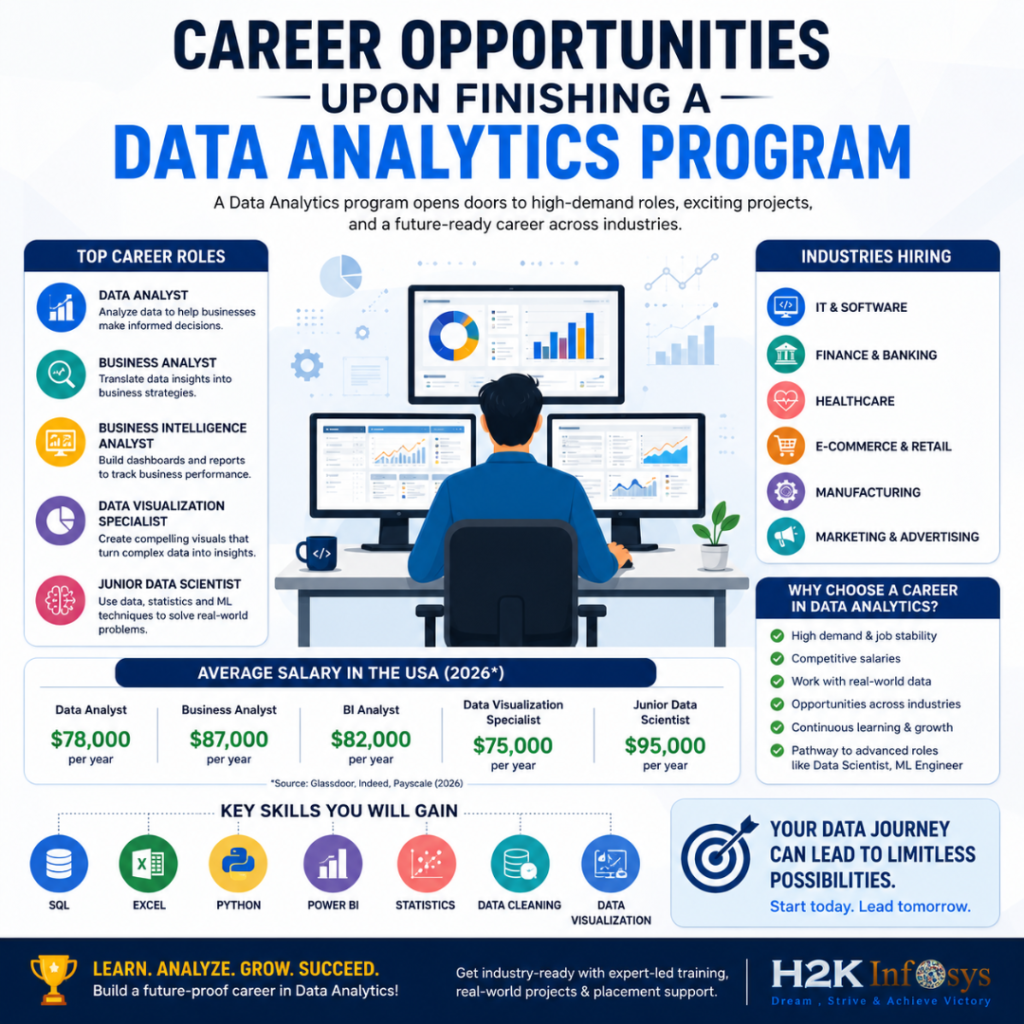
Some of the most popular career paths are:
- Business Analyst
- Reporting Analyst
- Operations Analyst
- Financial Analyst
- Marketing Analyst
- Product Analyst
- Business Intelligence Analyst
- Junior Data Scientist
- Data Analyst
Healthcare, banking, retail, insurance, logistics, manufacturing and technology organisations are still spending on analytics professionals to improve business decisions.
With the current hiring trends, professionals with a strong portfolio, real-world project experience, and skills in SQL, Python, Excel, and Power BI have a definite edge over those who are only certified.
The Importance of Practical Learning
Employers are increasingly looking for skills that candidates can demonstrate, rather than just qualifications.
Industry style projects, business insights you can present, and a portfolio to show your skills means you go into interviews with real examples of what you can do, not just theory.
This practical confidence often translates into better interviews and better job opportunities.
Selecting the Right Program
The industry exposure is different from course to course.
Before signing up, ask if the program includes:
- Real world projects
- Final project
- Portfolio development
- Career coaching
- Help with resumes
- Mock interview
- Job placement help
- Mentor Support
- Practical experience with SQL, Python, Excel and Power BI
Programs that combine training in a technical field with career preparation are generally a better fit for today’s competitive job market.
Why H2K Infosys Is Unique
If you’re serious about building a career in data analytics, structured training can be a game-changer. H2K Infosys provides a complete learning methodology, including instructor-led classes, hands-on projects, practical case studies, portfolio development, mock interviews and job placement support. Students get practical experience that is in line with what employers in the USA are looking for in entry and mid-level data analysts instead of just theory.
FAQs
Are there real life projects in Data Analytics program?
Yes. Quality programs contain business case studies, capstone projects, dashboard creation, SQL exercises, and real-world datasets to help students develop practical skills.
Is an online Data Analytics course enough to get a job?
A well-designed Data Analytics course online, a strong portfolio, interview prep, and practical project experience can make a huge difference in your chances of landing a data analyst role.
Top skills for data analysts in the USA
High-demand skills include SQL, Excel, Python, Power BI, Tableau, data visualisation, statistics, critical thinking, and business communication.
How do I create a strong analytics portfolio?
Work on real datasets, build end-to-end projects, publish dashboards, document your analysis, and show your work on platforms like GitHub or personal portfolio websites.
Are data analytics program worth it?
Yup. Reputable online courses for data analyst that combine practical learning, mentorship, career support and industry-specific projects can be a great way to ready learners for real-world analytics roles.
Related Topics You Can Dig
You may also want to consider: to gain a better understanding and develop a more robust analytics foundation
- SQL for Data Analytics
- Power BI for Business Intelligence
- Python for Data Analysis and Visualisation
Conclusion
A modern data analytics program should prepare you to solve real business problems, not just teach concepts. The best data analytics program combine technical training with hands-on projects, portfolio building, mentorship and career coaching so you’re ready to meet the expectations of employers from day one. To succeed in the competitive U.S. job market, select training that combines hands-on experience with theory. Not only will this combination add to your resume, but it will also give you the confidence to perform in interviews and succeed in your first data-analytics role.