One of the biggest questions people ask before enrolling in a cybersecurity course is: “How does cyber security training with job placement actually work?” The short answer is this: a good program teaches in-demand security skills, gives you hands-on experience, helps you prepare for interviews, and connects you with employers through placement support. Providers like H2K Infosys follow this career-focused approach by combining live instructor-led training, hands-on labs, real-world projects, interview preparation, and placement assistance to help learners become job-ready. The goal isn’t just to help you pass a course it’s to help you become employable.
That’s the ideal version, at least. And honestly, not every training provider delivers all of those pieces equally.
What Is Cyber Security Training With Job Placement?
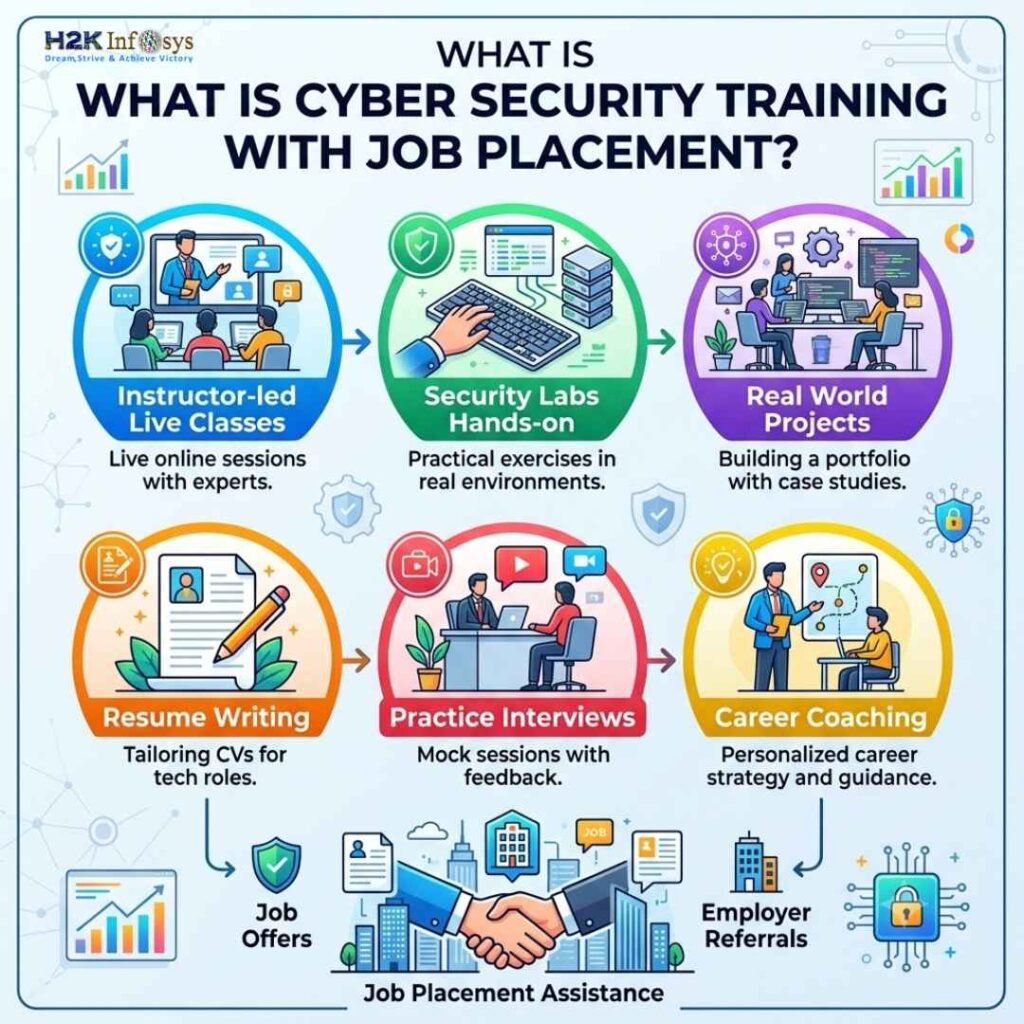
Think of it as a career-focused learning program rather than a traditional classroom course.
These programs typically include:
- Instructor-led live classes
- Security Labs Hands-on
- real world projects
- Resume writing
- Practice interviews
- Career coaching
- Job placement assistance or employer referrals.
The premise behind cyber security training and job placement is simple: employers want candidates who can do the work not just talk about it.
How the process generally works
Step 1: Understand the basics
Most novices start with topics such as:
- Basics of Network
- Operating systems (Windows & Linux)
- Security principles
- Threats and weaknesses
- Identity and Access Control
- Cloud Security Fundamentals
If you’re completely new to tech, this stage is important. A surprising number of students try to jump straight into ethical hacking and get overwhelmed.
Step 2: Hands-On Lab Training
This is where the real learning happens.
In strong cyber security training with job placement programs, students work in simulated environments and practice tasks such as:
- Analyzing suspicious network traffic
- Using Wireshark
- Monitoring logs in a SIEM tool
- Detecting phishing attempts
- Investigating security alerts
- Performing basic vulnerability scans
I’ve seen many hiring managers care more about lab experience than a long list of buzzwords on a resume.
Step 3: Real Projects
Good training providers don’t stop at labs.
Students may work on projects such as:
- Building a small SOC dashboard
- Investigating a mock ransomware incident
- Creating security policies
- Performing risk assessments
- Securing cloud resources
These projects become talking points during interviews.
Where Job Placement Support Comes In
This is the part most people are really asking about.
Placement support typically includes:
| Service | How It Helps |
| Resume Optimization | Highlights security projects and skills |
| LinkedIn Profile Support | Improves recruiter visibility |
| Mock Interviews | Builds confidence for technical rounds |
| Job Referrals | Connects students with hiring partners |
| Career Coaching | Helps choose the right entry-level role |
| Placement Assistance | Supports the job search process |
A Realistic Example
How a beginner might land a SOC Analyst role
Example pathway
Let’s say someone with no IT background joins a program.
Over 4–6 months, they:
- Learn networking and Linux
- Practice SIEM monitoring
- Complete a threat-detection project
- Earn a Security+ or similar certification
- Attend mock interviews
- Apply through the training provider’s placement network
The result?
They may qualify for roles such as SOC Analyst, Security Operations Associate, or Junior Security Analyst.
That’s often how cyber security jobs with training become accessible to career changers.
What Makes H2K Infosys Stand Out?
Since you mentioned leaning toward H2K Infosys, here’s why many learners consider it.
H2K Infosys is a job-oriented cyber security training with job placement program and not a purely academic program.
Some features likely to attract students:
- Live Online Instructor Classes
- Practical Security Labs
- Real-time experience on projects
- SIEM & SOC Training
- LinkedIn & Resume Help
- Preparing for the interview
- Customised placement support
The online format is often practical for working professionals, as they can study evenings or weekends and not have to leave their current job.
What Recruiters Are Looking For in 2026
Cybersecurity hiring has changed quite a bit.
Companies are increasingly looking for candidates who understand:
- Cloud security (AWS/Azure)
- SIEM platforms
- Threat detection
- Incident response
- Identity security
- AI-related security risks
- Security automation basics
According to recent industry hiring trends, entry-level roles that combine security fundamentals + cloud awareness + hands-on lab experience tend to receive more recruiter attention than theory-only resumes.
A Few Things Most Ads Don’t Tell You
Placement support is not the same as a guaranteed job.
Even excellent programs can’t force employers to hire someone. What they can do is dramatically improve your chances by helping you build skills, projects, and interview confidence.
The students who get hired fastest usually do three things:
- Practice labs consistently
- Build a strong LinkedIn profile
- Apply to jobs regularly instead of waiting passively
Is It Worth It for Beginners?
In many cases, yes.
If you’re switching careers or starting from scratch, a structured cyber security training with job placement program can shorten the learning curve. Instead of spending a year figuring out what to learn, you follow a guided path that aligns with entry-level hiring requirements.
That’s especially valuable in cybersecurity because the field is broad networking, cloud, security operations, compliance, ethical hacking, and more.
Final Thoughts
So, how does cyber security training with job placement work?
At its best, it works like a career accelerator: you learn practical security skills, gain hands-on experience, build projects, prepare for interviews, and receive placement support that helps you connect with employers.
For beginners looking to enter the field, programs like H2K Infosys Cyber Security Training with job placement are often appealing because they combine live training, real-world labs, project work, and career assistance in one structured pathway.
And honestly, that combination is what many hiring managers want to see today not just a certificate, but evidence that you can actually work in a security environment.
That’s where the real value of cyber security jobs with training begins.