AI data analytics is one of the most future-proof careers, as organisations are combining artificial intelligence with data-driven decision-making to boost efficiency, automate repetitive tasks, and gain insights faster than ever before. With data analytics training and placement programs and practical Data analytics classes online, professionals are better equipped and positioned for roles across healthcare, finance, retail, cybersecurity, manufacturing, and many other industries.
The interesting part is that AI is not replacing data analysts, it is changing what employers expect from them. And rather than spending hours cleaning spreadsheets or writing repetitive SQL queries, analysts can now use AI to do their work more efficiently but still focus on business strategy, storytelling and decision-making. That shift is exactly why AI Data Analytics is growing as a long-term career choice.
Why AI Data Analytics is Becoming a Necessity in Every Industry
A few years back, companies brought on analysts solely to make reports. Today the expectations are very different.
Businesses are seeking individuals who can combine classic analytics with AI-enabled tools, automate processes, build predictive models, derive business insights, and convey recommendations clearly to stakeholders.
Hiring trends across the United States reflect growing demand for professionals with both an understanding of analytics fundamentals and experience with AI-assisted workflows. More and more employers are listing job descriptions that call for experience with tools such as Power BI, Tableau, SQL, Python, Microsoft Copilot, ChatGPT and cloud-based analytics platforms.
This is why many learners prefer data analytics training and placement programs with AI applications, rather than just learning traditional reporting techniques.
Top 10 reasons why AI data analytics is a future-proof career
1. Almost Every Industry Needs AI Data Analytics Skills
AI Data Analytics offers one of the biggest advantages of its versatility. Unlike careers that are tied to a single industry, analytics skills transfer easily between industries.
Today’s employers use AI-powered insights to solve business problems like:
- Predicting customer behaviours
- How to detect fraud
- Better inventory planning
- Optimisations of marketing campaigns
- Forecast of sales
- Management of healthcare operations
- Cutting operating expenses
- Personalised customer experience
AI Data Analytics is an integral part of everyday business activities across finance, healthcare, logistics, insurance, retail and technology. This flexibility makes this profession much more resilient to changes in the economy than many specialised careers.
2. Companies Want Analysts That Can Work With AI
There is a misconception that AI will replace jobs for analysts. Actually, AI automates repetitive tasks, not replaces human judgement.
For instance, AI can:
- SQL queries suggestion
- Cleaned data sets
- Build Dashboards
- Summary of reports
- Detect anomalies
- Suggest visualisations
But it still requires a skilled analyst to:
- Understand the business goals
- Verify AI output
- Interpret trends in
- Explain insights to the management
- Strategic action recommendations
I’ve seen many professionals become far more productive after they’ve learned to use AI responsibly, rather than try to compete against it. Companies want people who can decide when to trust AI, and when to double-check its output. This is precisely why AI Data Analytics is becoming more valuable and not less.
3. AI Skills Training & Placement Programs for Data Analytics
Learning analytics today is very different from what it was five years ago. The traditional courses were predominantly focused on Excel, SQL and reporting.
The existing data analytics training and placement programs have been:
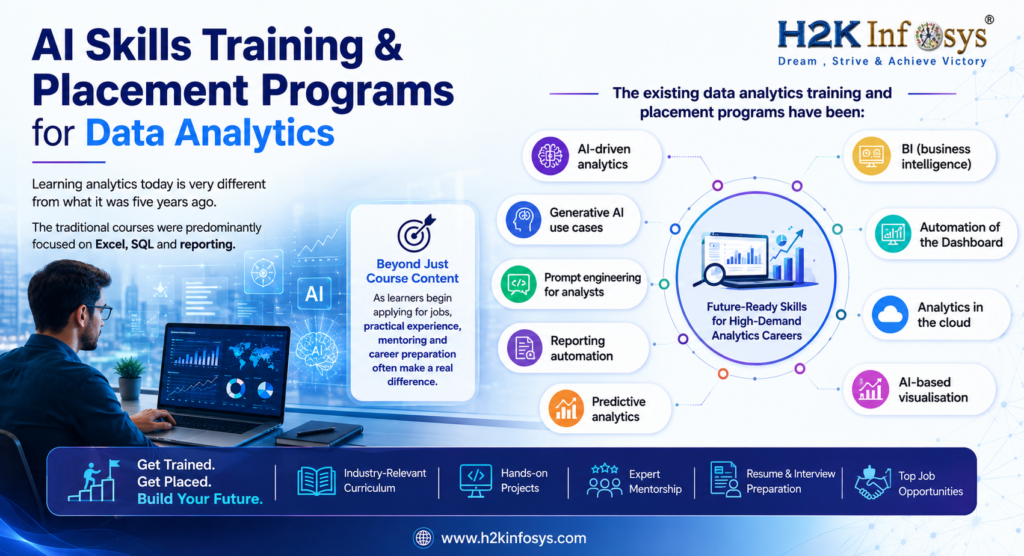
- AI-driven analytics
- Generative AI use cases
- Prompt engineering for analysts
- Reporting automation
- Predictive analytics
- BI (business intelligence)
- Automation of the Dashboard
- Analytics in the cloud
- AI-based visualisation
When comparing different providers it’s worth looking beyond just the course content. As learners begin applying for jobs, practical experience, mentoring and career preparation often make a real difference.
Reasons why H2K Infosys is often on the list of top training providers for AI Data Analytics training is that the course includes live instructor-led classes, hands-on projects, Generative AI concepts, resume preparation, mock interviews, and career support. The program is not just about software demos, but rather about applying analytics techniques to realistic business situations, giving learners the experience employers often seek.
For beginners, taking up structured Data analytics classes online can also provide the flexibility of learning while managing work or other commitments, especially if the syllabus has practical assignments and project-based learning.
4. Salaries for AI Data Analytics Continue to Rise
Many professionals switch careers to AI Data Analytics, and one of the reasons is the strong earning potential.
“There is a lot of money being poured into AI initiatives, but technology alone does not deliver business value. They still need skilled analysts to interpret the results, evaluate the quality of the data and turn the findings into recommendations that can be acted on.”
Analytics and AI skills also give professionals more job titles to choose from, such as:
- AI-enabled Data Analyst
- Business Intelligence Analyst
- Analytics Consultant
- Reporting Specialist
- Decision Intelligence Analyst
In the upcoming section, we will compare the best data analytics training and placement options, discuss salary trends, real-world AI projects, and how to choose the right learning path for long-term career growth.
5. AI Data Analytics Solves Real Business Problems Not Just Reporting
One of the most profound changes in the world of analytics is the move from descriptive reporting to intelligent decision making.
”Companies don’t want analysts to tell them what happened yesterday, they want people who can tell them what’s going to happen next and what they ought to do.”
That’s where AI Data Analytics comes in.
Picture an online retailer that suddenly sees a decline in sales. Rather than manually looking through thousands of transactions, an AI-powered analytics system can swiftly spot unusual buying patterns, point out affected product categories and even suggest possible reasons. The analyst then confirms those findings, considers business context and recommends practical actions.
This mix of AI speed and human expertise creates real business value. The professionals who go through data analytics training and placement programs along with hands-on AI projects, usually build confidence in solving such challenges even before stepping in the job market.
6. AI Data Analytics Enables Ongoing Learning
One of the reasons why AI Data Analytics is a future-proof career is that technology is evolving rapidly. AI tools, visualisation platforms and automation features are being added regularly. That might sound like a lot to take on at first, but it also means there’s an opportunity for professionals to continue developing their skills and stay up to date.
The tools that analysts today are expected to work with include:
- Microsoft Excel
- SQL
- Python
- Power BI
- Tableau
- Microsoft Copilot
- Chat GTP
- Google Gemini
- The Cloud Analytics Platform
Learning these tools together, not separately, allows professionals to understand how AI supports the entire analytics process.
Many learners prefer to take Data analytics classes online now, as they can continue to develop their new skills without interrupting their careers.
7. Employers Prefer Practical Experience Over Theory
The certificate is useful but employers tend to ask a different question in interviews:
“Can you solve real business problems?”
That’s why project-based learning has become so important in AI Data Analytics education.
Strong portfolios often feature projects such as:
- Forecasting customer churn
- Sales forecasting dashboards
- Analysis of marketing campaign
- Reporting on healthcare performance
- Analysis of Fraud Detection
- Inventory optimisation in retail
- Financial trends visualization
- HR workforce analytics
These projects show technical skills, but also an understanding of business objectives.
8. AI Data Analytics: Open the Door to Diverse Career Opportunities
One of the best things about AI Data Analytics is that you don’t have to be tied to one job title, With companies investing heavily in AI and digital transformation, analytics professionals have a variety of roles to choose from.
Popular career options include:
- Business Intelligence Analyst
- AI Data Analyst
- Data Analyst
- Analytics Consultant
- Marketing Analyst
- Product Analyst
- Reporting Analyst
- Operations Analyst
- Financial Analyst
- Healthcare Data Analyst
- Decision Intelligence Analyst
Many professionals begin their career as junior analysts, and with experience in business strategy, AI tools and communicating with stakeholders, they move into leadership positions.
AI Data Analytics is also flexible, this makes it easier to move into a new career. If you work in finance, healthcare, retail, or logistics, online Data analytics classes can often help you develop analytics skills while applying your industry knowledge.
9. AI Data Analytics Supports Better Business Decisions
But data alone does not create value. It’s the decisions you make from that data that do.
Today businesses are using AI Data Analytics to answer questions like:
- What will sell next month?
- Who can end their use of our services?
- Where are operating costs increasing?
- The best back to school marketing campaigns?
- How can we serve our customers better?
AI can crunch massive amounts of data in minutes, but experienced analysts bring the business context that turns numbers into actionable advice. That’s why employers increasingly seek people with technical skills and the ability to communicate and think critically.
10. AI Data Analytics Is Designed for Long-Term Career Growth
Technology will continue to evolve, but the need for data analysis, solving business problems and strategic guidance isn’t going away. In fact, AI is making analytics even more important.
Organisations are collecting data at a previously unimaginable pace, and somebody has to make sure that data is accurate, relevant and useful. Analysts who know how to use AI tools, and still have strong analytical thinking skills, will likely be in demand for years to come.
That’s why so many professionals are betting on data analytics training and placement programs that emphasise hands-on experience over theory. Real projects, business case studies and mentoring from industry prepare learners for the changing expectations of the workplace.
Career Path to a Successful Career in AI Data Analysis
If this is a new field for you, having a course of study can make all the difference.
- Step 1: Get the basics of your data correct
- Develop a solid understanding of Excel, SQL, statistics and data visualisation.
- Step 2: Master Analytics Tools
- Hands on experience with Power BI, Tableau, Python and Database management.
- Step 3: Learn about AI use cases
- Discover how Generative AI, automation tools and AI-assisted analytics can boost productivity without replacing analytical thinking.
- Step 4: Building a Portfolio
- Hands on projects with real world data sets, Dashboards, Forecasting models and Business reports.
- Step 5: Prepare for Interviews
- Resume writing, mock interviews, LinkedIn profile optimisation, communication skills.
Many training providers combine these components into a single program that enhances learners’ ability to transition into analytics careers.
Amongst all the choices, H2K Infosys AI Data Analytics Training provides a practical approach with live instructor-led sessions, real-time projects, Generative AI concepts, career mentoring, resume preparation, mock interviews, and H2K Infosys Job Placement support. If you are a learner who wants to take online Data analytics classes, this structured learning environment can help you build confidence to prepare for real job responsibilities.
Short Summary:
Is AI Data Analytics a good career option? Yes it is.
And that’s why:
- AI is not replacing data analysts, it is changing the role.
- AI-powered insights are driving every industry.
- There is good demand across healthcare, finance, retail, manufacturing, logistics and technology.
- Employers want real-world projects and business problem solving.
- Analytics and AI skills are great long term career opportunities.
- Structured data analytics training and placement programs help learners acquire job-ready skills.
- Online Data analytics classes are now offered making it easier for working professionals and beginners to upskill.
Frequently Asked Questions (FAQs)
What is AI data analytics?
AI Data Analytics is the combination of machine learning and artificial intelligence technologies with traditional data analytics to automate repetitive tasks, make better predictions, find patterns, and make business decisions more quickly.
Is AI Data Analytics a good career in 2026?
Yes. AI Data Analytics continues to be one of the fastest-growing career fields because organizations across industries are investing in AI-powered decision-making and need professionals who can interpret data accurately.
Conclusion
AI Data Analytics is more than just another technology trend it represents the future of how organizations make smarter, faster, and more informed decisions. As AI continues to reshape industries, professionals who understand both analytics fundamentals and AI-powered tools will remain valuable across a wide range of business functions.
Whether you’re a recent graduate, a working professional planning a career change, or someone looking to expand your technical skills, investing in AI Data Analytics can create long-term opportunities. Choosing comprehensive Data analytics training and placement programs and flexible Data analytics classes online that include practical projects, AI-focused learning, and career guidance can significantly improve your readiness for today’s competitive job market.