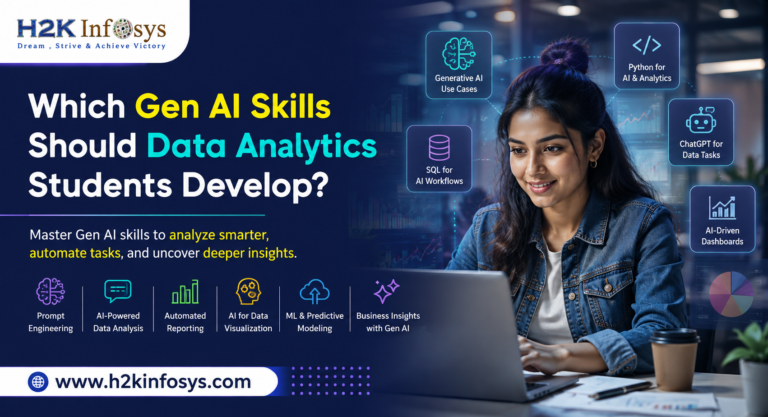
Data Analytics students must master five practical Gen AI skills: prompt engineering, AI-assisted SQL and Python, AI-powered data preparation, intelligent visualisation, and responsible AI validation. The real advantage for learners taking Data analyst online classes with Gen AI is to combine these skills with strong analytical fundamentals, rather than treating Gen AI as a replacement for analytical thinking.
That makes a difference.
Top 5 Gen AI Skills for Students of Data Analytics
A student who can tell an AI tool to write a SQL query is valuable. A student that can explain why the query is right, spot a misleading result, improve the data model and turn the result into a business recommendation is much more valuable.
Gen AI is transforming analysts’ work. For example, Microsoft’s most recent documentation on Power BI shows Copilot being used for report summaries, natural language questions, semantic models, and DAX generation. Tableau has added generative AI capabilities for data prep, calculations, visualisations and conversational analytics as well.
So what should students really be studying?
| Rank | Gen AI Skill | Why It Matters in Data Analytics | Example |
| #1 | Prompt Engineering | allows analysts to speak with AI tools | Create SQL, analysis plans |
| #2 | AI-Driven SQL & Python | Speed up coding and debugging | Develop and improve queries |
| #3 | AI-Driven Data Preparation | Reduce repetitive cleaning work | Detect missing values and anomalies |
| #4 | AI Visualisation & Storytelling | Translates findings into understandable insights | Construct dashboard narratives |
| #5 | Responsible AI & Validation | Prevent inaccurate conclusions | Validate AI-generated results |
These five areas provide a practical starting point for students who want to become modern AI-enabled analysts.
1. Prompt Engineering for Data Analysis
You only realise how simple it is once you start using prompt engineering.
In practice, it’s learning to provide an AI system with enough context to produce a useful output.
A feeble prompt could be:
“Think over this sales info.”
The prompt should include the business goal, the columns available, the audience, the time period, and the output type needed.
For instance:
“Look at the monthly sales by region, which three regions have the largest decline in sales year over year, what are some possible patterns and what are five questions that an analyst should ask before making a business recommendation.”
That is a whole different level of instruction.
Students under Data analytics training with Gen AI should practise prompts for SQL generation, data cleaning, exploratory analysis, dashboard explanations, documentation, and business summaries.
The important thing to remember is not memorising hundreds of prompts. The trick is learning to think clearly enough to give the AI the right problem.
What students need to practise
- Crafting context-aware prompts
- Giving AI explicit business goals
- Explicitly ask for assumptions
- Ask for other methods
- Having AI explain its thinking or method
- Refining prompts after checking the first response
- Using structured output formats
- Asking AI to find limitations
This is particularly useful when you need to process huge amounts of data or do the same analysis repeatedly.
2. AI-Powered SQL & Python
SQL remains one of the most practical technical skills for an analyst. Gen AI does not eliminate that need.
Instead it can be a powerful coding assistant.”
Microsoft’s existing Power BI documentation describes Copilot as supporting DAX generation and other analytical workflows.
Imagine a student gets a business request:
Please provide the top five products by revenue for each region for the last 12 months.
Rather than spending 30 minutes trying to recall the precise window-function structure, the student can simply ask an AI assistant for an initial draft.
But here is the catch, don’t just copy the query blindly.
The student should be proficient enough in joins, aggregation, filtering, window functions, subqueries, CTES, and performance considerations to be able to verify the generated SQL.
It’s the same with Python.
AI is able to help students
- Generate Pandas code
- Handling errors in Python
- Give me data cleaning methods.
- Write scripts for exploration analysis
- Generate visualisations
- Unknown function description.
- Remove duplicate code
- Create test cases
A good analyst uses AI to go faster, not to dodge learning Python or SQL.
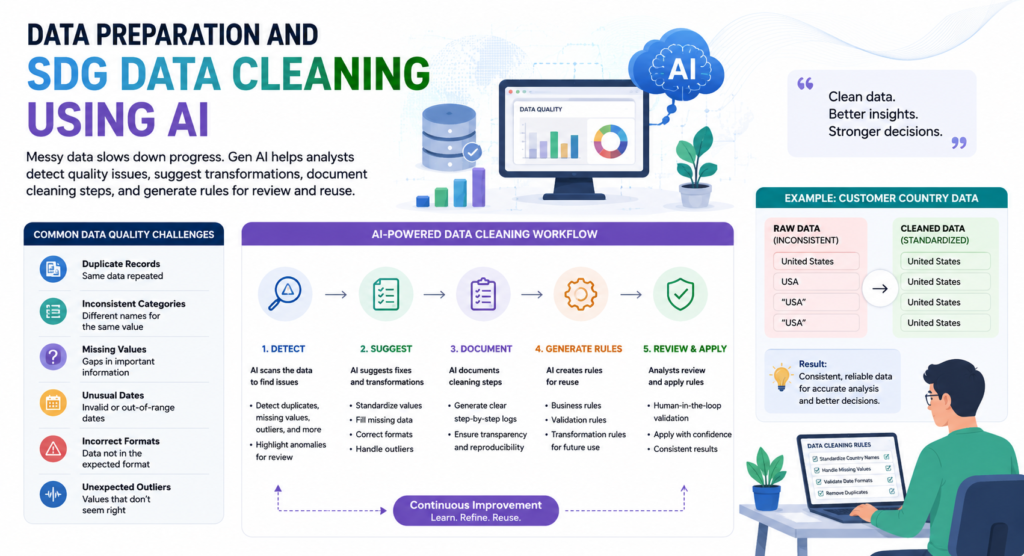
3. Data Preparation and SDG Data Cleaning Using AI
If you ask seasoned analysts about their daily work, you hear one thing over and over again: messy data takes up a lot of time.
Duplicate records, inconsistent categories, missing values, unusual dates, incorrect formats, and unexpected outliers can turn a simple project into a frustrating one.
This is where Gen AI is able to make a difference.
Students can learn how to use AI to find potential quality problems, suggest transformations, document cleaning steps and generate rules to be reviewed and put into action later.
For example, say you have a customer dataset:
- United States
- “USA”
- “USA”
- “USA”
An AI assistant can immediately see the inconsistency and suggest a way to standardise it.
But the analyst still needs to determine what the correct business rule should be.
That human judgement matters.
Microsoft points out that the AI-driven Power BI reports need the data and semantic models to be correctly prepared. Poor preparation can result in lower-quality or misleading outputs.
That’s a useful lesson for students: AI-ready analytics begins with good data.
A practical student project
By using a public e-commerce dataset and Gen AI for:
- Discover patterns of missing values.
- Find inconsistent category names.
- Suggest duplicate record check.
- Create SQL or Python cleansing logic.
- Manually validate the cleaned dataset.
- I have recorded every change.
That’s worth a lot more than saying, “I know chatgpt.”
They are able to show a real analytical workflow
4. Storytelling with Data and Visualising Using AI
A dashboard doesn’t work simply because it has nice charts.
Someone has to know what the numbers mean.
That’s why Data Analytics students still need visualisation and storytelling skills, even as AI becomes more capable.
Tableau’s current AI features are focused on assisting with data prep, calculations, questions, summaries and visualisation. Tableau Agent can empower users to explore data and create visualisations through conversational engagement.
It can also provide report summaries and answer questions about report data in Power BI.
So students should be taught to do it with the features.
For instance, an analyst might ask:
“What are the biggest revenue changes this quarter?”
The AI could identify a drop in one area.
The analyst’s job is to investigate:
- Did the decrease come from fewer customers?
- Did the price differ?
- Was there a supply problem?
- Any large customers dropping out?
- Is this a good comparison period?
That’s where the real Data Analytics comes in.
Students need to learn:
- Pick the correct chart for the question
- Be wary of AI-generated narratives
- Detect misleading graphics
- Explanation of Plain Language Trends
- Build executive friendly dashboards
- Link measures to business decisions
Simply put, don’t let AI tell the story for you. Let it show you the possibilities.
5. Data Governance, Validation & Responsible AI
This is perhaps the most underappreciated Gen AI skill on the list.
Artificial intelligence is able to generate plausible but incorrect answers.
Microsoft explicitly warns that Copilot outputs can be non-deterministic and must be evaluated and validated by users.
This means students need to develop the habit of checking the work produced by AI.
The analyst in question would ask:
- Are the data correct?
- Did you calculate that right?
- Are the assumptions tenable?
- Perhaps the AI misunderstood the question.
- Does the answer make business logic?
This is even more so with customer information, financial data, healthcare information or confidential company data sets.
Students need to know the basic ideas such as:
- Privacy of data
- Access Control
- personal information
- Model Constraints
- Hallucinations
- Bias
- Governance of data
- Human review
- Replicability
AI skills that aren’t applied responsibly can cause more problems than they solve.
H2K Infosys Data Analytics Training with AI: What Should Students Look For?
Selecting Data analyst online classes with Gen AI should not be solely based on a course that mentions using tools like ChatGPT or other AI tools.
Consider the full learning experience.
For students who want training that combines core analytical tools with newer AI-assisted workflows, a practical provider such as H2K Infosys can be relevant. The focus should be on experiential learning, live projects, instructor led guidance, career mentoring, resume making, mock interview and placement support.
What to expect in H2K Infosys Data Analytics with AI Training
| Training Field | What Must Be Obtained by Students |
| Core analytics | Excel, SQL, statistics, reporting |
| Visualisation | Tableau, Power BI |
| Programming | Python and analysis libraries |
| Generative AI | Prompting & AI-assisted workflows |
| Projects | Real business situations in the world |
| Career preparation | Resume and interview prep |
| Mentoring | Support during the learning process |
| Job support | Placement and career guidance. |
It’s not about any one tool, but the combination.
A student may know Power BI but struggle to explain a dashboard. Another may know Python but not understand business requirements. Maybe someone else is good at prompting, but they can’t check an AI-generated result.
Rather than treating Gen AI as a standalone topic, such gaps should be closed by a strong H2K Infosys Generative AI Course approach.
H2K Infosys – Career Support and Job Readiness
Employability has a lot more to do with technical knowledge.
Students should be able to present projects, explain analytical decisions, answer interview questions based on scenarios and communicate with non-technical stakeholders.
That’s where H2K Infosys Career Support can help in the learning process with resume preparation, mock interviews, mentoring and job placement assistance.
The crucial thing is to make learning evidence.
Rather than saying:
“I know AI & Data Analytics.
A candidate should be able to:
“I develop the sales dashboard, analyse customer behaviour with SQL, accelerate exploratory analysis with Gen AI, validate the results, and provide three recommendations to enhance regional performance.”
That sounds like work.
Generative AI Project Ideas for Data Analytics Students in the Real World
Don’t make every project a cookie-cutter sales dashboard if you’re building a portfolio.
Try projects that demonstrate how AI fits into the analytical process.
1. AI Supported Customer Churn Analysis
Use customer transactions to detect trends of churn.
Gen AI is able to help generate SQL, explain segments, suggest questions, create an initial analysis plan.
Your job is to validate the findings and recommend retention strategies.
2. AI-Driven E-Commerce Dashboard
Build a Power BI Dashboard to measure revenue, profit, customer segments, product performance, and regional trends.
Use AI features to generate summaries and review each key finding manually.
3. Marketing Campaign Analysis
Look at campaign data to find out which channels are giving you the best return.
Leverage Gen AI to help find patterns and generate hypotheses, but back up any recommendations with real calculations.
4. Analysis of the Employee Turnover
Analyse an anonymised HR dataset to find out what makes employees leave.
This is a good project for responsible AI as students can talk about bias, privacy and limitations.
Career Outcomes: Where can these skills lead you?
Gen AI with traditional Data Analytics skills can prepare students for roles such as:
- Data Analyst & Data Scientist
- Business Analyst
- Business Intelligence Analyst,
- Reporting Analyst
- Product Analyst II
- Marketing Analyst.
- Operations Analyst
- Analytics Consultant – Junior
The exact title is different at each company.
Salary is also very location, experience, industry and technical depth dependent. According to Indeed, as of July 2026, the average U.S. The average base salary for a Data Analyst is $86,545 a year, with a range reported from $53,699 to $139,481. These numbers are based on recent salary data from job postings and are intended to serve as a market indicator rather than a guarantee of outcome.
Generative AI skills alone will not get you a higher salary. Employers still want SQL, analytical thinking, communication, domain knowledge, visualisation and project experience.
An Easy Learning Roadmap for Students
If you’re starting fresh, don’t try to learn every AI tool at once.
A natural evolution would be:
- Step 1: Learn Excel and basic stats.
- Step 2: Build up strong foundations in SQL.
- Step 3: Familiarise yourself with Power BI or Tableau.
- Step 4: Use Python for analysis and automation
- Step 5: Learn about prompt engineering.
- Step 6: Leverage Gen AI for SQL, Python, clean-up and documentation
- Step 7: Learn AI-assisted visualisation and story telling
- Step 8: Validate, privacy protection & responsible AI.
- Step 9: Develop three to five portfolio projects.
- Step 10: Assemble your resume and practise interviews.
This sequence avoids a common pitfall: learning AI before knowing the analytical problem you are trying to solve.
FAQ’s
What are the first Gen AI skills students of Data Analytics should learn?
Some good starting points include prompt engineering, AI-assisted SQL and Python, automated data preparation, AI-powered visualisation, and validation of responsible AI. The students should learn these skills along with the traditional Data Analytics basics.
Are Gen AI Data analyst online courses good for beginners?
Yes, if it’s core analytics, not just AI tools. Beginners need to learn SQL, Excel, visualisation, statistics and basic Python plus Gen AI workflows.
Is Data Analytics Jobs Being Taken Over by Gen AI?
Gen AI is changing many analytical workflows, especially the repetitive coding, summarisation, exploration, and reporting tasks. But analysts still have to understand business questions, validate the results, communicate the findings and make solid decisions.
What to Expect from Data analytics training with Gen AI?
Look for hands-on projects, SQL, Power BI or Tableau, Python, data cleaning exercises, prompt engineering, AI-assisted analytics, responsible AI, instructor mentorship, career coaching, resume building, mock interviews and job placement support.
What is the H2K Infosys Data Analytics with AI Course?
The H2K Infosys Data Analytics with AI Course has been created based on practical learning of analytics integrated with modern AI skills. Students should assess if the curriculum includes core analytics, projects, Gen AI applications, mentoring, and career prep.
What is the H2K Infosys Job Placement assistance?
H2K Infosys Job Placement support is designed to help learners transition from training to employment with career-oriented preparation and placement support. Students should consult the provider for current program terms and services.
Why is responsible AI important for Data Analytics?
Because AI-generated answers can be wrong, incomplete or based on incorrect assumptions. Analysts need to verify calculations, understand data quality, protect sensitive data and employ human judgement prior to presenting conclusions.
Final thoughts
The future of Data Analytics is not simply about knowing which AI button to push.
It is about being the person who knows what question to ask, what data to trust, how to investigate the answer, and how to interpret what it means.
Gen AI is able to speed up analysts. It can help generate SQL, explain code, summarise dashboards, discover patterns and automate repetitive work. These AI-assisted workflows are already emerging as part of mainstream analytics platforms in today’s Power BI and Tableau.
The smartest thing students can do is to build strong fundamentals first and then layer on Gen AI skills.
This is also the philosophy behind effective H2K Infosys Data Analytics with AI Training combine practical analytics knowledge with modern tools, projects, mentoring, interview preparation and career support.
Whether you choose H2K infosys or any other provider, look beyond the name of the course. Ask about what you’ll actually be building, what datasets you’ll be working with, how much hands-on practice there is, and if you’ll learn how to validate AI-generated results.