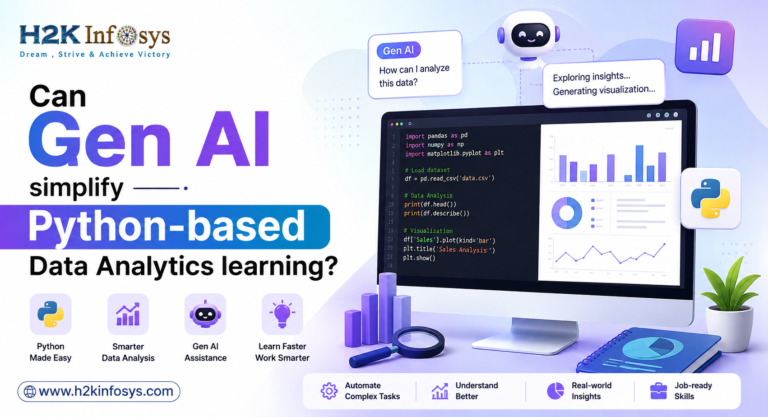
Yep. Gen AI is able to help beginners understand code, debug errors, practise with datasets, explain statistical concepts and build small projects faster, thus making Python-based Data Analytics easier to learn. But the best use is as a learning assistant, not to replace an understanding of Python, statistics, data cleaning and business reasoning.
The distinction is important. By 2026, AI-assisted coding will be a normal part of analytics workflows. “In a 2026 State of Analytics Engineering report from dbt Labs, 72% of those surveyed said AI-assisted coding was a top priority, but 71% said they were still worried about bad or hallucinated data making its way to stakeholders.
So, Can Gen AI Simplify Learning Python Based Data Analytics? Sure, but the smartest thing is to use AI to learn why something works, not just to copy the output.
5 ways Gen AI may make learning data analytics with Python easier
1. Gen Artificial Intelligence Can Take Some of the Fear Out of Python
For a beginner in Data Analytics, Python can seem complex at first.
Variables, loops, functions, lists, dictionaries, libraries, DataFrames, errors and rules of syntax you will see very soon. It’s easy to think, “Maybe Python isn’t my thing”.
Gen AI changes that initial experience.
A student might say:
“Explain pandas DataFrames to me like I’m a complete beginner to Python.
Follow up with:
Sell me something Give me a simple sales pitch
Then:
“Give me three exercises to hammer this in.”
This makes for a much more interactive learning experience than just reading a chapter and hoping it all sticks.
This matters for Data Analytics students because Python is generally learned with a purpose. You are not learning programming to be a software developer. You’re being trained on it to clean data, investigate patterns, calculate metrics and communicate findings.
2. It Can Explain Python Code Line by Line
Code explanation is one of the most useful applications of Gen AI.
Let’s say a beginner is given this pandas operation:
sales.groupby(['region'])['revenue'].sum()
Someone with an experience in Data Analytics might get it at once. A novice may not.
Gen AI is able to break it down:
- groupby() groups the records by region
- Selects the column revenue [“revenue”] .
- .sum() outputs total revenue for each region.
The explanation ties Python syntax to a real business question.
Students learn the logic behind commands rather than just memorising them.
That is a much more healthy way of learning Data Analytics.
3. More Interactive Debugging
Errors are part of the learning process in python. There’s no getting away from them.
A missing bracket, an incorrect column name, a wrong data type, or an indentation problem can prevent an entire notebook from running.
Gen AI is able to help a learner understand the error and suggest possible solutions.
For example, let us say, a student receives:
KeyError: 'Revenue'
Instead of just telling AI to “fix it,” the learner can ask:
Why am I getting this KeyError? How can I verify that the column name exists?”
That second question matters.
It encourages troubleshooting, not dependency.
In practical Data Analytics work, knowing how to investigate an error is often more valuable than writing perfect code the first time.
4. How Gen Artificial Intelligence Can Help Convert Messy Data Into Practice Exercises
A beautifully organised spreadsheet is rarely the start of Real-world Data Analytics.
You might get missing values, duplicate rows, inconsistent dates, odd category names and numbers as text.
Gen AI is able to assist learners in creating practice scenarios for these problems.
For instance:
Scenario: An online retailer has 5 years of transactional data.
The learner can ask the Gen AI to suggest:
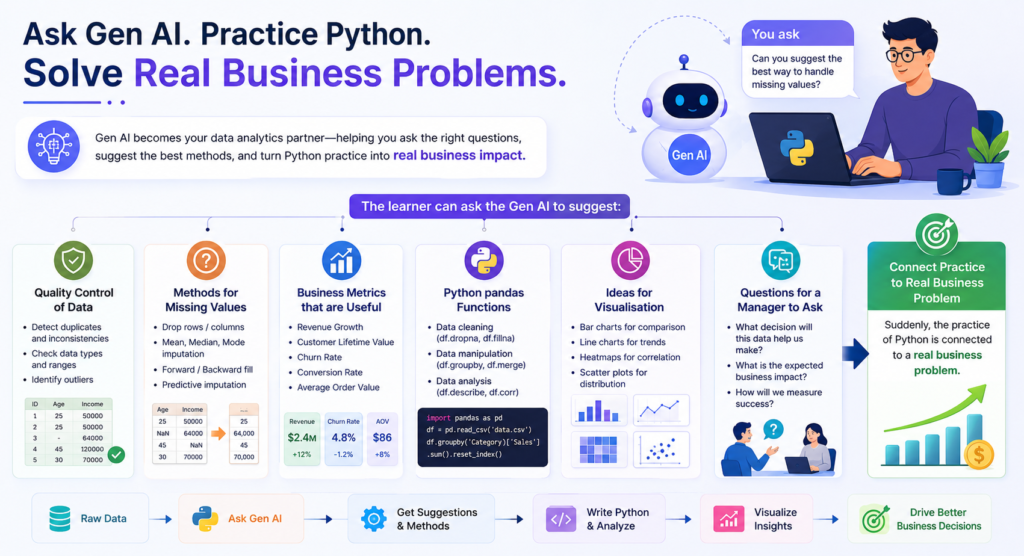
- Quality control of data
- Methods for missing values
- Business metrics that are useful
- Python pandas functions
- Ideas for visualisation
- Questions for a Manager to Ask
Suddenly, the practice of Python is connected to a real business problem.
One of the reasons why an Online Data Analytics Course with Gen AI may be useful is when the course curriculum is based on practical exercises and not just on showing AI prompts.
5. It can Accelerate Visualisation Learning
Another area where Gen AI may help is visualising data.
A learner might have a DataFrame of monthly sales and ask:
“What chart would best show monthly revenue trends and why?”
The answer could be line charts, bar charts, seasonality and comparisons.
After that the learner can go on to construct the visualisation using Python libraries like Matplotlib.
The trick is not to let AI automatically choose every chart.
Ask why the particular visualisation communicates the message more effectively.
That small habit makes a huge difference in Data Analytics, because a technically correct chart can still tell the wrong story.
What Gen AI Should NOT Do for Data Analytics Learners
There’s a catch here.
Gen AI writing every Python script, explaining every error, and doing every assignment can actually make learning weaker.
A student might do a project but not be able to say what the code is doing.
That’s the problem in interviews.
A hiring manager might ask:
Why did you use a left join here?”
Knowing the code was suggested by an AI is not good enough.
The improved learning cycle is:
Try → Get stuck → Ask AI → Understand → Tweak → Test → Explain
Not:
Copy → Submit Prompt
That should be the differentiator of any serious Data Analytics Certification with Generative AI.
How to Incorporate H2K Infosys Training in This Learning Approach
Gen AI may be more useful when there is a structured training environment, because learners still have an instructor, projects and a learning roadmap around the technology.
H2K Infosys Data Analytics with AI Training can be customised in such a way that hands-on learning can be done where Python, analytics concepts and new AI capabilities are part of the course and not taught as separate subjects.
That structure can help answer questions Gen AI alone can’t always handle well for a beginner:
- What is the first thing I should learn in Python?
- How much statistics do I really need?
- What projects should I put on my resume?
- How do you explain a dashboard in interview?
- Does my analysis make sense?
- How do I give business recommendations?
These are questions in human-led learning.
The bigger lesson is simple, Gen AI is able to accelerate practice but mentoring helps set direction.
What to Expect from H2K Infosys Data Analytics with AI Course
When considering training options, look beyond the words “AI-powered.”
Ideally a useful course should include:
| Learning Area | What Students Should Be Looking For |
| Python | pandas, NumPy, clean and analyse data |
| Data Analytics | Business questions, actual datasets |
| Visualisation | Clear charts, dashboards and stories |
| Gen AI | Prompting, code help and analysis workflows |
| Projects | Hands-on portfolio-ready projects |
| Career Support | Mock Interview & Resume Building |
| Mentoring | Support when students get stuck |
This is where H2K Infosys Career Support can add value for the learners who want a structured path rather than completely self-study.
A Practical Workflow for Gen AI + Python Data Analytics Learning
Here is an easy way I would recommend to a beginner.
- Step 1: Learn Python Basics
- Begin with variables, conditions, loops, functions, and simple data structures.
- Don’t skim these just because they look easy.
- Step 2: Move on to pandas and NumPy 2.
- Once you have the fundamentals down, get into DataFrames, filtering, grouping, merging and missing values.
- Step 3: Use Gen AI as Your Tutor
- Employ AI to comprehend unknown code and generate exercises.
- Don’t ask it to do your project immediately.
- Step 4: Handling Real Datasets
- Test customer transactions, marketing campaigns, employee data, product sales, or web activity.
- Step 5: Create Visualisations
- Discover patterns and trends with Python.
- Then, describe what those patterns mean in business terms.
- Step 6: Challenge the AI Output
- This step is often skipped.
- Do the maths. Examine assumptions. Try out the code. Search for misinterpretations.
- This is particularly relevant in the 2026 analytics landscape as AI adoption accelerates and concerns around trust and governance accelerate.
- Step 7. Create a Complete Project
- Something like this might be a good first project:
- Business question Data collection Cleaning Exploration Insight Recommendation Visualisation
This is far more like the real Data Analytics work than stand-alone Python exercises.
Real World Example: Using Gen AI on Sales Data
You have a learner. You give it an e-commerce data with:
- Date of Order
- Customer address
- Product category
- Amount
- Revenue
- Sale
- Make money
The learner could be asked a series of questions rather than telling the Gen AI to “analyze this dataset.”
- Question 1: Which columns require cleaning?
- Question 2: Are there any missing or duplicate records?
- Question 3: Which product types are the most profitable?
- Question 4: Is discounting connected with profit?
- Question 5: Unusual sales patterns in which months?
- Question 6: What should the business look into next?
Gen AI is able to support generating python approaches for each question.
But it is the learner who decides whether the result makes sense.
That final judgement is the essence of Data Analytics.
Gen AI: Do We Still Need to Learn Python?
No. It’s changing the way Python is used.
The more recent industry conversation has been around AI-assisted coding rather than displacing people from analytical workflows altogether. AI-assisted coding is part of daily workflows, but trust and governance challenges highlighted in 2026 analytics engineering report.
The June 2026 edition of Python Data Analysis also reflects the evolution of the field, combining traditional Python analytics with machine learning, GenAI, LLMs, and data engineering topics.
So, simply put, the skill goes from:
Can you write every line of code manually?”
toward:
“Are you able to understand, evaluate, adapt and responsibly implement code to analytically solve a problem?”
That’s a much more useful skill for today’s Data Analytics professionals.
Career Outcomes: Why Python & AI Skills are Important
The career picture also helps explain why learners are adding AI capabilities to their analytical tools.
Operations research analysts had a median annual wage of $91,290 in May 2024, according to the U.S. Bureau of Labour Statistics. Employment is projected to grow 21% from 2024 to 2034, much faster than average.
That number should not be taken as a guarantyd Data Analytics salary. Compensation is dependent on job titles, experience, location, industry and technical skills.
Still, it speaks to a greater need for professionals who can use analytical and quantitative techniques to solve business problems.
But for those considering U.S. opportunities, a mix of Python, SQL, visualisation, business understanding and responsible AI usage can make for a more robust skills profile.
Career preparation must therefore include more than certificates.
All of projects + technical skills + communication + interview readiness matter.
H2K Infosys Generative AI Course & Career Guide
If you are a learner looking at H2K Infosys Generative AI Course options in addition to Data Analytics training, the helpful question is not just, “Does the course teach Gen AI?”
Ask:
- Can AI help me learn Python better?
- Will I work on real-world datasets?
- Can I describe my projects without the help of AI?
- Do I learn to solve problems analytically?
- Do you have career mentoring?
- Do you offer resume and mock interview services?
- May I include my work in a portfolio?
A training provider gets more useful when these pieces fit together.
For example, the support of H2K Infosys Job Placement should be seen as a part of a larger career-preparation process instead of a replacement for the development of technical ability.
5 Practical Skills to Build Alongside Gen AI
If you are learning Python for Data Analytics in 2026, then focus on these five things:
| Skill | Why It Matters |
| Python | Automates cleaning, analysis and repetitive tasks |
| SQL | Essential for working with structured business data. |
| Visualisation | Turns findings into stories that can be understood |
| Statistics | helps to tell meaningful patterns from noise |
| Gen AI literacy | Boosts coding, exploration and documentation |
The strongest learners are not necessarily the ones who know the most AI prompts.
They will be the people who can take these skills and still think for themselves.
Data Analytics with Gen AI FAQs
Can Gen AI make learning Data Analytics based on Python easier?
Yeah. It can explain Python concepts, generate practice exercises, troubleshoot errors, suggest approaches to analysis and help learners understand unfamiliar code. However, students should also check the output of AI and develop their own analytical reasoning.
Is Gen AI Data Analytics Certification helpful for beginners?
The certification can be useful when it blends foundational analytics with practical Python, SQL, visualisation, projects, and responsible AI usage. Having a certificate does not mean you have a job.
Is Gen AI Online Data Analytics Course better than traditional learning?
not in the first place The choice depends on the quality of the course, the support of the instructor, hands-on projects, curriculum, and career preparation. The greatest benefits of Gen AI are in augmenting the learning experience, not replacing it.
If Gen AI is able to write code, do I need Python anymore?
Affirmative. You should be able to read, test, debug and change the generated code well enough to understand python. AI-generated code can contain errors and analytical decisions still require human judgement.
Can Gen AI help in data analytics projects?
Yes. It can help brainstorm project questions, explain code, identify possible analytical techniques, and suggest visualisation approaches. The learner must still check the analysis and take responsibility for the final conclusions.
What to Look for in Data Analytics Training with Gen AI
On the menu: Practical projects, Python and SQL training, visualisation, statistics, instructor guidance, Gen AI applications, career mentoring, resume prep & mock interviews.
Final Thoughts
Gen AI will certainly make learning Python-based Data Analytics simpler – but it should make learning interactive, not make learning optional.
Use it when Python looks complicated. use when an error doesn’t make sense Use it to create practice questions, investigate alternative methods, and learn about concepts you don’t know.
Try the problem yourself then close the AI window.
This is where the real skill comes in.”
When comparing options such as Online Data Analytics training with Gen AI, the best option for learners is likely to be a combination of structured instruction, practical projects, career mentoring and responsible AI usage.
When considering H2K Infosys Data Analytics with AI Course options, the real value is in how well the training links Python, analytics, Gen AI and career readiness together into a single practical learning experience.