Most structured Cyber Security Training Online programs, including H2kinfosys, include foundational coverage aligned with major industry certifications such as CEH, CISSP, and CompTIA Security+. These certifications represent widely recognized knowledge frameworks used across enterprise security teams. In many cyber security training with job placement–oriented programs, learners are introduced to certification domains, exam objectives, and real-world security workflows that map to these standards, even if the course itself is not an official industry certifications provider.
What Is Coverage of CEH, CISSP, and Security+ in Cyber Security Training Online?
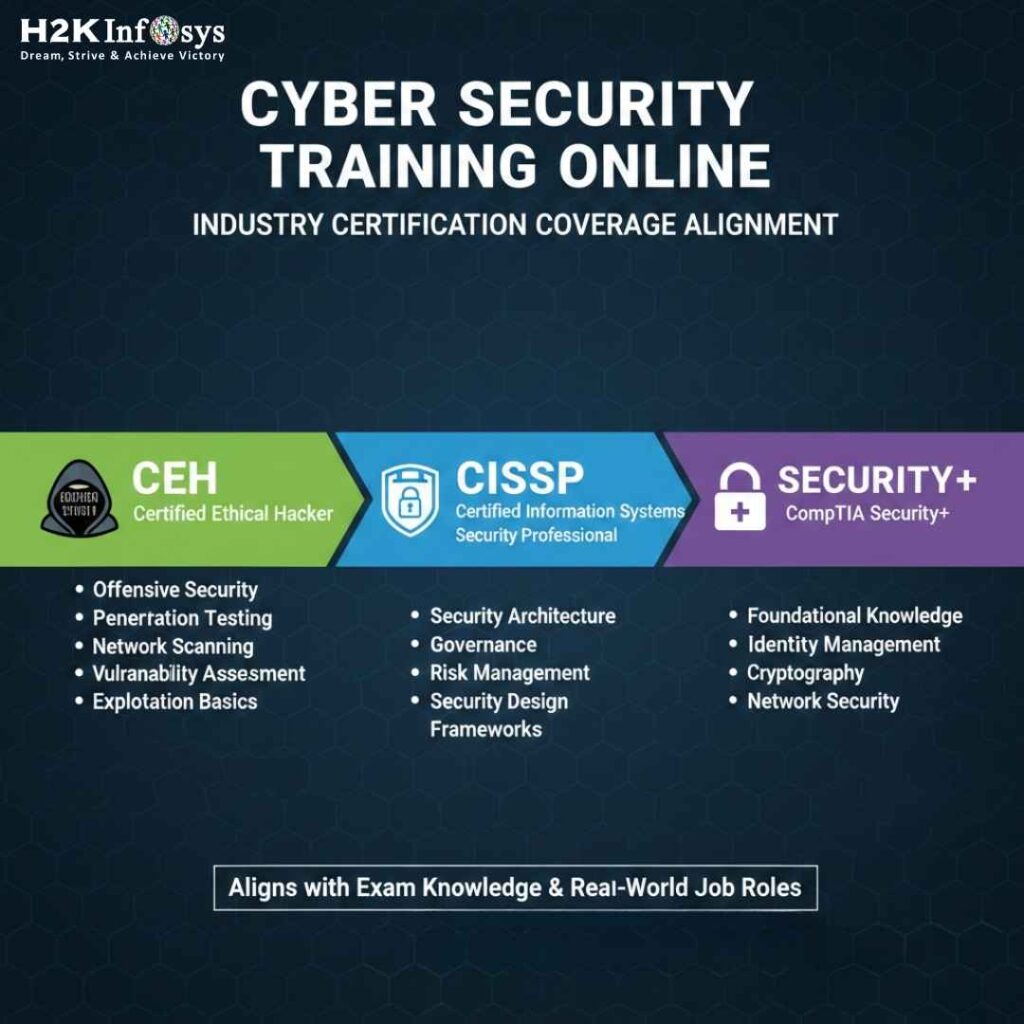
Industry certifications coverage typically means the training aligns with the knowledge domains, security frameworks, and practical skills required for industry certifications exams and real-world job roles.
Common Certification Alignment Areas
| Certification | Focus Area | Typical Training Coverage |
| CEH (Certified Ethical Hacker) | Offensive security, penetration testing | Network scanning, vulnerability assessment, exploitation basics |
| CISSP (Certified Information Systems Security Professional) | Security architecture, governance | Risk management, security design, compliance frameworks |
| CompTIA Security+ | Foundational cybersecurity knowledge | Threats, identity management, cryptography, network security |
Training often introduces these topics through labs, tools, and enterprise case studies rather than exam memorization.
How does online cyber security training help with real-world IT projects?
Modern business security teams use tiered security tactics that include monitoring, prevention, detection, and reaction.
Example Workflow for Real-World Security
Step 1: Finding threats
- SIEM technologies like IBM QRadar or Splunk keep an eye on logs
- Security analysts look into strange behavior
Step 2: Assessing Vulnerability
- Tools like Nessus or OpenVAS scan infrastructure
Step 3: Responding to the incident
- Teams use either the NIST or SANS response frameworks.
Step 4: Review After the Incident
- Finding the root reason
- Better ways to control security
Training programs use lab settings to mimic these operations. This is especially important for people who want to work in cyber security jobs with training courses.
Why are industry certifications important for those who work?
Industry Certifications help firms share knowledge and give people formal ways to learn.
Benefits for Professionals
- Demonstrates baseline competency
- Helps match talents with business security frameworks
- Supports career advancement into specialized jobs
- Often needed in sectors that have to follow rules
Instead of hiring people just because they passed an exam, many companies use industry certifications domains as job role benchmarks.
What Skills Do You Need to Take Cyber Security Training Online?
Technical Skills
- Basics of networking, like TCP/IP, DNS, and routing
- Operating systems, such Linux and Windows security models
- Basic scripting (Python and PowerShell fundamentals)
- Using security tools
Skills for Analysis
- Analysis of logs
- Recognizing patterns
- Risk assessment
Skills for Business and Communication
- Writing down incidents
- Reporting security issues to stakeholders
- Understanding policy
Some programs also include training in cyber security sales, which teaches people how to talk about technological hazards in terms of how they affect business.
How are certification ideas used in businesses?
How to Use CEH Domains
- Penetration testing teams use it
- Red teams
- Experts in vulnerability assessment
Example:
- Using the OWASP Top 10 approach to test web apps
Using CISSP Domains
- Who uses it: Security architects
- Managers of security
- Teams in charge of governance
Example:
- Making security architectures that don’t trust anyone
Using the Security+ Domain
- SOC analysts use it
- Junior engineers in charge of security
- Administrators of IT security
For example:
- putting in place policies for multi-factor authentication
What Job Roles Use These Certification Skills Daily?
| Job Role | Certification Relevance | Daily Tasks |
| SOC Analyst | Security+, CEH | Log monitoring, alert triage |
| Security Engineer | Security+, CISSP | Security tool deployment |
| Penetration Tester | CEH | Ethical hacking assessments |
| Security Consultant | CISSP | Security audits and policy design |
| Compliance Analyst | CISSP, Security+ | Regulatory control mapping |
What Careers Are Possible After Learning Cyber Security Training Online?
Common career paths include:
Entry Level
- Security Analyst
- SOC Analyst
- IT Security Support
Mid Level
- Security Engineer
- Threat Intelligence Analyst
- Vulnerability Management Specialist
Advanced Level
- Security Architect
- Security Consultant
- Chief Information Security Officer (CISO track)
Training designed for cyber security training with job placement usually focuses heavily on entry-to-mid-level job readiness.
How Certification-Aligned Training Is Typically Structured
Phase 1: Foundations
- Networking security
- Operating system hardening
- Identity and access management
Phase 2: Defensive Security
- SIEM monitoring
- Threat detection
- Incident response
Phase 3: Offensive Security Exposure
- Ethical hacking basics
- Vulnerability scanning
- Exploit concepts (lab-based)
Phase 4: Governance & Compliance
- Risk frameworks
- Security policies
- Audit preparation
Common Industry Tools Covered Alongside Certification Concepts
| Category | Tools |
| Network Analysis | Wireshark |
| Vulnerability Scanning | Nessus, Qualys |
| Penetration Testing | Metasploit, Burp Suite |
| SIEM | Splunk, QRadar |
| Endpoint Security | CrowdStrike, Defender |
These tools are often mapped to industry certifications domains.
Common Problems Professionals Have When They Learn About Certification Topics
1. Too Much Theory Without Application
Solution:
- Lab-based learning
- Scenario-based exercises
2. Tool Overload
Solution:
- Focus on workflow understanding first
3. Industry Certifications vs Real Job Skills Gap
Solution:
- Hands-on SOC simulations
- Incident response exercises
Realistic Project Scenario Example
Scenario:
Suspicious Network Activity Task
Investigate unusual outbound traffic from internal servers.
Steps
- Analyze firewall logs
- Use Wireshark packet capture
- Check endpoint process logs
- Correlate with SIEM alerts
- Document incident response
This type of exercise directly maps to Security+ and CEH domains.
Learning Path Mapping: Training vs Certification
| Training Stage | Certification Alignment |
| Basic Security Concepts | Security+ |
| Ethical Hacking Fundamentals | CEH |
| Security Architecture & Governance | CISSP (Intro level only) |
Note: CISSP requires professional experience; training typically covers theory foundations.
Frequently Asked Questions: Cyber Security Training Certifications in the Industry
Do the formal certification tests come with it?
Not usually. Training gets students ready for certification, but they have to buy the tests separately.
Can people who are new to CEH or CISSP start with them?
Most beginners start with Security+ ideas. CISSP is for people who are already experienced and have advanced skills.
Do employers need certifications?
Some jobs need them, but many like to see them in action.
How long does it take to get ready?
- Security+: 3 to 6 months is a normal time frame for learning
- CEH: 6 to 9 months, labs included
- CISSP: Usually done after years of work experience
Do the things you learn in certification programs benefit you in real life?
Yes. They fit in with normal security procedures and enterprise frameworks.
Key Takeaways
- Cyber Security Training Online commonly aligns with CEH, CISSP, and Security+ knowledge domains
- Security+ concepts are usually beginner friendly
- CEH introduces ethical hacking fundamentals
- CISSP concepts support architecture and governance understanding
- Hands-on labs are critical for job readiness
- Industry Certifications alignment supports real-world enterprise workflows
- Training often supports career entry into cyber security jobs with training pathways
If you want structured, hands-on exposure to industry certifications-aligned cybersecurity skills, you can explore practical learning paths through H2K Infosys training programs.
These programs focus on real project workflows and career-ready security skill development.