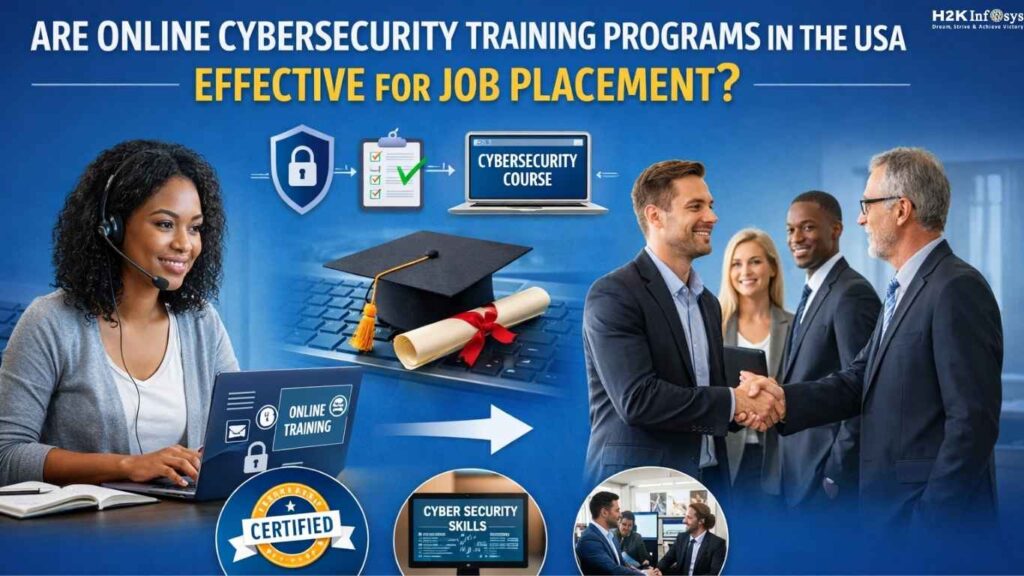
Online cybersecurity training programs in the USA can help with job placement, but honestly, that only really happens when they go beyond the usual theory-heavy setup. If it’s just recorded videos and slides, most people don’t get very far with it in today’s hiring environment.
I’ve noticed this pattern a few times now, and the difference is actually pretty striking. Learners who go through more structured programs like the ones offered by H2K Infosys often point out that what really helped wasn’t just the course material itself, but the hands-on practice. Working inside labs, dealing with realistic scenarios, and getting some actual direction on interviews… That’s where things start to click.
The reality behind “Online cybersecurity training and job placement” in the USA
If you search for cyber security training and job placement, you’ll see hundreds of programs promising fast-track careers. Some are solid, but many still sell the idea that a certificate alone is enough. That’s where people get stuck.
In the US job market (especially going into 2026), employers are not just scanning resumes for “completed course” lines. They want proof that you can actually do the work like reading logs in a SIEM tool, responding to alerts, or understanding cloud misconfigurations in AWS or Azure environments.
One hiring manager I spoke with recently put it very simply:
“If you can’t explain what you did in a lab, the certificate doesn’t matter much.”
That line kind of stays with you.
What actually makes cyber security training with job placement work
Not all programs are equal. The ones that genuinely help with online cybersecurity training with job placement usually share a few things in common:
They don’t stop at theory. You’ll spend time inside real tools like Splunk, Wireshark, or EDR platforms, not just reading about them.
They simulate real incidents. Think ransomware alerts, phishing investigations, or cloud access violations things that actually happen in companies.
And they push you toward certifications like Security+ or CEH, not as “final goals,” but as stepping stones.
I remember a candidate I came across who had no IT background at all. What changed everything for him wasn’t just the course, it was the constant lab work. He kept showing recruiters screenshots of dashboards, logs he analyzed, and small incident reports he wrote. That got him interviews faster than his resume ever could.
That’s the real pattern.
Where cyber security jobs with training are actually happening
There’s a growing trend in the US where entry-level roles are now tied to structured training pipelines. Companies and training providers are trying to bridge the talent gap in areas like:
- SOC (Security Operations Center) analyst roles
- Cloud security support roles
- Junior incident response positions
- IAM (Identity and Access Management) support roles
This is where cyber security jobs with training programs are showing value because they align learning directly with job tasks.
And it makes sense. With cloud adoption exploding and AI-driven threats becoming more common, companies don’t have time to train people from scratch for months. They want candidates who can jump into monitored environments and start assisting almost immediately.
The gap nobody talks about (this is important)
Here’s something people don’t always say out loud:
Not every “job placement” program actually places people.
Some only provide interview lists or basic resume help. That’s not the same as structured hiring pipelines or employer partnerships.
In real terms, here’s what usually separates successful learners from everyone else:
- They practice consistently, not just during classes
- They build small home labs and break/fix systems
- They document everything they do (this matters more than people think)
- They stay updated with current threats like AI-driven phishing or cloud misconfigurations
A lot of learners skip this part and expect the certificate to carry them. In online cybersecurity training, that rarely works anymore.
2026 trend shift: why hands-on is everything now

The cybersecurity field is shifting quickly. In 2026, companies are heavily focused on:
- Zero Trust architecture
- Cloud-native security (AWS, Azure, GCP)
- AI-assisted threat detection
- Automation in SOC environments
So when someone completes online cybersecurity training, recruiters immediately check one thing:
“Have they actually touched these environments or just learned definitions?”
That’s why practical exposure has become the center of hiring decisions.
A simple way to judge any program before joining
If you’re evaluating online cybersecurity training with job placement, here’s a simple mental checklist I always suggest:
If the program can’t clearly show:
- Live labs
- Tool-based training
- Real incident scenarios
- Interview preparation tied to actual job roles
…it’s probably not going to translate into real online cybersecurity training jobs.
And this is just me speaking honestly many people realize this a bit late, after spending months in theory-heavy courses.
Final thought (based on real-world observation)
Online cybersecurity training in the USA does work, but only when it feels less like “studying” and more like “doing the job before you get hired.”
The strongest outcomes usually come from programs that blend cyber security training with job placement with real-world simulations, consistent practice, and career guidance that actually mirrors industry expectations.
If you’re aiming for online cybersecurity training roles today, don’t just ask “Is this course good?”
Ask instead: “Will this make me job-ready in a real SOC or cloud security environment?”
That small shift in thinking makes a huge difference.