Introduction
Yes, you absolutely can get a job after taking data analytics classes online. In fact, many people working as junior analysts today started with data analytics classes online. For beginners, platforms like H2kinfosys or Microsoft Learn can help them land their first role.
But there’s a small catch that people don’t always mention: the course alone doesn’t get you the job; the skills you build and the projects you show do. Once you understand that part, the path becomes much clearer.
Let’s break down how it actually works in the real world.
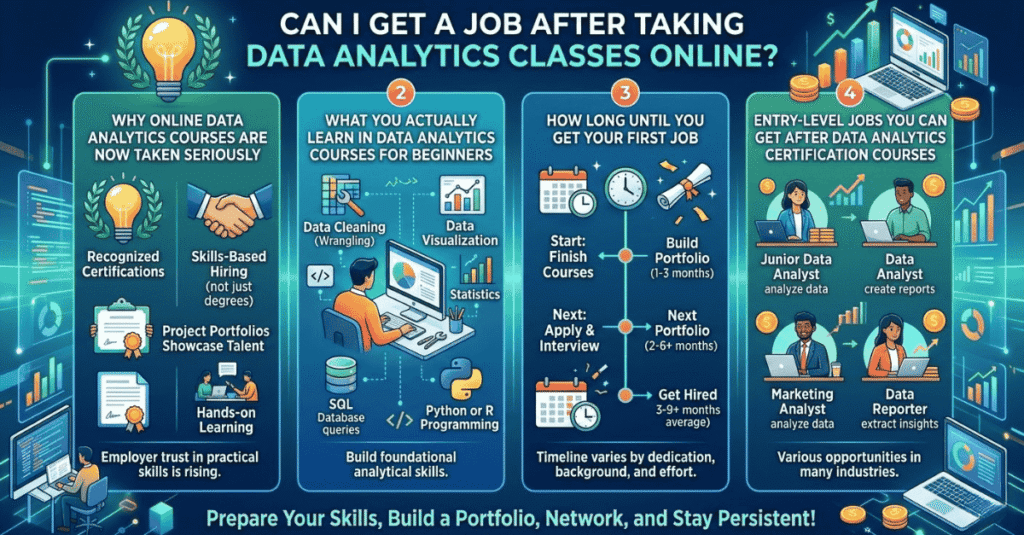
Why Online Data Analytics Courses Are Now Taken Seriously
A few years ago, companies didn’t give much weight to online certificates. That’s changed.
Today, companies care less about where you studied and more about whether you can work with real data analytics classes online. Startups, tech companies, marketing agencies, and even hospitals are hiring analysts who learned online.
One reason is the massive growth of data analytics classes online. According to recent industry reports, companies have generated more data in the last two years than in the previous decade combined. Someone has to analyze it.
That’s where data analytics classes are online certification courses come into play. They teach practical skills like
- Cleaning messy datasets
- Creating dashboards
- Writing SQL queries
- Finding patterns in customer behavior
- Presenting insights to decision-makers
And truthfully, these are exactly the skills entry-level analysts rely on every day.
What You Actually Learn in Data Analytics Courses for Beginners
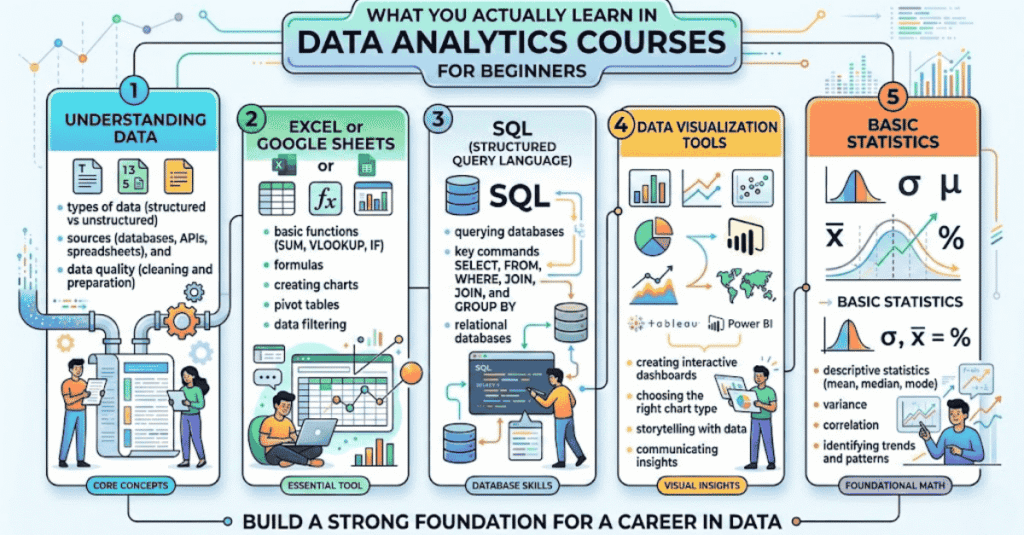
Most data analytics classes online for beginners follow a similar structure. If you’ve never worked with data before, the course usually starts with the basics.
Typical learning path:
1. Understanding Data
You learn how businesses collect and use data, such as sales numbers, website traffic, customer behavior, etc.
2. Excel or Google Sheets
Almost every beginner course starts here. You learn things like:
- Pivot tables
- Data cleaning
- Simple data visualization
3. SQL
The latter phase is where things start to feel “real.” SQL lets you pull data from databases. Many entry-level analyst jobs require at least basic SQL.
4. Data Visualization Tools
Tools like
- Tableau
- Power BI
- Looker Studio
These help turn raw numbers into charts and dashboards.
5. Basic Statistics
It’s not intimidating; it’s just necessary to comprehend trends, averages, and correlations.
When you finish data analytics classes online certification courses, you should be able to analyze a dataset and explain what it means for a business.
Are employers inclined to hire individuals who have completed data analytics certification courses?
In short: yes, but they recruit based solely on skills.
Generally, recruiters look for three things:
1. A Recognized Certificate
Having certificates from popular providers helps, like
- Google data analytics classes online
- IBM Data Analyst Professional Certificate
- Microsoft Data Analyst Certification
These indicate completion of certification courses in the area of structured data analytics.
2. Real Projects
This is the big one.
Hiring managers love to see:
- A sales analysis dashboard
- A customer churn analysis
- Website traffic insights
- Data storytelling reports
Even small projects make a real impact.
3. A Portfolio
Most successful beginners build a small portfolio using:
- GitHub
- Tableau Public
- Notion
- Personal websites
It’s basically your proof that you can do the job.
How Long Until You Get Your First Job
One of the most common questions people tend to have is how soon after completing data analytics classes online for beginners can we expect to get a job.
Based on my experience in the industry, a realistic timeline is something like this:
Months 1–3:
Learn fundamentals (Excel, SQL basics).
Months 3–5:
Months 3–5: Complete projects and practice with datasets.
Months 5–7:
Look for junior roles, internships, or freelance work.
Certain people get hired more quickly, especially those with a background in business, marketing, finance, or IT.
Entry-Level Jobs You Can Get After Data Analytics Certification Courses
You don’t always start as a “Data Analyst.” Sometimes the role title is slightly different.
Common beginner roles include:
- Junior Data Analyst
- Business Analyst (Entry Level)
- Marketing Data Analyst
- Reporting Analyst
- Operations Analyst
These roles usually involve:
- Creating dashboards
- Tracking KPIs
- Running reports
- Finding trends in data
As you gain experience, you can transition into better-paying roles such as senior data analyst and analytics manager.
What ‘s the Salary for Beginners?
Salaries differ from country to country, but here’s a general guide using hiring trends at the time of writing:
India
Entry-level data analysts are typically paid around:
₹4 LPA – ₹8 LPA
It can evolve into this role with 2–3 years of experience:
A Small Truth Most Courses Don’t Tell You
Here’s something I’ve noticed after speaking with many new analysts:
The hardest part isn’t learning the tools. It’s learning how to think with data.
Anyone can learn Tableau buttons or SQL syntax.
But employers value people who can answer questions like
- Why did sales drop last month?
- Which marketing channel is performing best?
- Which customers are likely to churn?
That “analytical thinking” develops through practice with real datasets, not just watching tutorials.
The Smart Way to Use Data Analytics Courses
To ensure the courses effectively lead to a job opportunity, please consider using this approach:
Step 1: Take one solid beginner course.
Step 2: Start practicing immediately with datasets from Kaggle or Google Dataset Search.
Step 3: Build 3–5 portfolio projects.
Step 4: Share dashboards publicly.
Step 5: Apply consistently.
That’s the strategy many self-taught analysts follow.
Final Thoughts
So yes, you can definitely get a job after taking online data analytics classes online. Thousands of people have done it.
But the real opportunity comes when you go beyond the certificate.
Consider data analytics certification courses as the initial step, not the final destination. Build projects, practice with messy real-world data analytics classes online, and show your work publicly.
Do that consistently, and sooner or later, a hiring manager will notice.
And honestly… That’s exactly how many modern data analysts started their careers.
You do not have enough Humanizer words left. Upgrade your Surfer plan.