
Yes, you can definitely learn cyber security even if you have no IT background at all. In fact, many people in the field today started out in completely unrelated fields such as sales, finance, marketing, and even healthcare. However, due to the advent of cyber security training online sites such as H2KInfosys, as well as other sites such as IITWorkforce, StationX, and EC-Council, it is now possible for anyone to learn everything they need to know about the field and get into a job, regardless of their background.
So, let’s break this question down, as it is something that comes up a great deal when someone first begins to look into a career in the field of cyber security.
Why Cyber Security Is One of the Few Tech Fields That Welcomes Beginners
A decade ago, it was difficult for someone to get into the field of cyber security if they had no prior IT experience. Most people began their careers as system administrators or network engineers before moving into the field of information technology security.
However, times have changed.
Cyber attacks have become an unprecedented problem for organizations all over the world. Ransomware, data breaches, and AI-powered phishing attacks have become an everyday phenomenon. In fact, according to many industry reports in 2025, companies are struggling to fill hundreds of thousands of cyber security jobs worldwide. This has opened doors for those who are new to the field. While it used to be expected that someone has years of prior IT experience, it seems that many employers now care far more about someone’s skills, certifications, and whether or not they actually know how to use real security tools.
This is where modern cyber security training online programs come into play, as they are designed to provide beginners with the same skills that professionals use to get the job done.
What Does Cyber Security Training Entail for Beginners?
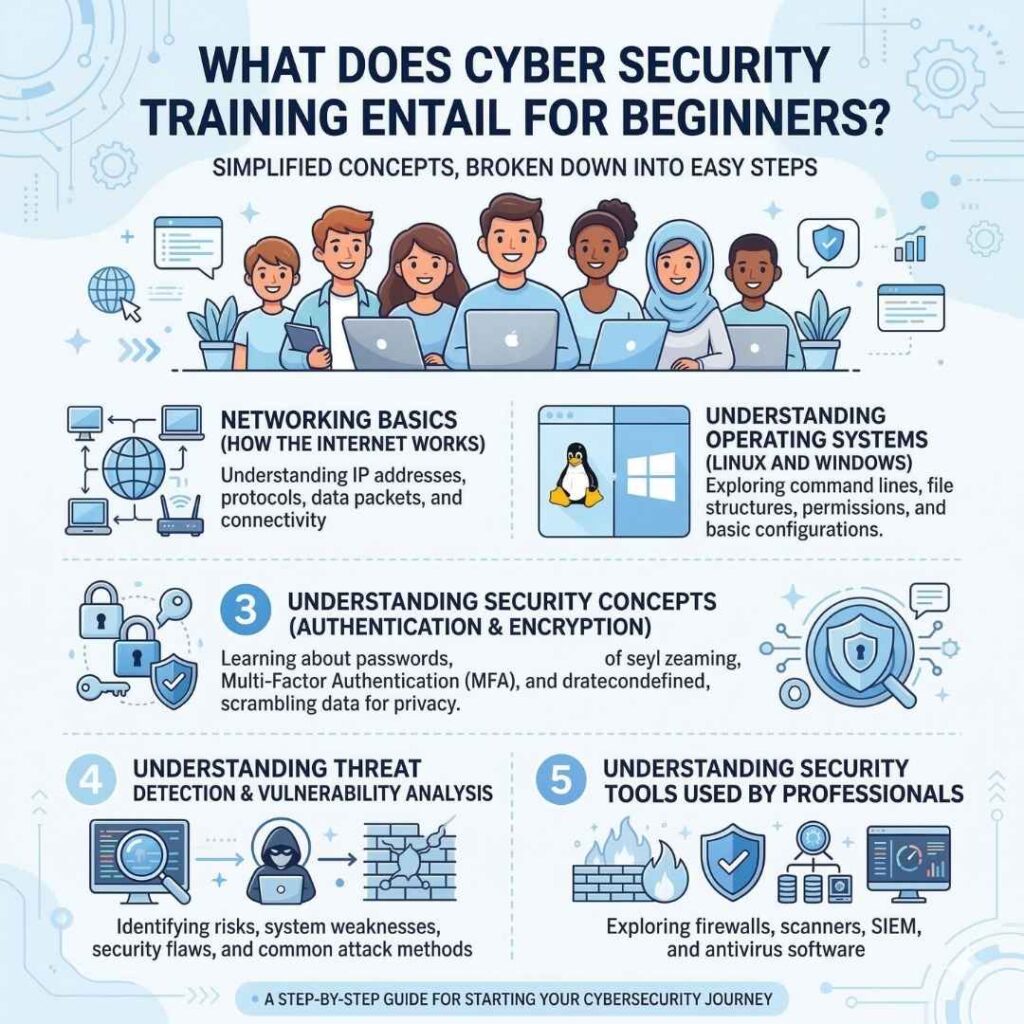
If you are imagining complicated programming and other complex concepts, don’t worry! Beginner programs are designed to be much more simple.
A good beginner’s guide to cyber security training will entail the following concepts, broken down into easy steps such as:
- Networking basics (how the internet works)
- Understanding operating systems such as Linux and Windows
- Understanding security concepts such as authentication and encryption
- Understanding threat detection and vulnerability analysis
- Understanding security tools used by professionals
As such, beginners are surprised at how easy the process of understanding cyber security training concepts really is.
As such, instead of simply being lectured to, beginners will be expected to take part in activities such as:
- Identifying potential threats
- Conducting investigations on potential cyber attacks
- Conducting vulnerability scans
- Understanding how hackers use security vulnerabilities
As such, beginners will be surprised at how easy it is to adapt to new concepts, especially when they are non-technical.
Real-World Scenario: Career Switching into Cyber Security
A perfect example of someone who successfully transitioned into the field of cyber security through such training programs is someone I met at a cyber security training meetup last year. She had previously worked as a retail store manager but had zero experience in the field.
As such, she decided to enroll in a structured cyber security training online program that focused on hands-on training and real-world tools. As such, she was able to pass her certification test within eight months of enrolling.
Was it easy? Not really.
She had to dedicate extra hours to understanding networking concepts, but the difference was that she was using real-world tools instead of theory.
Stories like that are becoming more common, especially as companies are looking for motivated learners rather than traditional IT backgrounds.
Skills You Actually Need to Start
One of the biggest lies about being a cyber security training professional is that one needs to be a coding mastermind.
One doesn’t.
One should note that most entry-level positions in this field are more about problem-solving and analysis than anything else.
Some of the most important entry-level skills include:
Curiosity
Security experts are always wondering how a particular problem happened and how someone could exploit it.
Pay close attention to details
One should note that noticing a suspicious login or network activity is mainly about paying close attention to details.
Willingness to learn technical concepts
One should note that one doesn’t necessarily have to come from an information technology background but should be willing to learn how things work.
One should note that it is interesting to learn that people from different backgrounds, such as customer support, auditing, and even cyber security training, have transitioned well to this field since they already know about information technology and risk management.
Types of Entry-Level Cyber Security Jobs
After one finishes cyber security training and gains some experience, there are several entry-level positions that one can get in this field.
Some of these positions include:
- Security Operations Center Analyst
- Junior Penetration Tester
- Security Compliance Analyst
- Security Support Specialist
One should note that these positions were specifically created for those who want to enter this field after completing their training in cyber security jobs with training programs.
The Growing Demand for Cyber Security Professionals
If you are wondering whether cyber security training remains a field worth entering, the answer is yes, probably more than ever.
In 2025, many high-profile cyber attacks occurred on hospitals, financial institutions, and government organizations around the world. AI-driven cyber attacks are also becoming more sophisticated, and this has led many organizations to seek more professionals to help keep their systems safe.
This has also led many organizations to adopt the hiring of personnel based on skills rather than qualifications.
This, I think, has been one of the major reasons that make it possible for new entrants to get into the field.
How Long It Usually Takes to Become Job-Ready
Well, this would depend on the amount of time one dedicated to studying, but based on most cyber security training programs, it would take one approximately this time:
- 3 to 4 months: learn the basics
- 4 to 6 months: get hands-on experience with various security tools
- 6 to 9 months: become job-ready
Of course, some might take even less time, especially if they are dedicated to learning every day.
The most important factor, however, is not your experience with IT, but your dedication.
Even one or two hours of focused learning every day can make a big difference over time. ⏳
One Thing Most Beginners Don’t Expect
Something interesting happens when one starts to learn cybersecurity.
You start seeing security risks everywhere.
You notice weak passwords, suspicious emails, and unsecured Wi-Fi connections. It feels almost like putting on a new pair of glasses that suddenly reveals how digital systems actually work.
This is often the moment when beginners stop feeling intimidated and start becoming genuinely fascinated with cybersecurity.
Final Thoughts
Can someone learn cybersecurity without an IT background?
Absolutely.
With the rise of cyber security training online, it is now possible to learn the exact skills necessary to transition into cyber security jobs with training, even if you have been in completely different careers. And interestingly, experience in areas like business operations or even cyber security sales training can actually be an advantage, since security teams often need people who understand both technology and real-world risk.
Cybersecurity is one of the few tech careers where curiosity, persistence, and hands-on practice matter more than where you started.
And honestly, that’s probably why so many career changers are entering the field right now. 🔐