Yes, it is possible to switch careers to Data analytics without prior experience. Many professionals transition into it by building foundational skills, completing this Online data analytics certificate, and gaining hands-on exposure through practical projects. Employers typically evaluate skills, problem-solving ability, and tool proficiency rather than prior job titles alone.
What is Data Analytics?
It is refers to the process of collecting, cleaning, transforming, and analyzing data to extract actionable insights. It involves tools and techniques such as SQL for querying databases, Power BI and Tableau for visualization, and business intelligence (BI) practices for decision-making.
In enterprise environments, It supports functions like forecasting, performance tracking, customer behavior analysis, and operational optimization. It is not limited to technical roles; professionals from finance, marketing, operations, and IT frequently interact with this workflows.
Why is Data Analytics a Viable Career Switch Option?
It is considered an accessible transition path because it combines technical and analytical skills that can be learned incrementally. Unlike highly specialized engineering roles, entry into it often focuses on practical tool usage and business understanding.
Key reasons why professionals switch to Data analytics:
- Demand exists across industries such as healthcare, finance, retail, and IT
- Skills are transferable from domains like Excel, reporting, or operations
- Learning paths are structured through this certification programs
- Entry-level roles often prioritize practical knowledge over prior experience
Many working professionals begin their transition by enrolling in a Data Analytics certificate online, which provides structured exposure to tools and workflows used in real projects.
How Does Data Analytics Work in Real-World IT Projects?
In enterprise IT environments, This follows a structured workflow:
1. Data Collection
Data is gathered from multiple sources such as databases, APIs, CRM systems, and cloud platforms.
2. Data Cleaning
Raw data is processed to remove inconsistencies, duplicates, and missing values using SQL or scripting tools.
3. Data Transformation
Data is structured into formats suitable for analysis, often using ETL (Extract, Transform, Load) processes.
4. Data Analysis
Analysts use SQL queries or BI tools to identify patterns, trends, and anomalies.
5. Data Visualization
Tools like Power BI and Tableau are used to create dashboards for stakeholders.
6. Reporting and Decision Support
Insights are presented to business teams to support decision-making.
Professionals transitioning into Data analytics must understand this lifecycle, as it reflects actual workplace expectations.
What Skills Are Required to Learn Data Analytics?
Switching to Data analytics without experience requires building a combination of technical and analytical skills.
Core Technical Skills
- SQL for querying relational databases
- Data visualization using Power BI or Tableau
- Excel for data manipulation and reporting
- Basic understanding of data modeling and BI concepts
Analytical Skills
- Problem-solving and logical thinking
- Ability to interpret trends and patterns
- Business understanding and domain awareness
Supporting Skills
- Communication for presenting insights
- Documentation of analysis processes
- Familiarity with data governance practices
Most Data Analytics certification programs, including those offered by H2K Infosys, are designed to build these skills through guided learning and project-based training.
How is Data Analytics Used in Enterprise Environments?
In enterprise settings, It is integrated into daily operations and strategic planning.
Common Use Cases
- Sales performance tracking through dashboards
- Customer segmentation and behavior analysis
- Financial reporting and forecasting
- Supply chain optimization
Tools in Production
- SQL databases (e.g., MySQL, SQL Server)
- BI tools like Power BI and Tableau
- Data warehouses and cloud platforms
Teams working in this must also consider:
- Data security and access control
- Performance optimization of queries
- Scalability of dashboards and reports
These are practical constraints that learners encounter when transitioning from training to real-world roles.
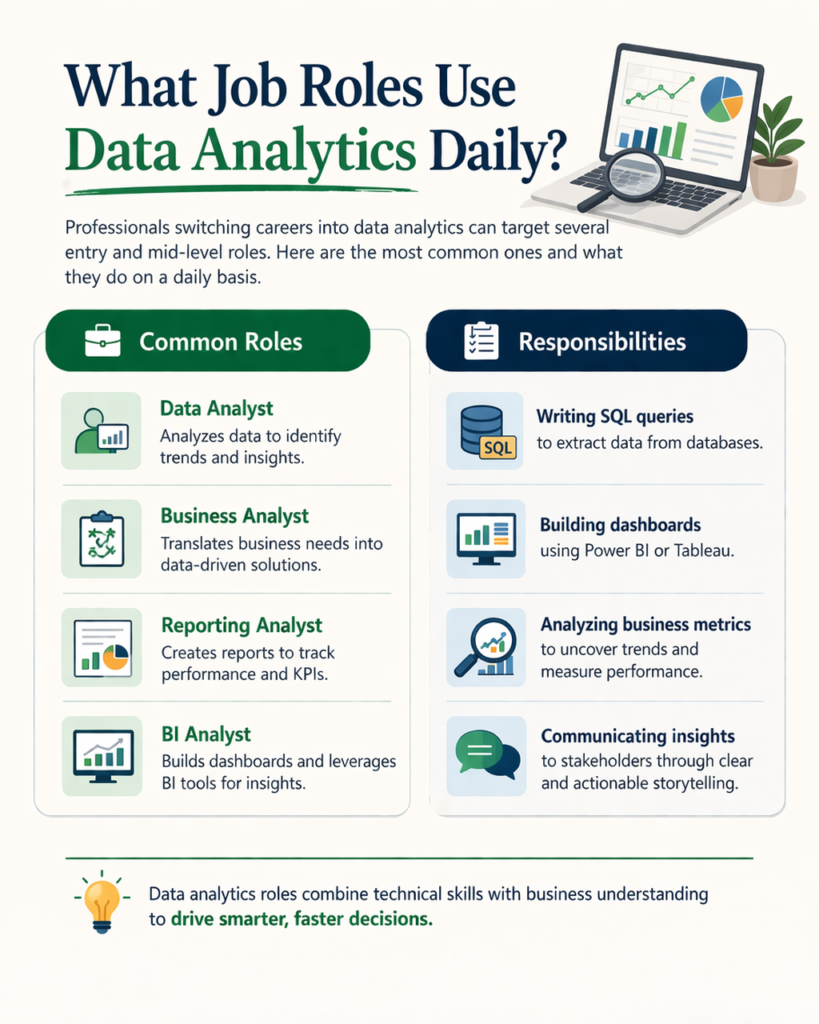
What Job Roles Use Data Analytics Daily?
Professionals switching careers into it can target several entry and mid-level roles.
Common Roles
- Data Analyst
- Business Analyst
- Reporting Analyst
- BI Analyst
Responsibilities
- Writing SQL queries to extract data
- Building dashboards using Power BI or Tableau
- Analyzing business metrics
- Communicating insights to stakeholders
A structured Analytics certificate online helps learners align their skills with these role expectations.
How H2K Infosys Supports Career Switching into Data Analytics
Training providers play a critical role in helping professionals transition into it without experience. H2K Infosys focuses on practical, job-oriented learning rather than purely theoretical instruction.
Key Learning Approach
- Hands-on training with real-world datasets
- Step-by-step guidance on SQL, Power BI, and Tableau
- Exposure to business intelligence workflows
- Interview preparation aligned with industry expectations
Practical Training Focus
Unlike generic courses, structured programs emphasize:
- Building dashboards similar to enterprise reporting systems
- Writing optimized SQL queries for large datasets
- Understanding project lifecycle in Data analytics
This approach helps learners bridge the gap between learning and job readiness.
Can You Get a Job in Data Analytics Without Experience?
Yes, but it requires demonstrating practical skills rather than relying on formal work experience.
What Employers Look For
- Hands-on project experience
- Understanding of Data analytics workflows
- Ability to solve business problems using data
- Familiarity with tools like SQL and Power BI
How to Build Experience
- Complete guided projects during training
- Practice real-world datasets
- Build a portfolio of dashboards and reports
- Participate in mock interviews
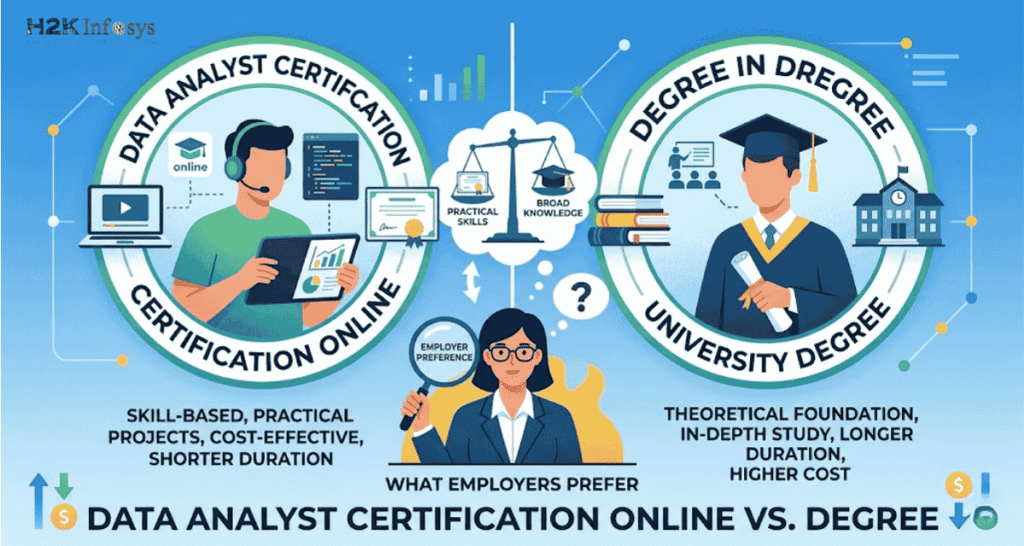
A Data Analytics certification helps validate foundational knowledge, but practical exposure is equally important.
What Careers Are Possible After Learning Data Analytics?
After completing a Data Analytics certificate online, professionals can explore multiple career paths depending on their interests and prior background.
Entry-Level Paths
- Junior Data Analyst
- Reporting Analyst
- Operations Analyst
Growth Opportunities
- Senior Data Analyst
- BI Developer
- Data Consultant
Over time, professionals may specialize in areas such as advanced analytics, data engineering, or business intelligence architecture.
Frequently Asked Questions (FAQ)
Is coding required for Data analytics?
Basic coding is helpful but not mandatory. SQL is essential, while advanced programming is optional for entry-level roles.
How long does it take to switch to Data analytics?
Typically, 3–6 months of consistent learning and practice through a Online certification program.
Can non-IT professionals transition into Data analytics?
Yes, professionals from finance, marketing, and operations often transition successfully due to their domain knowledge.
Is a Data Analytics certificate online enough to get a job?
It provides foundational knowledge, but practical projects and skill application are necessary to secure a role.
What tools should beginners focus on?
SQL, Power BI, Tableau, and Excel are commonly used in Data analytics roles.
Conclusion
Switching to Data analytics without experience is achievable through structured learning and consistent practice. The field emphasizes practical skills, making it accessible to professionals from diverse backgrounds.
Key Takeaways
- This focuses on extracting insights from data using tools like SQL and BI platforms
- A Data Analytics certificate online provides structured entry into the field
- Real-world projects are essential to demonstrate capability
- Enterprise workflows and tool usage should be clearly understood
- Training providers like H2K Infosys support hands-on learning and career transition
Explore structured Data analytics training programs to build practical skills aligned with industry needs. Consider enrolling in H2K Infosys courses to gain hands-on experience and advance your career.