Introduction
Cyber attacks continue to rise every year, and organizations across industries need trained professionals to secure networks, applications, and sensitive data. Many new learners compare Cybersecurity vs Ethical Hacking when deciding which career path to pursue. At first glance, these fields might appear similar, but they differ significantly in skills, responsibilities, and job roles.
This detailed guide explains Cybersecurity vs Ethical Hacking with real-world examples, skill comparisons, industry insights, and practical career relevance. Whether you want to defend systems or test them for weaknesses, this blog will help you understand how Cybersecurity vs Ethical Hacking differ and how H2K Infosys supports your journey through Cyber security training, CEH Certification, and Cyber security training and placement programs.
Understanding Cybersecurity
Cybersecurity focuses on protecting networks, devices, data, and systems from unauthorized access. In the context of Cybersecurity vs Ethical Hacking, cybersecurity represents the defensive side.
Cybersecurity professionals set up preventive controls, monitor threats, and respond to cyber incidents using tools and structured security frameworks.
Core Areas of Cybersecurity
- Network Security
Protects routers, firewalls, switches, and communication channels. - Information Security
Ensures confidentiality, integrity, and availability of critical data. - Endpoint Security
Secures laptops, servers, mobile devices, and IoT systems. - Cloud Security
Protects cloud platforms from misconfigurations and unauthorized access. - Security Operations (SOC)
Detects and responds to security events in real time using SIEM tools.
Cybersecurity is a continuous process that includes prevention, detection, and response.
Real-World Example
A healthcare company stores sensitive patient data. Cybersecurity specialists implement encryption, access policies, multifactor authentication, and real-time monitoring to keep the environment secure. This illustrates one critical difference in Cybersecurity vs Ethical Hacking since cybersecurity teams avoid breaches, while ethical hackers attempt to find vulnerabilities before attackers exploit them.
Understanding Ethical Hacking
Ethical hacking is the authorized practice of simulating cyberattacks to identify weaknesses. In the comparison of Cybersecurity vs Ethical Hacking, ethical hacking represents the offensive approach.
Ethical hackers think like attackers but operate within rules and legal boundaries. Their goal is to expose vulnerabilities so organizations can strengthen defenses.
Common Ethical Hacking Practices
- Penetration Testing
Ethical hackers perform tests on networks, applications, or cloud environments. - Vulnerability Assessment
Identifies and reports system weaknesses before exploitation. - Wireless Security Testing
Checks Wi-Fi networks for weak authentication, outdated encryption, or rogue devices. - Social Engineering
Tests human awareness through phishing simulations or impersonation attempts. - Red Team Operations
Acts as a real-world adversary to test an organization’s entire security posture.
Ethical hacking is crucial because cyber attackers often exploit unnoticed weaknesses. Ethical hackers ensure organizations address these gaps proactively.
Real-World Example
An e-commerce site hires an ethical hacker to perform web application testing. The ethical hacker discovers a SQL injection vulnerability that could expose customer data. Fixing it prevents a major breach and enhances public trust.
Cybersecurity vs Ethical Hacking: Key Differences
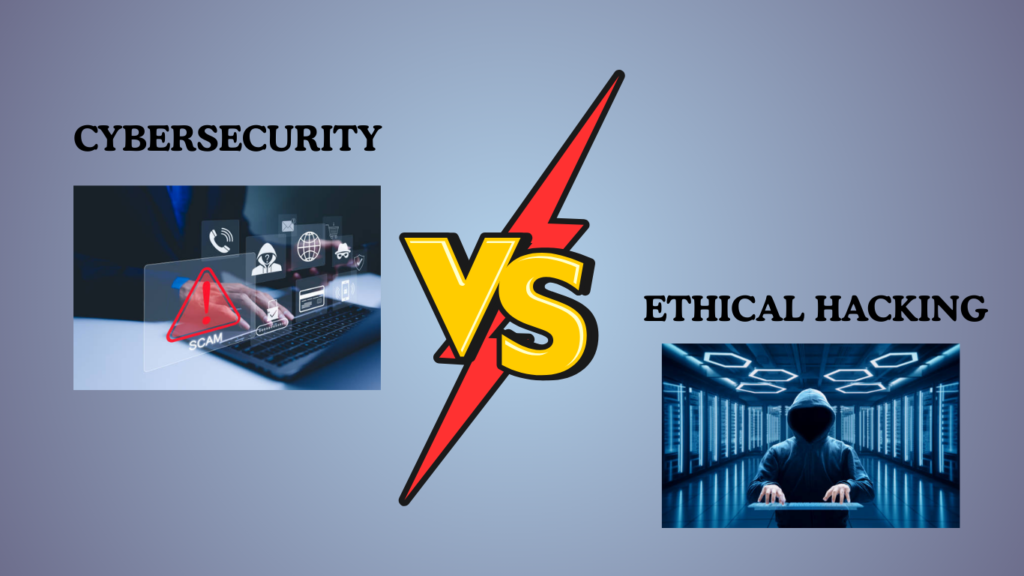
Below is a detailed look at the differences between Cybersecurity vs Ethical Hacking, one of the most frequently asked comparisons among IT beginners.
| CATEGORY | CYBERSECURITY | ETHICAL HACKING |
| Primary Role | Defend systems and prevent attacks | Simulate attacks to find vulnerabilities |
| Approach | Reactive and proactive defense | Offensive testing and probing |
| Goal | Protect data, systems, and networks | Identify weaknesses before criminals exploit them |
| Key Skills | Security monitoring, encryption, firewall setup | Penetration testing, scripting, exploit development |
| Typical Tools | SIEM, IDS, firewalls, antivirus | Burp Suite, Metasploit, Kali Linux, Nmap |
| Mindset | Defensive thinking | Hacker mindset within legal boundaries |
Understanding these contrasts helps clarify Cybersecurity vs Ethical Hacking for learners deciding their ideal career direction.
Why Cybersecurity vs Ethical Hacking Confuses Many Learners
Many beginners assume cybersecurity and ethical hacking are the same because both aim to secure systems. However, the confusion around Cybersecurity vs Ethical Hacking usually results from their overlapping skill sets.
Cybersecurity requires foundational knowledge of networks, systems, and threat analysis. Ethical hacking requires great technical skills and creativity to simulate real attacker behavior. Both fields often work together during assessments, audits, and incident response.
Skills Required for Cybersecurity vs Ethical Hacking
To understand Cybersecurity vs Ethical Hacking in terms of career preparation, let’s explore the skills required for each domain.
Skills for Cybersecurity Careers
- Understanding of operating systems
- Firewall configuration
- Intrusion detection
- Identity and access management
- Risk assessment
- Threat modeling
- Security compliance and governance
Cybersecurity professionals solve real-world problems and often work in structured environments like SOC teams.
Skills for Ethical Hacking Careers
- Advanced Linux knowledge
- Python or Bash scripting
- Exploit development
- Vulnerability scanning
- Web application testing
- Password cracking techniques
- Reverse engineering
Ethical hackers rely heavily on testing skills and practical hands-on experience using security tools.
Understanding these skill sets reinforces one of the biggest differences in Cybersecurity vs Ethical Hacking: cybersecurity defends while ethical hacking attacks (legally).
Career Opportunities in Cybersecurity vs Ethical Hacking
Cybersecurity Roles
- Cyber Security Analyst
- SOC Analyst
- Network Security Engineer
- Cloud Security Specialist
- Security Architect
These roles are commonly offered through Cyber security training and placement, Cyber security analyst training online, and Cyber security training with job placement programs at H2K Infosys.
Ethical Hacking Roles
- Penetration Tester
- Ethical Hacker
- Vulnerability Assessor
- Red Team Analyst
Most organizations prefer candidates with CEH Certification, which strengthens credibility when entering the ethical hacking field.
Industry Demand for Cybersecurity vs Ethical Hacking Professionals
According to global studies, cybercrime damages may reach trillions of dollars annually. Demand for professionals in both fields continues to rise because companies need strong defense and proactive testing.
Reports indicate that more than 70 percent of companies struggle to fill cybersecurity roles. Ethical hacking demand has increased due to the rise in ransomware attacks and application-level vulnerabilities.
This evidence highlights why newcomers compare Cybersecurity vs Ethical Hacking when exploring long-term career opportunities in IT security.
Real-World Scenario: Cybersecurity vs Ethical Hacking Working Together
To understand Cybersecurity vs Ethical Hacking in action, consider this scenario:
A retail company experiences suspicious activity within its customer portal.
- Cybersecurity teams monitor logs, isolate the affected system, block malicious IP addresses, and secure compromised accounts.
- Ethical hackers simulate how the intruder gained access, identify the vulnerable endpoint, and recommend fixes.
Together, they strengthen the organization’s entire security posture.
Learning Path for Cybersecurity vs Ethical Hacking at H2K Infosys
H2K Infosys offers structured programs designed for both beginners and advanced learners.
Cybersecurity Training Covers
- Networking essentials
- Application and cloud security
- SIEM tools
- Threat detection
- Incident response
You also receive Cyber security training and placement support including mock interviews and job guidance.
Ethical Hacking (CEH Certification) Covers
- Attack phases
- Reconnaissance
- Scanning and enumeration
- Exploitation
- Post-exploitation methods
Hands-on labs simulate real attacker techniques.
This makes H2K Infosys a trusted platform for learning Cybersecurity vs Ethical Hacking with practical experience.
When Should You Choose Cybersecurity vs Ethical Hacking?
Choose Cybersecurity if you:
- Like structured workflows
- Prefer monitoring, analysis, and defensive strategies
- Want to work in SOC or governance roles
Choose Ethical Hacking if you:
- Enjoy problem solving through offense
- Like testing systems for vulnerabilities
- Prefer hands-on exploitation and penetration testing
Most learners today study Cybersecurity vs Ethical Hacking together because both fields complement each other and create broader job opportunities.
Conclusion
The comparison of Cybersecurity vs Ethical Hacking is essential for anyone planning a security career. Cybersecurity protects systems through policies and monitoring, while ethical hacking identifies vulnerabilities through controlled attacks. Both are necessary to secure modern digital environments.
H2K Infosys helps you build real skills through Cyber security training, CEH Certification, online classes cyber security, and Cyber security training with job placement support.
Begin your journey now with H2K Infosys. Enroll today to gain hands-on skills and build a strong career in cybersecurity or ethical hacking.