Yes, most modern cybersecurity courses cover cloud security, and H2K Infosys is in line with what the industry expects because most enterprise apps and infrastructure now run in the cloud. In structured cybersecurity training and placement programs, cloudsecurity is usually integrated with network security, identity management, and threat detection. Many cyber security training and job placement focused programs also include hands-on exposure to securing cloud workloads, monitoring cloud threats, and implementing access controls across multi-cloud environments.
What Do Cybersecurity Courses Cover Cloud Security?
Cybersecurity education has evolved alongside enterprise IT transformation. Earlier, security training focused mainly on on-premise networks, firewalls, and endpoint security. Today, organizations rely heavily on cloud platforms such as AWS, Azure, and Google Cloud, making cloud security a foundational cybersecurity skill.
When people ask whether cybersecurity courses cover cloudsecurity, they usually mean:
- Do courses teach how to secure cloud infrastructure?
- Do they include cloud threat monitoring?
- Do they cover identity and access management in cloud environments?
- Do learners practice real cloud security configurations?
Most industry-aligned cyber security training and placement curricula include cloudsecurity modules because companies expect security professionals to protect hybrid and cloud-native systems.
Core Cloud Security Areas Covered
Typical cybersecurity courses cover:
- Cloud architecture security basics
- Identity and Access Management (IAM)
- Cloud network security
- Data encryption in cloud storage
- Cloud logging and monitoring
- Compliance and governance frameworks
How Does Cyber Security Training Online Work in Real-World IT Projects?
In real enterprise environments, cloud security is not handled separately from cybersecurity. It is embedded into daily workflows across development, infrastructure, and operations teams.
Real Enterprise Cloud Security Workflow
| Stage | Security Activity | Tools Commonly Used |
| Architecture Design | Threat modeling | Microsoft Threat Modeling Tool |
| Deployment | Secure configuration validation | AWS Config, Azure Policy |
| Monitoring | Threat detection | SIEM, Cloud-native monitoring |
| Incident Response | Log investigation | Splunk, Sentinel |
| Compliance | Audit reporting | Cloud compliance dashboards |
Example of a Real Project Situation
- A security analyst at a cloud-enabled business might:
- Check IAM permissions for too much rights
- Check cloud logs for strange login attempts
- Look into strange data transfers from cloud storage
- Check that encryption policies are in place for sensitive workloads.
This is why modern cybersecurity training and placement programs stress the use of simulated cloud environments in hands-on laboratories.
Why is it important for those who work to have cloud security?
It’s crucial to know about cloudsecurity because businesses are moving away from traditional data centers and toward cloud-first or hybrid architectures.
Important Business Drivers
- Infrastructure for remote workers
- Using SaaS applications
- DevOps and automated pipelines
- Requirements for global data access
Risks to Security Without Knowledge of Cloud Security
- Storage that isn’t set up correctly can expose private info.
- Weak identity controls that let people in
- Not being able to see across many cloud environments
Today, security experts need to know:
- Model of Shared Responsibility
- Architecture with no trust
- Tools for cloud-native security
- Basic security for containers and serverless systems
What Skills Do You Need to Take Cyber Security Training Online?
People who want to work in cybersecurity with an emphasis on cloud security should build up a range of skills.
Basic Technical Skills
- Basics of networking
- Managing Linux with Windows
- Basic scripting (Bash, Python)
- Basics of security
Specific Skills for Cloud Security
- Setting up IAM policies
- Analysis of cloud logging
- Basic security for APIs
- How to use encryption
Security Operations Skills
- Incident triage
- Threat detection
- Log correlation
- Vulnerability management
How Is Cloud Security Used in Enterprise Environments?
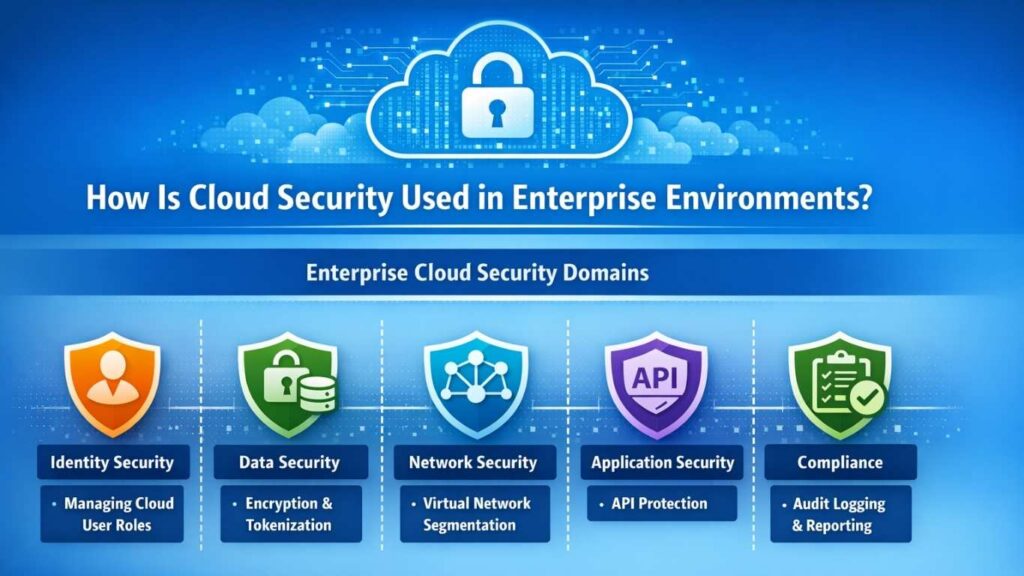
Cloudsecurity operates across multiple enterprise security domains.
Enterprise Cloud Security Domains
| Domain | Example Tasks |
| Identity Security | Managing cloud user roles |
| Data Security | Encryption and tokenization |
| Network Security | Virtual network segmentation |
| Application Security | API protection |
| Compliance | Audit logging and reporting |
Enterprise Constraints Security Teams Face
- Multi-cloud environment complexity
- Compliance regulations (GDPR, HIPAA, PCI-DSS)
- Performance vs security balancing
- Cost optimization vs security tooling
What Job Roles Use Cloud Security Daily?
Cloudsecurity knowledge applies across multiple cybersecurity job roles.
Role vs Cloud Security Usage
| Job Role | Cloud Security Responsibilities |
| Security Analyst | Monitor cloud threats and alerts |
| CloudSecurity Engineer | Design secure cloud architecture |
| SOC Analyst | Investigate cloud security events |
| DevSecOps Engineer | Integrate security into CI/CD pipelines |
| Security Auditor | Validate cloud compliance posture |
Professionals completing cyber security training and job placement aligned learning paths often transition into these roles.
What kinds of jobs can you get after taking online cyber security training?
Cloudsecurity knowledge opens up more job chances because more and more businesses are using the cloud.
Jobs for Beginners
- Junior Security Analyst
- Analyst for CloudSecurity Support
- Analyst for managing vulnerabilities
Mid-Level Jobs
- Engineer for CloudSecurity
- Automation Engineer for Security
- Engineer for Threat Detection
Advanced Roles
- Architect for CloudSecurity
- Manager of Security Engineering
- Consultant for Enterprise Security
Industry Tools Commonly Taught in Cloud Security Modules
| Category | Tools |
| Cloud Platforms | AWS, Azure, GCP |
| Security Monitoring | Splunk, Azure Sentinel |
| Vulnerability Scanning | Nessus, Qualys |
| Identity Security | Okta, Azure AD |
| Container Security | Prisma Cloud, Aqua Security |
Example of a Basic Cloud Security Workflow in Steps
Step 1: Strengthening Identity
- Turn off accounts that aren’t being used.
- Make MFA mandatory
Step 2: Protecting the Network
- Set up private subnets
- Use firewall rules
Step 3: Protecting Your Data
- Allow encryption at rest
- Turn on encryption while in transit
Step 4: Keep an eye on things
- Turn on audit logs
- Set up SIEM alerts
Step 5: Check for compliance
- Check the compliance policy
- Make reports for audits
Common Problems Students Have
Problems with technology
- Understanding the shared responsibility paradigm
- Managing more than one cloud platform
- Understanding security logs
Problems with Learning
- Too much learning in theory without labs
- Not enough exposure to real business workflows
- Little practice with hands-on configuration
Best Practices for Enterprise Cloud Security
- Rule of Least Privilege
- Model of Security with No Trust
- Monitoring all the time
- Enforcing Security Policies Automatically
- Validation of Infrastructure as Code Security
Learning Path Table for Cloud Security in Cybersecurity Training
| Stage | Learning Focus | Outcome |
| Beginner | Networking + Security Basics | Understand threats |
| Intermediate | CloudSecurity Tools | Configure security controls |
| Advanced | Automation + DevSecOps | Secure pipelines |
Questions and Answers
Is cloud security included in all cybersecurity courses?
Most modern courses do, especially those that are meant for jobs in business. Older or simpler programs might only cover it for a short time.
Is it hard for beginners to learn about cloud security?
It may seem hard at first, but structured learning with laboratories helps you feel more sure of yourself.
What cloud platform should those who want to learn about cybersecurity start with?
A lot of people start with AWS or Azure because they are popular in business settings.
Will employers want to know about cloud security in 2026?
Yes. Job descriptions for security analysts and cloud security professionals often include cloud security as a need.
Does cloud security take the place of network security?
No. Cloud security is based on network security ideas and applies them to cloud infrastructure.
Important Points
- Cloudsecurity training is a regular part of modern cybersecurity courses.
- Cloudsecurity is increasingly a standard aspect of business cybersecurity processes.
- Professionals need to know about IAM, monitoring, encryption, and compliance.
- Having cloud security expertise makes it easier to change jobs and go up in your career.
- Real-world cloud security readiness needs hands-on labs.
Check out H2K Infosys’s cybersecurity programs to get real-world cloudsecurity experience that is similar to what you would find in a business.
Structured cybersecurity training can help you build useful abilities that will help you go up in your career in modern IT security roles.