
You don’t need coding skills to enter cybersecurity as a beginner, but having some basic scripting skills under your belt along the way can definitely help things along and open more doors for you.
So, that’s my honest take. And if I’m being real with you, it comes from seeing how most beginners actually break into the field without heavy coding. From my experience, most people don’t need much programming at all when they’re starting out in cybersecurity. In fact, many land their first roles with little to no coding knowledge, especially when they follow structured learning paths through platforms like h2kinfosys that emphasize real-world skills. What they do have, though, is a solid understanding of systems, networks, and how attacks play out in real-world scenarios and that’s what really makes the difference.
Why Cybersecurity Feels Like It Requires Coding
When people hear “cybersecurity,” they immediately picture people typing away frantically at their computer, typing away at their keyboard, and hacking into computer systems like in all those hacker movies. It’s not wrong, but it’s also not right.
The reason for this is because cybersecurity is a huge field.
Some areas of cybersecurity training and placement are heavy on coding, but many areas of cybersecurity are more about understanding systems, understanding networks, understanding how things are attacked, and responding to those attacks. It’s not so much about “how do we build this software,” but more about “how do we understand how things break and why.”
What You Actually Need as a Beginner
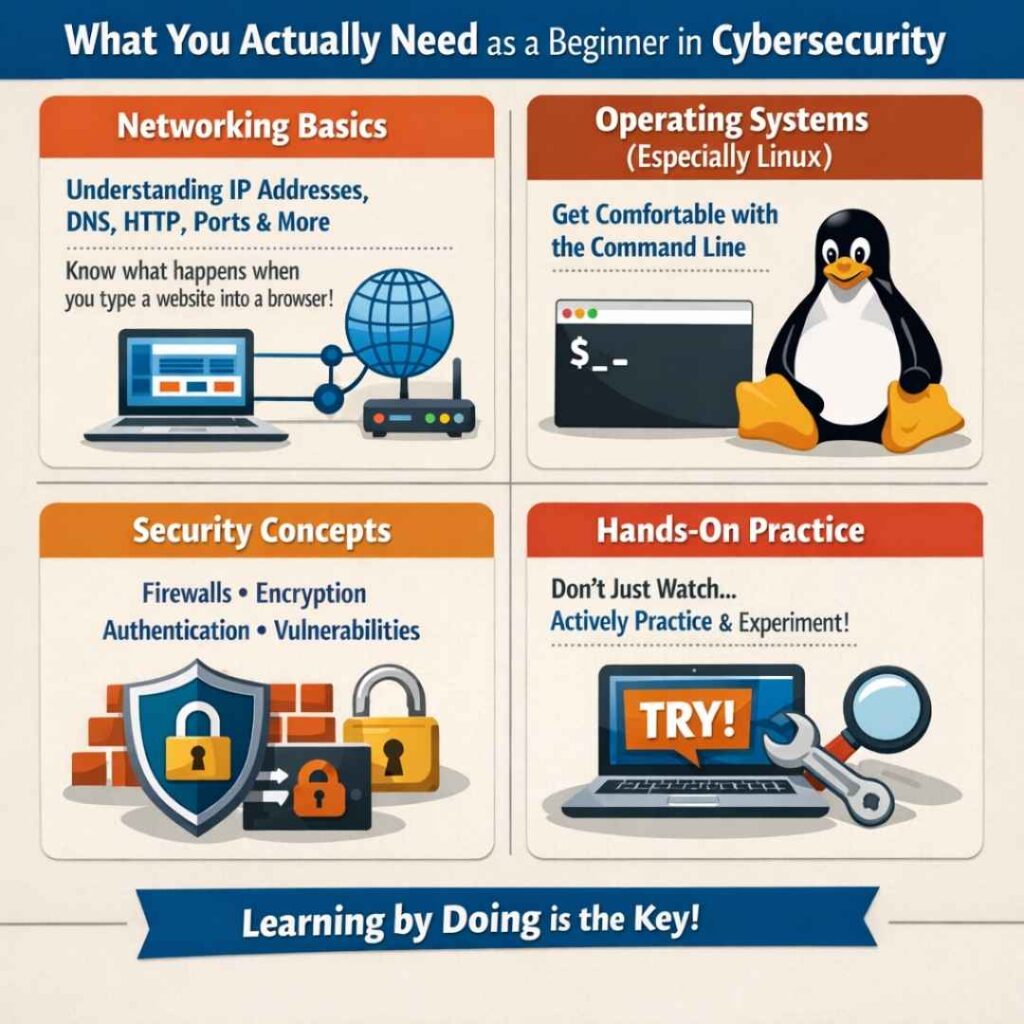
If you’re new to cybersecurity, you don’t need much of anything, but here are a few things that are more important than coding when it comes to cybersecurity.
- Networking Basics
You should understand how networks function, including IP addresses, DNS, HTTP, ports, etc.
If you don’t even know what happens when you type in a website into a browser, then you need to start here. - Operating Systems (Especially Linux)
A lot of cyber security work is done in a Linux environment. Even basic comfort with the command line can go a long way. - Security Concepts
Things like:
Firewalls
Encryption
Authentication
Vulnerabilities
These concepts show up everywhere. - Hands-On Practice
This is where a lot of new people go wrong. They watch videos, take notes… but do nothing.
The harsh truth is: platforms offering cyber security training with job placement are gaining popularity in 2026 because they throw you into the real world: cyber attacks, detection, response… the works.
This is more important than knowing how to code from the start.
So… When Does Coding Become Important?
Coding becomes important, but not necessary once you start delving deeper.
Here’s where coding can help you out:
Coding can help you automate tasks (Python is popular for this)
Coding can help you write scripts to analyze things (like Python)
Coding can help you understand exploit attacks
Coding can help you customize tools
Let me give you a basic example.
You’re analyzing thousands of log entries to try and detect suspicious activity related to login attempts. Do you manually scan through them all… or do you write a quick Python script to automatically detect suspicious activity?
This is where coding can work for you.
The Most Useful Languages (Later, Not Now)
If you do want to learn coding, do not overcomplicate things.
Here are the top languages to start out with:
Python: easiest and most useful for cyber security
Bash: useful for Linux environments
JavaScript: useful for web security exploration
Keep in mind: this is only useful once you’ve established your foundation.
Real-World Trend: Skills Over Degrees
In 2026, the hiring landscape for cybersecurity has changed a lot.
Instead of asking:
“Do you know how to code?”
They’re asking:
“Do you know how to detect a phishing attack?”
“Can you analyze a suspicious login?”
“Can you explain what went wrong in a breach?”
It is no wonder cyber security training and job placement is becoming a more popular choice. It is a skills-based approach, not a theoretical or knowledge-based one.
I have witnessed first-hand people with no coding knowledge at all outperform others simply because they could walk through a scenario confidently.
Roles You Can Start Without Coding
Are you concerned about coding skills? Do you want to consider roles such as:
Security Analyst (SOC Analyst)
IT Support role with a focus on Security
Vulnerability Management Analyst
Risk and Compliance roles
These are roles you can consider and are a perfect fit for a cybersecurity training and job placement course.
A Quick Reality Check (From Experience)
Something I wish people knew at the beginning of their journey is this:
You don’t need to be perfect to begin.
You don’t need:
Programming skills
10+ Certifications
Years of experience
You need:
Curiosity
Consistency
Exposure
That is it.
And honestly, once you begin working with tools and scenarios, learning basic programming becomes a lot easier as it now makes sense.
Final Thought
It is not about coding first and foremost. It is about being able to think like a cybersecurity professional (and sometimes a bad guy too). The coding part is just one of the tools you will learn along the way.
Are you hesitating because of this reason: “I don’t know programming?” Then you are most likely holding yourself back for no reason at all.
Start anyway. The rest will figure itself out once you are in the game.