
No, prior IT experience is not required, and this is why training providers like h2kinfosys create programs for beginners to help entry-level individuals get started in the profession. Many of today’s successful cybersecurity experts did not begin in IT; in fact, they came from entirely different fields and learned the necessary skills through organized training that was targeted toward those with no prior experience.
Is the notion that cybersecurity is only for IT professionals still in your head? If so, that idea is outdated. The rapidly evolving nature of the profession due to the rise of cloud computing, AI, and frequent data breaches has created a need for training programs. These programs are designed for individuals with no prior experience in the field.
Let’s be real.
The Field Is Widely Open at Last!
Cybersecurity was previously considered a narrow discipline predominantly for network engineers and hardcore programmers. That is not the case today. The increase in cyber threats due to remote work, the use of cloud technology, and the rapid adoption of AI has created an enormous need for trained professionals.
It is true that millions are still underestimating the global cybersecurity workforce gap. The growing demand is not just for seasoned professionals, but also for junior employees who can be trained and developed into the role.
Due to the gap, there are many cybersecurity positions that come with training, and are geared towards those who do not have an IT background. Most employers are more concerned about your practical skills and approach, rather than the position you have held in the past.
I have seen multiple people from the following backgrounds transition into cybersecurity:
– Customer support
– Sales
– Teaching
– Banking
– Even Hospitality
I know an individual who worked in a retail position, and after witnessing a ransomware attack on his company, he decided to begin cybersecurity training. He had no background in IT. Within ten months, he secured a position as a junior security analyst. He did not get lucky; he was just organized and trained.
What is taught in the cybersecurity training courses
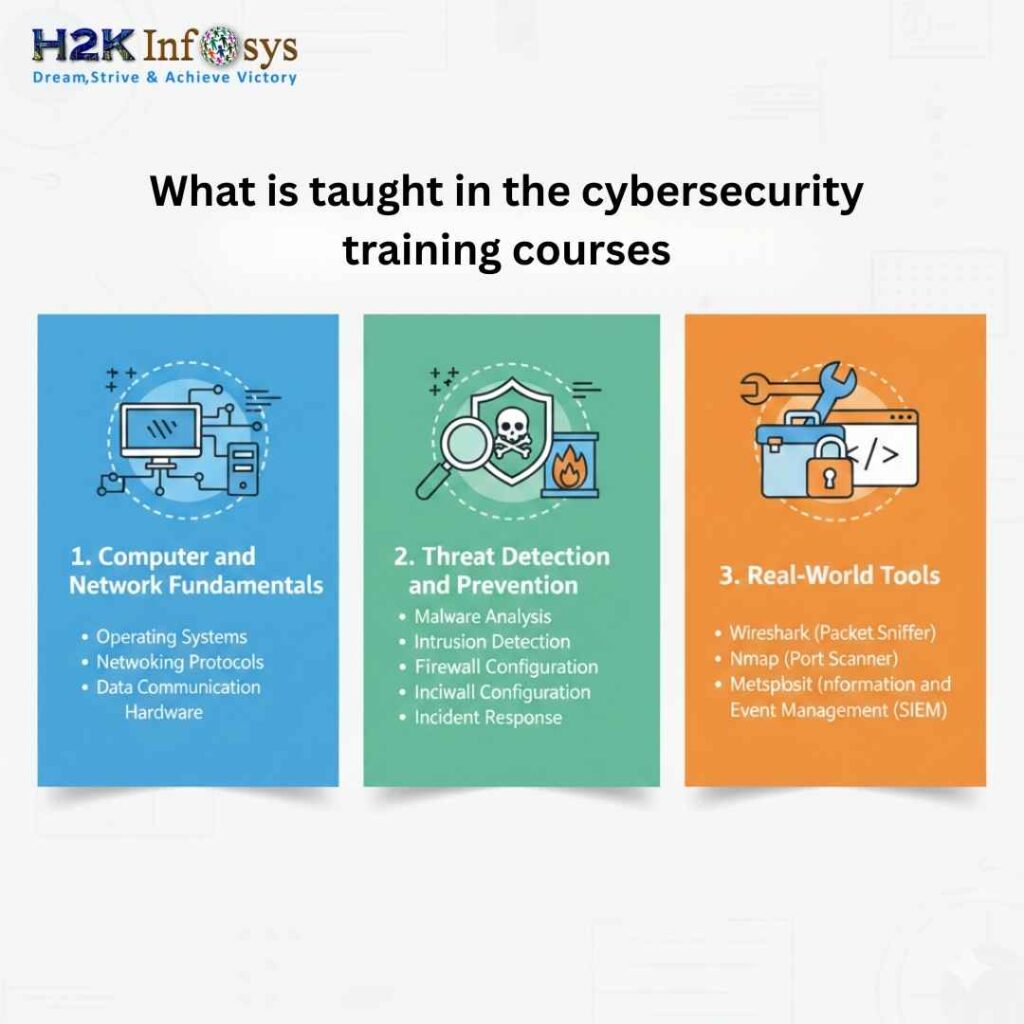
The majority of beginner cybersecurity courses will not teach you advanced subjects. Instead, they will teach you the building blocks of a cybersecurity career.
1. Computer and network fundamentals
You will be learning how data communication works, how the internet operates and how systems can be compromised.
You will also learn about
- IP addresses
- Firewalls
- Servers
- Operating systems
While these subjects may seem overwhelming at first, they will be taught to you in a simple manner.
2. Threat Detection and Prevention
You will understand how systems are attacked and how businesses defend themselves. This includes:
- Phishing Attacks
- Malware
- Weak Passwords
- Social Engineering
These are some of the threats businesses face on a daily basis.
3. Real Work Tools
Modern courses have realistic simulations. You will have practical training by using the same tools current security analysts use.
This is the training that cyber security courses with job placement programs offer. They emphasize practical work over the theory.
Cybersecurity is not just technical. There are many different paths you can take.

A common misconception is that cyber security is wearing black hoodies and coding in a dark place. While this can describe one subfield of the area, it is far from the truth
There are many entry-level roles, including:
- Security Analyst
- SOC Analyst (Security Operations Center)
- Risk Analyst
- Compliance Analyst
- Cybersecurity Sales Specialist
The last job title is surprising to many people. Cybersecurity sales training prepares people to assist organizations in selecting appropriate security solutions. For sales or business graduates, these positions are great because they combine communication and cyber knowledge.
The truth is, there is a vast gap in the job market for cyber security sales. This is because many organizations are investing in security tools.
Example with Real Experience: What is Causing This Surge in Demand
Healthcare, telecommunications, and banking all suffered massive data breaches due to large-scale corporate attacks in 2024 and 2025, impacting millions of users.
A large data breach in a healthcare company is one example where sensitive data of patients was compromised, and the company began hiring aggressively for cybersecurity positions, even at the most junior level.
This is the trend for 2026.
Companies now understand that prevention is better than cure, and rather than hiring only senior personnel, there is a trend of hiring junior personnel who have the ability to supervise the system and take corrective action.
Thus, the flooding of junior cybersecurity positions with a training component, companies have taken a willingness to educate new employees.
What Cybersecurity Employers Want
When hiring junior cybersecurity professionals, employers typically want:
- An open outlook for learning
- A problem-solving culture
- Some technical background
- Some level of advanced training
They don’t expect novices to know everything.
I have talked to most hiring managers, and they have told me they prefer practical training candidates to theory only candidates.
This is where job placement programs for cyber security training stand out, they align with the real needs of employers.
How Training Programs Help Beginners Succeed
Good cybersecurity training programs typically provide:
• Beginner-friendly curriculum
• Hands-on labs
• Real attack simulations
• Resume and interview coaching
• Job placement assistance
Some programs even connect you directly with employers.
This answers the question that most beginners have: “What happens after I finish training?”
Is Cybersecurity Hard for Beginners?
It is challenging, but it is not impossible.
It is more about consistency than it is about intelligence.
The most challenging part is not the technology; it is learning the new concepts and maintaining the consistency.
The first few weeks may feel strange because you have not worked in tech
before, but after you understand the basics, the most important part is to make
sure that you are not stuck.
Cybersecurity is like learning a new language. In the beginning, nothing makes sense, but then you start to see the patterns and it starts to flow.
Who Is Cybersecurity Training Best Suited For?
Cybersecurity is particularly suitable for people who:
• Are looking to make a career switch into tech
• Want a secure job with low risk and good potential for growth
• Want to engage in problem solving
• Are curious about how things work
• Are looking for a career with potential for many years
• Are willing to work
• Are not needing to have a tech or IT degree
Salary Expectations for Beginners
Entry-level cybersecurity salaries are already competitive.
Depending on location, beginners usually make considerably more than many conventional entry-level jobs.
And in cybersecurity, salaries increase quickly as you gain more experience.
Professions usually move up to better paying positions within a few years, such as:
• Security Engineer
• Threat Analyst
• Security Consultant
This pathway offers excellent long-term growth potential.
Conclusion
You do not need IT experience to begin cybersecurity sales training. The industry invites newcomers, many successful professionals began in the exact same position as you.
There are a huge number of positions in cybersecurity that require training, as the number of cyber threats continues to increase.
The right training program along with consistency, and a focus on practical skills is the way to go.
The field of cyber security is rapidly expanding, and is open to all who are interested in learning and applying themselves. If you have been considering this, the time to act is now.