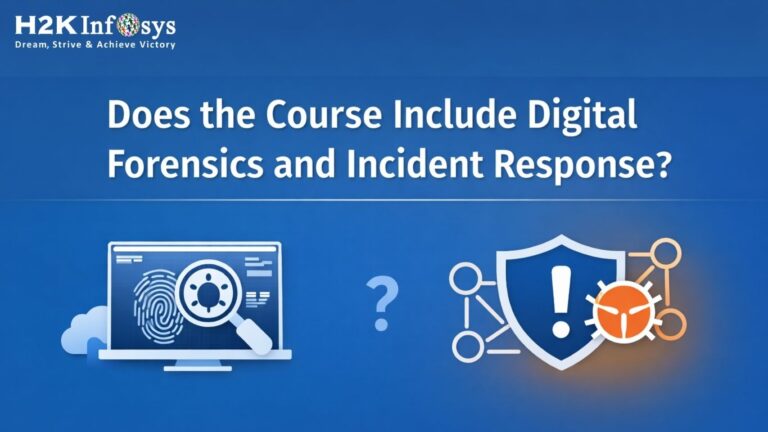
Yes, most organized Cyber Security Training Online programs, like those made by H2K Infosys, cover digital forensics and incident response from the ground up to an advanced level. This is because these are important tasks for modern security teams. In cyber security training with job placement–focused programs, learners typically study investigation basics, evidence handling, log analysis, and structured incident response workflows aligned with enterprise security standards.
What is Digital Forensics and Incident Response?
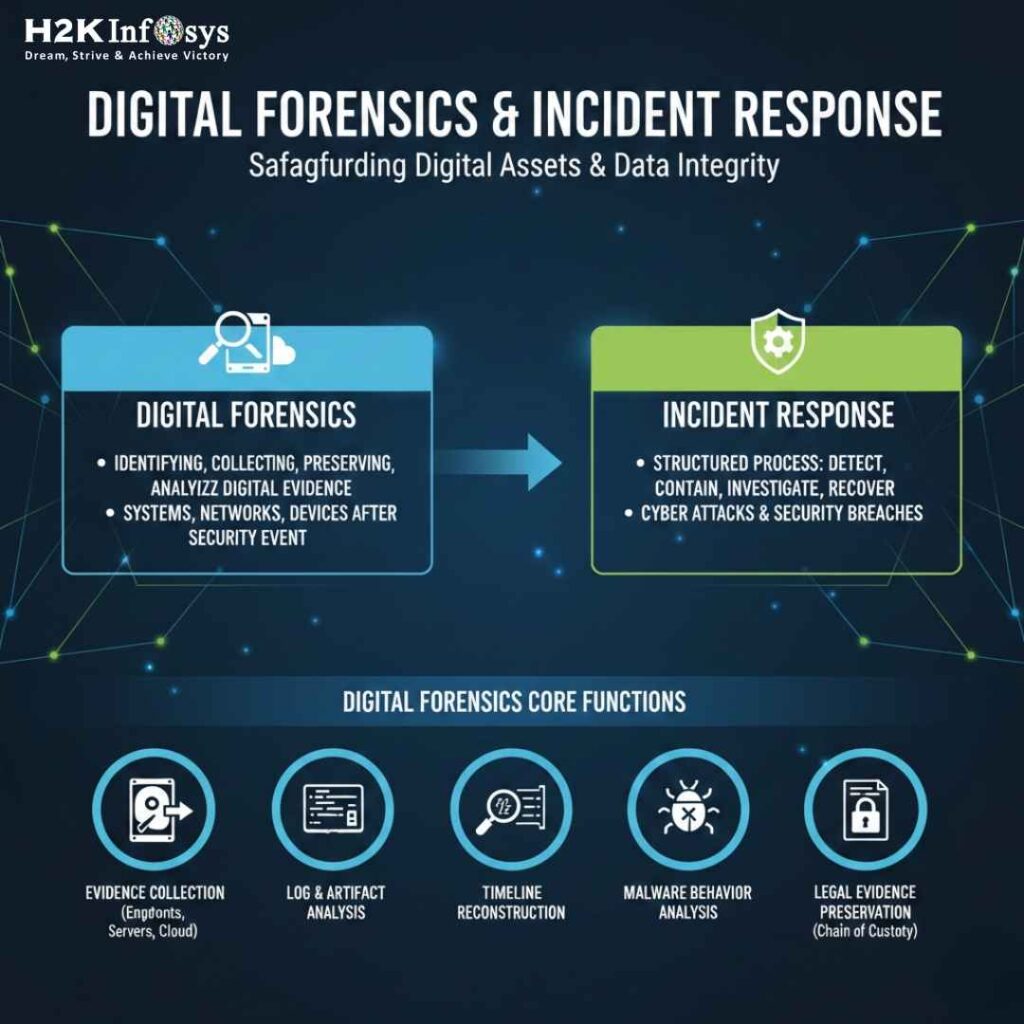
Digital forensics is the process of identifying, collecting, preserving, analyzing, and presenting digital evidence from systems, networks, and devices after a security event. Incident response is the structured process organizations follow to detect, contain, investigate, and recover from cyber attacks or security breaches.
Digital Forensics Core Functions
- Evidence collection from endpoints, servers, and cloud systems
- Log and artifact analysis
- Timeline reconstruction
- Malware behavior analysis
- Legal evidence preservation (chain of custody)
Incident Response Core Functions
- Threat detection and validation
- Attack containment
- Root cause investigation
- System recovery and remediation
- Post-incident reporting and improvement
In enterprise environments, these functions work together. For example, incident responders detect and contain threats, while forensic analysts determine how the attack occurred.
How Does Cyber Security Training Online Cover These Skills?
Cyber Security Training Online programs typically integrate digital forensics and incident response through layered learning models:
Foundation Layer
- Security fundamentals
- Threat types and attack vectors
- Operating system security basics
- Networking fundamentals
Technical Layer
- Log analysis tools
- Endpoint investigation
- Memory and disk forensics basics
- Incident response lifecycle frameworks
Practical Layer
- Security monitoring lab simulations
- Attack scenario investigations
- Case-based forensic exercises
- SIEM-based alert triage workflows
Many cyber security jobs with training preparation programs simulate real Security Operations Center (SOC) environments.
Why is digital forensics and incident response important for people who work?
Organizations today work in contexts where threats are always present. Alerts must be answered by security staff in minutes, not days.
Importance for Businesses
- Investigations into compliance with regulations
- Finding insider threats
- Getting back from ransomware
- Investigations into data breaches
- Preparing legal proof
Effect on Business
Without incident response and forensics, attacks go unnoticed for longer.
- More data is lost
- Risks of not following the rules grow
- Costs of recovery go up
Professionals who have gone through cyber security sales training or operational security programs often talk to clients or internal teams about how these methods lower risk.
How Is Incident Response Used in Real-World IT Projects?
Example Enterprise Incident Response Workflow
| Phase | Real Task | Tools Used |
| Detection | SIEM alerts triggered | Splunk, QRadar |
| Triage | Analyst validates alert | EDR tools |
| Containment | Block malicious IP | Firewall, EDR |
| Investigation | Analyze system artifacts | Autopsy, Volatility |
| Recovery | Restore systems | Backup systems |
| Lessons Learned | Improve controls | Security frameworks |
What Skills Do You Need to Take Cyber Security Training Online?
Skills in Technology
- Basics of networking
- Knowledge of operating systems like Windows and Linux
- Basic scripting languages like Python and PowerShell
- Understanding log analysis
- Basic information on threat intelligence
Skills for Analysis
- Recognizing patterns
- Finding the root reason
- Understanding evidence
- Setting priorities for risks
Knowledge of the Process
- The NIST model for the incident response lifecycle
- Steps for keeping evidence safe
- Standards for documentation
How do businesses use digital forensics?
People often utilize digital forensics in:
Operations for Security
- Investigations into malware
- Detecting insider data theft
- Analysis of unauthorized access
Legal and Compliance
- Investigations into legal and compliance audits
- Reporting to the government
- Getting ready for legal case evidence
Security in the Cloud
- Analysis of cloud activity log
- Investigation into IAM abuse
- Finding abuse of APIs
Industry Tools Commonly Introduced in Training
| Category | Tools |
| SIEM | Splunk, IBM QRadar |
| Endpoint Detection | CrowdStrike, Microsoft Defender |
| Forensics | Autopsy, FTK, EnCase |
| Memory Analysis | Volatility |
| Network Analysis | Wireshark |
| Threat Intelligence | MISP, VirusTotal |
These tools are widely adopted in enterprise security operations.
What Job Roles Use Digital Forensics and Incident Response Daily?
Security Operations Roles
- SOC Analyst
- Incident Responder
- Threat Hunter
Investigation Roles
- Digital Forensics Analyst
- Malware Analyst
- Cyber Crime Investigator
Strategic Security Roles
- Security Engineer
- Blue Team Analyst
- Security Consultant
Professionals entering cyber security jobs with training pathways often start in SOC roles and later specialize.
What Careers Are Possible After Learning Cyber Security Training Online?
Entry-Level
- Junior SOC Analyst
- Security Monitoring Analyst
- Vulnerability Assessment Analyst
Mid-Level
- Incident Response Specialist
- Forensic Investigator
- Threat Intelligence Analyst
Advanced
- Security Architect
- DFIR (Digital Forensics & Incident Response) Specialist
- Security Operations Manager
Example of a Real Project Scenario: Investigating an Incident
Scenario
The company sees strange outgoing traffic from a finance server.
Response in Steps
- SIEM sends out a warning for an abnormality.
- Analyst checks traffic pattern
- The endpoint tool separates the server
- Image of the crime scene taken
- Malware analysis was done
- Data theft confirmed
- Report of the incident made
- Updated security controls
Integrating learning paths with business standards
Most programs make sure that training is in line with:
- NIST Framework for Responding to Incidents
- ISO 27001 Security Controls
- CIS Security Controls
- Mapping Threats with MITRE ATT&CK
These frameworks help teams make their inquiry methods the same.
Role vs Skill Mapping Table
| Role | Core Skills |
| SOC Analyst | Log analysis, alert triage |
| Incident Responder | Threat containment, investigation |
| Forensic Analyst | Evidence recovery, disk analysis |
| Threat Hunter | Behavioral detection, anomaly analysis |
Frequently Asked Questions
Is digital forensics part of every cyber security training program that includes job placement?
Most of them incorporate the essentials of investigation and incident response protocols, but not necessarily at higher levels.
Is it necessary to know how to code for digital forensics?
Basic scripting skills are helpful but not required for entry-level jobs.
Is working in incident response stressful?
There may be time-sensitive situations, but organized processes help teams handle their burden well.
How long does it take to understand the basics of DFIR?
Most students acquire the basics in 3 to 6 months of concentrated study and laboratories.
Are these abilities useful in cloud settings?
Yes. Cloud forensic investigation is becoming a routine necessity.
Main Points
- Digital forensics and incident response are two of the most important parts of enterprise security.
- Most online Cyber Security instruction programs incorporate basic DFIR instruction.
- These abilities are necessary for SOC, investigation, and threat response jobs.
- Enterprise tools and frameworks change the way things work in the real world.
- To be ready for a job, you need to get hands-on experience in a lab.
Check the H2K Infosys Cyber Security classes to learn how structured training settings teach real-world DFIR operations.
Look over the course tracks to learn how the hands-on laboratories help people move up in their careers in security operations and investigations.