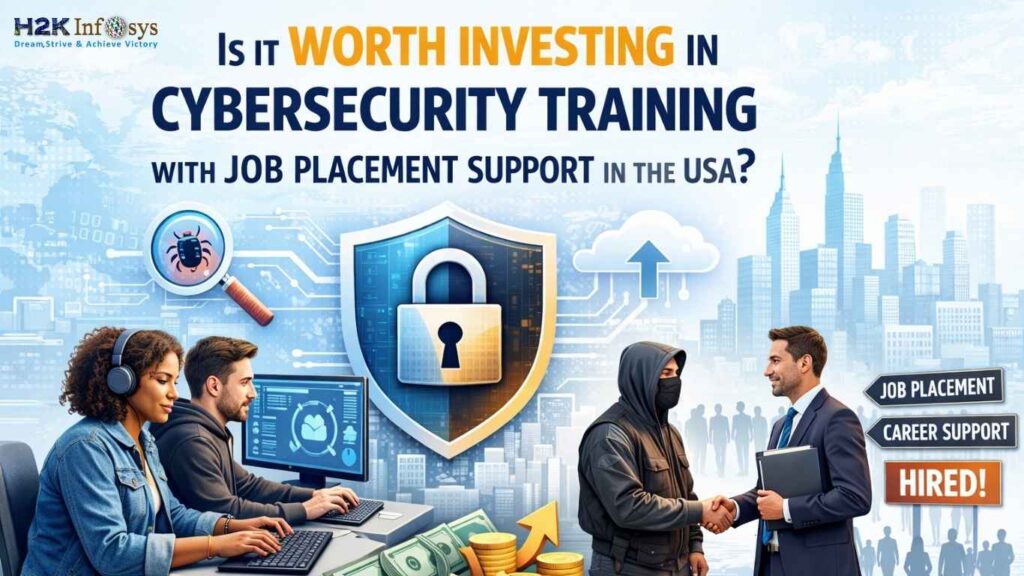
Yes, H2K Infosys Cyber Security program provides training that includes interview preparation and career coaching guidance, not just technical training. H2K puts purposeful emphasis on program realism to assist participants to transition into actual positions as cyber security professionals, including training on resume presentation and critiques, mock interviews, and real time situational exercises.
But honestly, that’s just part of the truth. The real value of a trade program lies not in what the course description entails, but in the overall value received when being interview preparation for the working world post training.
Let’s put this into a real world and practical format.
The unassumed value of interview training.
Many people still believe that the tools with the greatest perceived value to a Cyber Security Analyst, such as Splunk, the SIEM tools and all vulnerability scanning tools are supposed to net immediate success. Such an assumption has a well documented history of failure. Recruiters and interview preparation are most often offended when entering an interview with an interviewer’s mindset and being unprepared to exercise the fullest extent of the interviewee’s predicated decision-making skills.
Taking as an example an interview for a Security Analyst, a hiring manager may ask, “What steps do you think should be implemented to mitigate risks for an organization that have been subjected to multiple unauthorized access (hacked) and information theft (data breach) attacks?”.
This is not a question that has a right or wrong answer in a textbook. They are looking for an applicant’s rational or thought process.
Program providers are now focused on developing more advanced and relevant curriculum. As such, the differentiation of programs that bundle job placement assistance and cybersecurity training are becoming more attractive than those offering basic technical skills training. For instance, H2K Infosys employs interview preparation simulation techniques and trains participants on how to speak and act as though they have experience as opposed to just reading prepared answers.
This focus is incredibly time sensitive.
In response to ransomware attacks targeting the global healthcare and financial systems, organizations began opening positions for SOC Analysts, Cloud Security Specialists and Threat Intelligence roles. These roles will have high demand in 2025 and 2026. Companies are seeking candidates with experience as opposed to those with certifications.
What you get from interview preparation at H2K Infosys
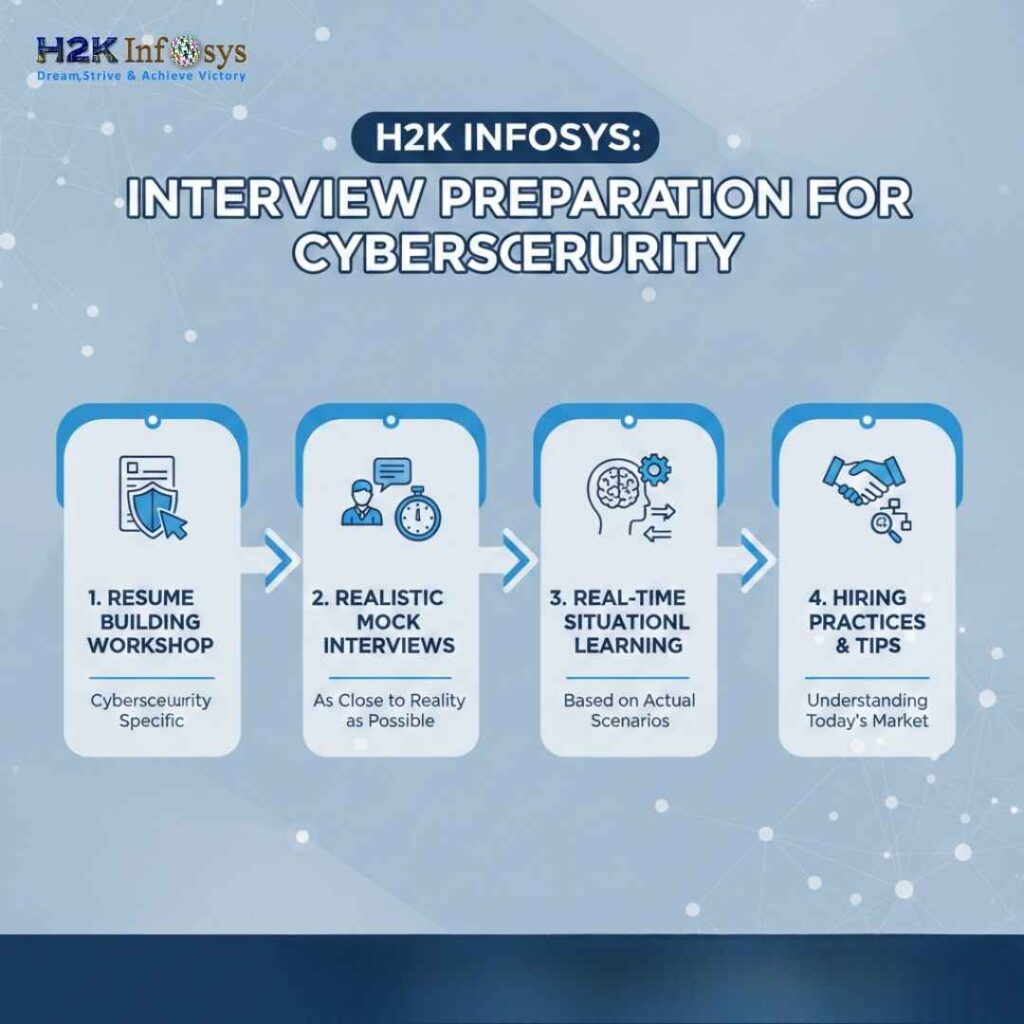
Students have said a lot about how these programs are designed but one thing that is fairly consistent is the interview preparation. This seems to be the area of the program with the most layers.
1. Cybersecurity Specific Resume Building Workshop
This is not a generic resume class. It is specific to the security roles.
Instead of saying:
“Completed cybersecurity Course”.
They will assist you in framing your experience as:
“Performed log analysis using SIEM tools to detect unauthorized access attempts in simulated enterprise environments.”
Hiring managers recognize that as the real thing and it is going to give you a good chance at getting the interview.
I recall a few years ago I was evaluating resumes for an IT consulting company. Those candidates that explained work done in labs were more likely to get interview preparation requests than candidates that just listed certifications.
2.Mock Interviews that are as Close to Reality as Possible
I’m afraid this might be the single most important thing of all.
Students have to go through mock technical interview preparation to answer the following questions:
- How does SIEM work to uncover insider threats?
- What are the next steps after the identification of a phishing attack?
- How do you respond to and investigate network traffic that is suspicious?
The answers to these questions and others that I have not mentioned are not coincidental. They are expected in most if not all SOC Analyst and cyber security sales training environments when working with clients and stakeholders.
And yes, training in cyber security sales is a good thing. Security specialists need to be able to convey the risks, defend their recommendations, and rationalize their recommendations to the management of a company in a non-technical interview preparation way. It is, in fact, one of the most important aspects of their job.
3.Learning in Real-Time Based on Actual Situations
One of the things that is always very evident in a program such as H2K Infosys is the teaching of scenarios
Instead of simply describing what malware does, students engage in simulations of real life incidents.
They may review cases such as:
- Suspicious logins
- Malware alerts in SIEM dashboards
- Network traffic anomalies
This is the sort of critical thinking that employers want.
Companies are evolving in their hiring practices.
They are targeting entry-level applicants who possess strong investigative skills. This is why the market is flooded with cyber security job positions that include training, labs, and interview preparation.
4. Tips on Understanding Today’s Hiring Practices
This is the most important tip, although often the most ignored.
In 2026, cyber security hiring is not going to be done by throwing job applications at multiple listings. Many positions are filled by
- Recruiter networks
- Internal referrals
- Training program placement
H2K Infosys is one of the programs that shows students:
- Where to apply
- How to connect with recruiters
- Strategies for effective self-presentation
- How to maintain contact post interview
This may seem trivial, but it becomes the difference between success and failure.
Navigating the hiring system is as critical as having strong technical skills, and, in many cases, it is the only factor that leaves candidates with strong cyber security skills without job offers.
The Rapid Growth of Cyber Security Offers Index
The Increasing Need for Cyber Security Experts has made the field increasingly competitive.
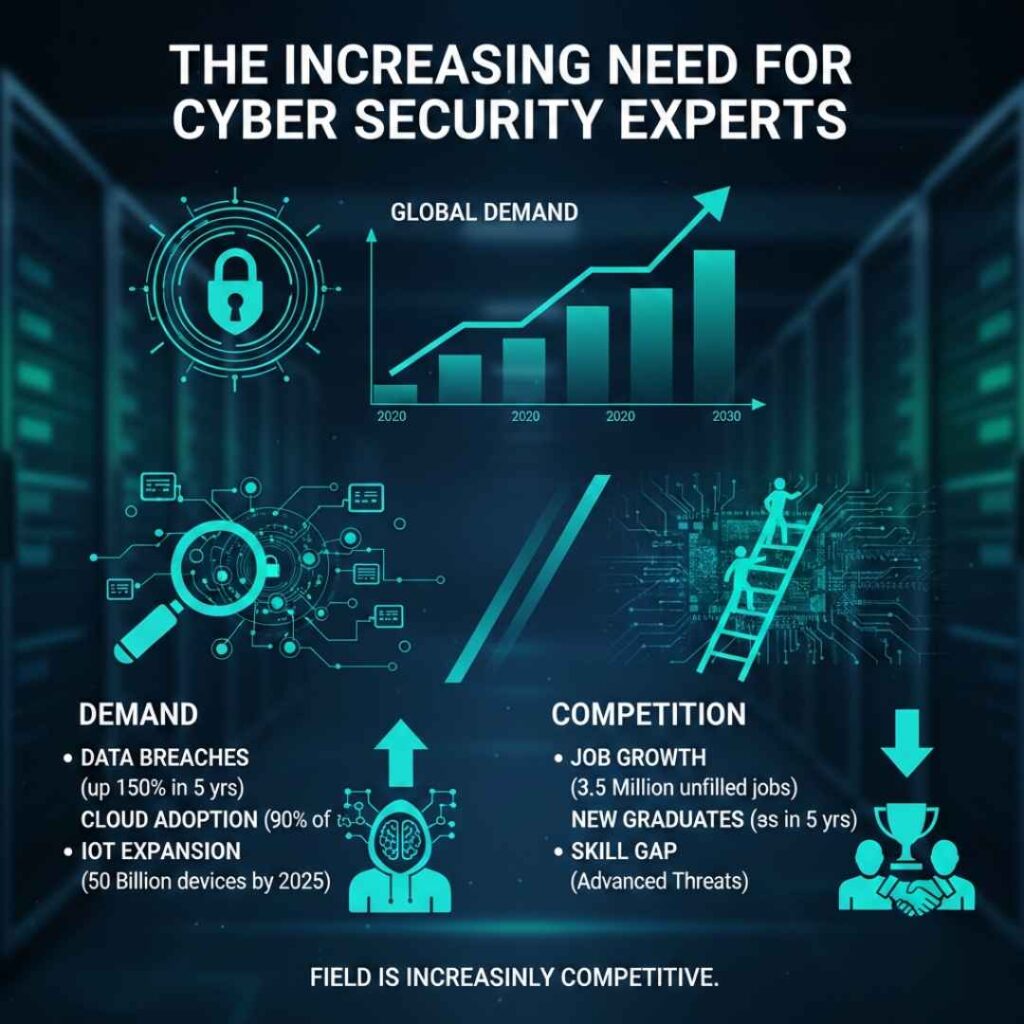
Based on hiring forecasts for 2025 and 2026, companies within all fields will be allocating more funds for hiring focused on security. Increased need for security hiring is fundamental in relation to cloud computing, remote jobs, and AI based cyber threats.
These roles represent some of the highest demand:
- SOC Analyst
- Cloud Security Engineer
- Security Operations Specialist
- Threat Intelligence Analyst
Several of these positions can be obtained via cyber security training with a job placement component, particularly if interview preparation coaching is included.
Employers want candidates to be ready, they understand entry-level candidates will not have years of experience.
- Can you analyze a problem?
- Can you articulate your thought process?
- Can you remain calm during a situation?
Those skills are what interview coaching develops.
Why Practical Guidance Is Especially Important for Career Changers
Currently a large cohort of learners in cyber security strands are coming from outside IT
I’ve spoken with individuals coming from
- Customer support roles
- Sales
- Network administration
- Even completely unrelated industries
These candidates, in the absence of interview preparation coaching, find it particularly difficult to convert their experience into something relevant to cyber security.
However, with adequate scaffolding, they are able to articulate skills such as:
- Attention to detail
- Incident Handling
- Communication
- And align them with security roles.
This is where experience in cyber security sales training could even become a merit. Experts with sales or customer-interactive experience typically thrive in security positions that require communication, risk justification, and stakeholder management.
An Example: The Impact of Interview Prep
I spoke to a learner who had basic cyber security certifications. She was not receiving a single call for an interview.
When she got into a training program that had a component of interview preparation, she made three major transformations:
Restructured her resume
Engaged in mock interviews
Was able to articulate her lab experience
She started getting interview calls within two months and finally, got a job as SOC Analyst.
The extent of improvement in her technical knowledge was comparable to the improvement in the quality of her self-presentation. That’s the difference that interview preparation makes.
The Confidence Element
There is an aspect that is not obvious but extremely valuable: confidence.
There is an air of uncertainty when you prepare to walk into an interview. You hesitate. You doubt yourself.
Once you go through the mock interviews, you understand the true expectations of the interviewers, and everyone else in the room is able to relax and speak in a more conversational manner.
They are not speaking like students anymore.
You can tell the difference from a big group of students.
Final Thoughts:
Yes, interview preparation and career services are included in the H2K Infosys Cyber Security program, and the truth is, that component is as important as the technical training.
In the current employment landscape, having adequate knowledge of a particular field is no longer sufficient. Employers prioritize candidates who possess the required knowledge, and can reason, articulate, and mitigate security challenges. Programs that integrate sufficient practice and the ability to simulate the interview process ensure that candidates improve their prospects of obtaining cyber security positions and employment-oriented training.
In particular, the cyber security sector will be lucrative, but highly competitive in 2026. This means that cyber security training and job placement and organized interview preparation training is invaluable. It is invaluable because learning about cyber security is only undertaking the first of a two-part process.
The second entails studying how to secure a job in cyber security, which will mark the beginning of significant career advancement.