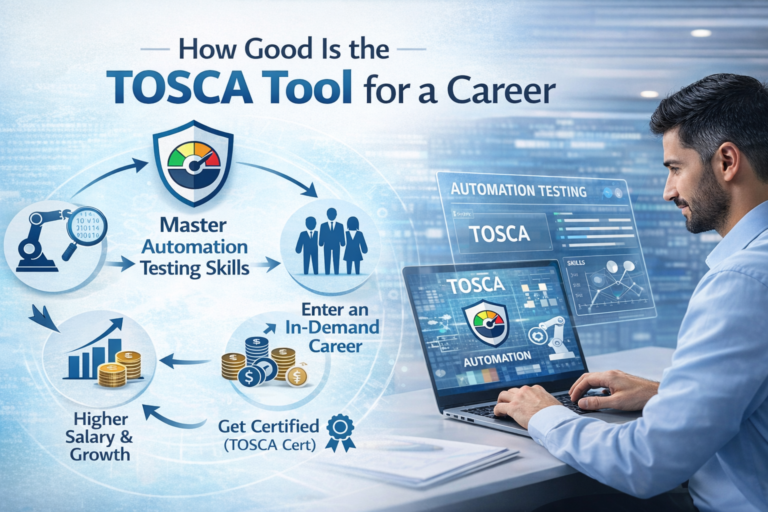
Automation testing has changed the way companies build and release software. Businesses now want faster releases, stable applications, and better test coverage. Because of this demand, automation testing tools have become very important in the software industry. One tool that stands out in this field is TOSCA. Many learners who join H2K Infosys training programs often ask whether learning TOSCA can truly help them build a strong testing career. The answer depends on understanding the value of the TOSCA tool for a career in modern QA environments.
This guide explains how TOSCA works, why companies use it, and how professionals can build a strong automation testing career by learning it. You will also learn about training, certification, and real-world job opportunities.
The Growing Demand for Automation Testing
Software testing has changed a lot in the last decade. Companies release software updates faster than ever before. Manual testing alone cannot handle this speed.
Industry reports show that:
- The global automation testing market continues to grow every year.
- Companies prefer automation tools that reduce testing time.
- Skilled automation testers earn higher salaries than manual testers.
This shift creates strong demand for tools like TOSCA. Many organizations now prefer candidates who understand automation frameworks and test automation tools.
This trend is one major reason why many professionals now consider the TOSCA tool for a career in automation testing.
What Is TOSCA?
TOSCA is a modern automation testing tool developed by Tricentis. It supports end-to-end test automation across different platforms.
TOSCA allows testers to automate:
- Web applications
- Mobile applications
- Desktop software
- APIs and microservices
- Enterprise applications like SAP
The main feature of TOSCA is model-based testing. This approach removes the need for heavy coding.
Instead of writing complex scripts, testers build test cases using reusable modules.
Key Features of TOSCA
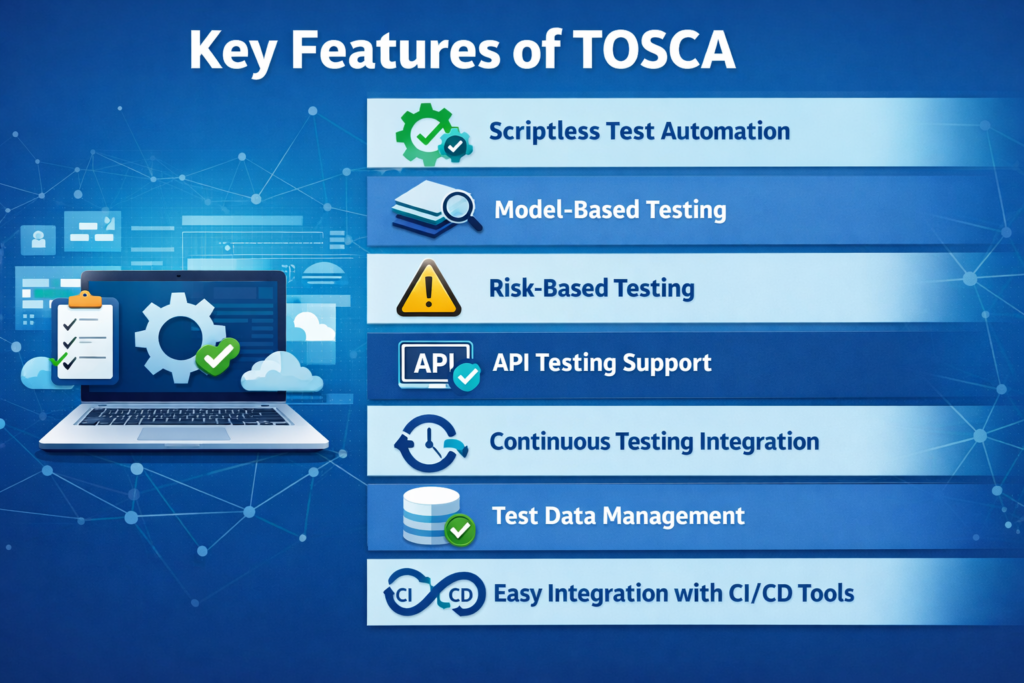
- Scriptless test automation
- Model-based testing
- Risk-based testing
- API testing support
- Continuous testing integration
- Test data management
- Easy integration with CI/CD tools
These features make the TOSCA tool for a career a strong option for beginners and experienced testers.
Why Companies Prefer TOSCA
Many companies now choose TOSCA because it improves testing efficiency.
1. Scriptless Automation
Traditional automation tools require strong programming skills. TOSCA removes this barrier.
Testers can create automated tests using visual models instead of long scripts.
This makes the TOSCA tool for a career ideal for manual testers who want to move into automation.
2. Faster Test Creation
TOSCA uses reusable modules. Testers can build multiple test cases using the same components.
This saves time and improves productivity.
3. Strong Enterprise Support
Large companies use complex systems such as SAP, Salesforce, and Oracle. TOSCA supports testing across these platforms.
Because of this capability, many enterprise organizations hire testers who understand the TOSCA tool for a career in automation testing.
4. Continuous Testing Support
Modern development teams use DevOps and CI/CD pipelines. TOSCA integrates with tools that support continuous testing.
This helps teams release software faster without compromising quality.
How TOSCA Works in Automation Testing
Understanding how the tool works helps professionals see the value of the TOSCA tool for a career in QA automation.
Step 1: Application Scanning
TOSCA scans the application and identifies UI elements.
These elements become reusable objects.
Step 2: Module Creation
The tool creates modules from the scanned elements.
Testers use these modules to build test steps.
Step 3: Test Case Design
Testers combine modules to create test cases.
This process removes the need for long scripts.
Step 4: Test Execution
Testers run automated tests across different environments.
The system generates detailed reports.
Step 5: Test Maintenance
Reusable modules reduce maintenance effort when the application changes.
This workflow shows why many professionals choose the TOSCA tool for a career in automation testing.
Skills You Learn in a TOSCA Automation Course
A good TOSCA Automation Course teaches both theory and hands-on skills.
Learners typically gain the following skills:
Core Automation Skills
- Test automation fundamentals
- Model-based testing
- Test case design
- Automation framework understanding
Technical Skills
- UI test automation
- API testing
- Test data management
- Continuous testing integration
Practical Project Experience
Good training programs include real-time projects where students automate real applications.
These projects help learners understand how companies use the TOSCA tool for a career in real testing environments.
Importance of Tricentis TOSCA Certification
Certification validates your automation skills.
The Tricentis TOSCA Certification path usually includes multiple levels:
AS1 Certification
This level covers basic concepts and navigation.
AS2 Certification
This level focuses on advanced test design and automation.
Test Automation Engineer Certification
This certification proves professional automation expertise.
Certified testers often stand out during hiring. Recruiters often search for professionals who understand the TOSCA tool for a career in enterprise testing projects.
Real-World Example of TOSCA in Action
Consider a large banking company.
The company launches new online banking features every month.
Manual testing alone would slow down the release process.
The QA team uses TOSCA to automate regression testing.
Automation helps the team:
- Run hundreds of tests quickly
- Detect defects early
- Maintain test stability
The team saves many hours during every release cycle.
This example shows how the TOSCA tool for a career becomes valuable in large enterprise environments.
Career Opportunities After TOSCA Training
Professionals who complete TOSCA Online Training can apply for many automation roles.
Common job titles include:
- Automation Test Engineer
- QA Automation Engineer
- Software Test Engineer
- Test Automation Architect
- QA Analyst
Many global companies hire testers with TOSCA skills.
These companies include:
- Banking organizations
- Healthcare companies
- Retail platforms
- Insurance firms
- Enterprise software providers
This demand increases the value of the TOSCA tool for a career in automation testing.
Salary Potential for TOSCA Professionals
Automation testing professionals often earn strong salaries.
Several factors affect salary:
- Experience level
- Certification level
- Company size
- Location
Entry-level automation testers earn competitive salaries compared to manual testers.
Experienced automation engineers earn significantly higher pay.
This financial growth motivates many learners to pursue the TOSCA tool for a career in software testing.
Who Should Learn TOSCA?
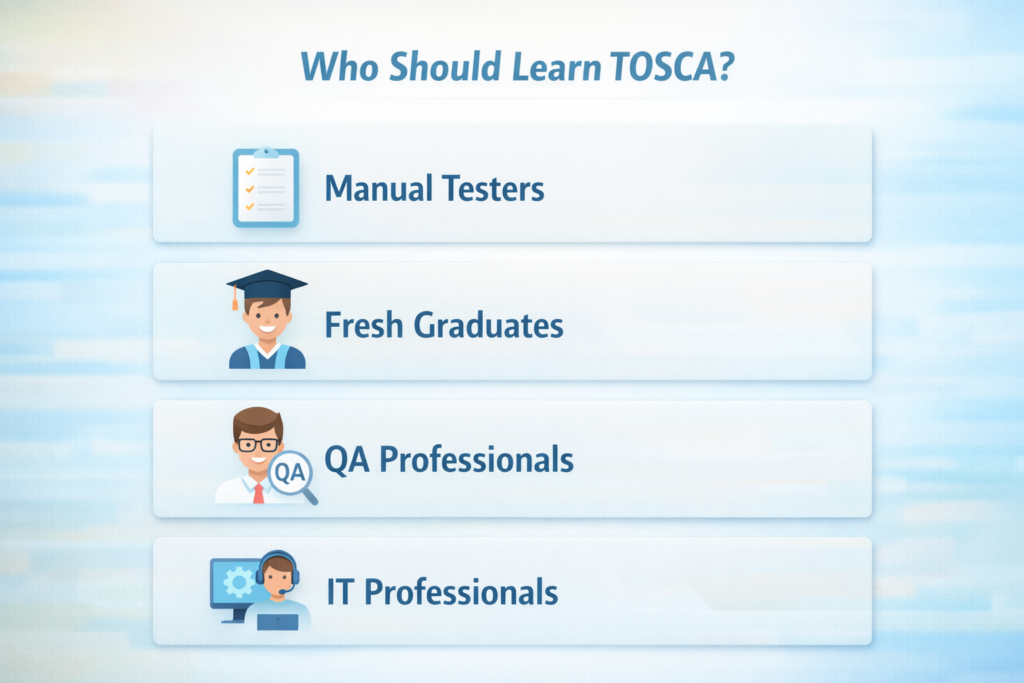
TOSCA is suitable for many types of professionals.
Manual Testers
Manual testers can easily transition into automation.
The scriptless approach makes learning easier.
Fresh Graduates
Graduates who want to enter software testing can start with automation skills.
QA Professionals
Experienced testers can upgrade their skill set with automation expertise.
IT Professionals
Developers and analysts can expand their testing knowledge.
All these groups can benefit from learning the TOSCA tool for a career in automation testing.
Why Online Training Helps
Online learning has become very popular in the IT training industry.
TOSCA Online Training offers several advantages.
Flexible Learning
Students can learn from home at their own pace.
Live Instructor Support
Experienced instructors explain real-world scenarios.
Hands-On Practice
Students practice automation tasks using real tools.
Career Guidance
Training programs often include resume preparation and interview support.
These benefits help students prepare for jobs that require the TOSCA tool for a career in software testing.
What to Expect in a TOSCA Training Program
A structured training program typically includes the following modules:
Module 1: Automation Testing Basics
- Software testing fundamentals
- Automation vs manual testing
Module 2: TOSCA Overview
- TOSCA architecture
- Tool navigation
Module 3: Module Creation
- Application scanning
- Object identification
Module 4: Test Case Design
- Building reusable test cases
- Model-based test design
Module 5: Execution and Reporting
- Running automated tests
- Understanding reports
Module 6: Advanced Automation
- API testing
- Continuous testing
This structured learning path helps students build strong skills using the TOSCA tool for a career in QA automation.
Advantages of Learning TOSCA
There are many reasons why testers choose this automation tool.
Easy to Learn
The visual design approach simplifies automation.
High Industry Demand
Large companies use TOSCA in enterprise environments.
Less Coding Required
Manual testers can transition into automation faster.
Scalable Automation
The tool supports testing across many platforms.
Because of these benefits, the TOSCA tool for a career continues to attract many professionals in the testing field.
Challenges to Consider
Every technology also has some challenges.
Tool Licensing
TOSCA requires enterprise licensing, so smaller companies may not use it.
Learning Curve
Model-based testing requires practice to master.
Competition
Automation testing is competitive, so strong skills are important.
However, proper training and hands-on practice can help learners overcome these challenges when pursuing the TOSCA tool for a career.
How to Start Your TOSCA Career
If you want to build a career in automation testing, follow these steps.
Step 1: Learn Automation Basics
Understand testing concepts and automation principles.
Step 2: Join a TOSCA Automation Course
Structured training helps learners understand the tool faster.
Step 3: Practice with Real Projects
Hands-on experience improves confidence.
Step 4: Earn Certification
The Tricentis TOSCA Certification validates your skills.
Step 5: Prepare for Interviews
Practice automation scenarios and test design questions.
These steps help professionals build strong expertise in the TOSCA tool for a career in automation testing.
Future of TOSCA in the Testing Industry
Automation testing will continue to grow in the coming years.
New technologies such as AI testing and continuous delivery will increase automation demand.
Enterprise organizations already rely on TOSCA for large testing environments.
As companies adopt faster development cycles, automation tools will become even more important.
Because of this trend, many experts believe the TOSCA tool for a career will remain highly valuable in the software testing industry.
Key Takeaways
- Automation testing demand continues to grow in the software industry.
- TOSCA supports scriptless automation through model-based testing.
- The tool works well for enterprise applications like SAP and large platforms.
- Professionals can learn automation through structured TOSCA Online Training.
- Certification such as Tricentis TOSCA Certification improves job opportunities.
- Real project practice helps learners gain practical automation experience.
- Automation testing roles offer strong salary growth.
- Many global companies hire testers with TOSCA skills.
Conclusion
Automation testing is a critical skill in modern software development. Learning the TOSCA Automation Course can help professionals move from manual testing into high-demand automation roles.
Start your training today and build strong automation skills with expert guidance at H2K Infosys. Your journey toward a successful testing career can begin now.