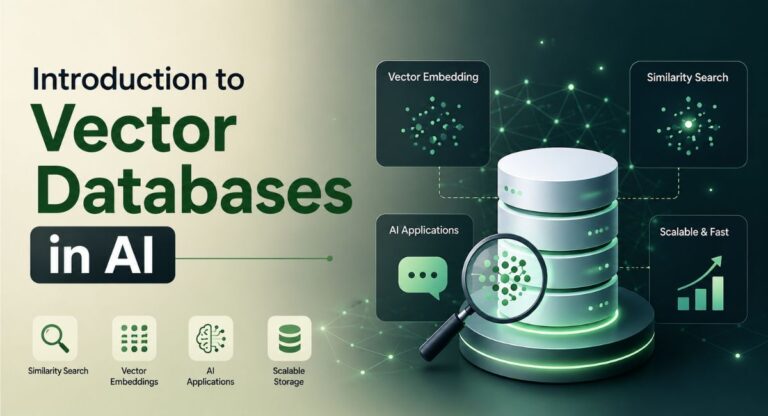
Large amounts of data in the field of artificial intelligence (AI) need to be handled and processed effectively. The complexity of data increases when we delve into more sophisticated AI applications like picture recognition, voice search, or recommendation engines. Vector Databases in AI come into play in this situation. Databases in AI, in contrast to conventional databases, which store scalar values, are specifically made to manage multi-dimensional data points, also known as vectors. These vectors, which carry data in several dimensions, can be compared to arrows in space that point in a specific magnitude and direction.
Vector databases have become essential tools for storing, accessing, and analysing high-dimensional data vectors as the digital age propels us into an era dominated by AI and machine learning. The goal of this article is to give readers a thorough grasp of what vector databases entail, particularly focusing on the critical role of Vector Databases in AI. Check out the online Artificial intelligence course to learn more about Vector Databases in AI.
What is a Vector Databases in AI?
A vector database is a specialized database designed to store, search, and retrieve vector embeddings numerical representations of text, images, audio, and other data. In AI applications, vector databases help systems find information based on meaning or similarity, rather than just exact keyword matches.
For example, in an AI chatbot, a vector database can quickly find documents that are semantically similar to a user’s question and provide them to an AI model for generating a relevant answer.
Popular examples of Vector Databases in AI include Pinecone, Milvus, Weaviate, and Chroma, which provide unique functionalities for various AI applications.
Examples: Pinecone, Milvus, Weaviate, and Chroma.
A vector Databases in AI, for instance, allows you to:
- Look for music that has a similar melody and rhythm to a certain tune.
- Find articles having a similar theme and viewpoint as another specified one.
- Find devices that are similar to a particular device in terms of features and user ratings.
How Does a Vector Database Work?
In conventional databases, tables are used to hold simple data like words and numbers. However, vector databases use distinct methods for searching and deal with sophisticated data types called vectors.
Vector databases use precise metrics of similarity to find the closest match, as opposed to normal databases, which hunt for exact data matches.
Approximate Nearest Neighbour (ANN) search, which uses hashing and graph-based searches, is a special type of search used by vector databases.
We must first comprehend the idea of embeddings in order to fully comprehend the operation of vector databases and how they differ from conventional relational databases like SQL.
Traditional databases struggle to store unstructured data because they lack a set format, such as text, photos, and audio. This data is translated into numerical representations using embeddings so that it can be used in applications for artificial intelligence and machine learning.
Giving each thing, whether it’s a phrase, an image, or something else, a special code that captures its meaning or essence is what embedding is like. This coding aids computers in comprehending and evaluating these elements more quickly and effectively. Imagine reducing a lengthy book to a succinct synopsis that still conveys the essential ideas.
The conventional method for achieving this embedding process is to use a unique form of a neural network created specifically for the job. Word embeddings, for instance, turn words into vectors so that words with similar meanings are closer in the vector space.
Algorithms can comprehend linkages and similarities between things because of this transformation.
In essence, embeddings act as a bridge, transforming non-numeric data into a format that machine learning models can use, allowing them to more effectively identify patterns and relationships in the data.
Examples of vector databases
Due to their effectiveness in performing “similarity search,” vector databases, with their distinctive capabilities, are occupying niches in a variety of industries. Here is a more thorough look at their various applications:
Enhancing retail experiences
Vector databases are changing how people shop in the thriving retail industry. They make it possible to create sophisticated recommendation algorithms that curate individualised purchasing experiences. For instance, an online shopper might get product recommendations based on user behaviour and interests as well as similarity analyses of product qualities and past purchases.
Analysis of financial data
There are a ton of complex patterns and trends in the financial industry. Financial analysts can identify patterns essential to investment plans using vector databases, which are excellent at interpreting this dense data. They can foresee market moves and create better investing plans by noticing minute similarities or differences.
The Vector Databases in AI are being utilized extensively for the analysis of complex financial data, allowing analysts to uncover hidden trends.
Healthcare
In healthcare, Vector Databases in AI enable personalized treatments by analyzing patient data more effectively.
Personalization is crucial in the healthcare industry. Vector databases make it possible for more specialised medical treatments by evaluating genomic sequences, ensuring that medical solutions are more closely aligned with unique genetic makeup.
Improving applications for natural language processing (NLP)
The usage of Vector Databases in AI has transformed the capabilities of virtual assistants, making interactions smoother and more intuitive.
Virtual assistants and chatbots are becoming more and more common in the digital world. These AI-driven systems rely significantly on language comprehension. These algorithms are able to understand and reply to human inquiries more precisely by turning enormous amounts of text input into vectors. For instance, businesses like Talkmap use real-time natural language comprehension to facilitate more seamless interactions between customers and agents.
Media analysis
In terms of security, Vector Databases in AI play a vital role in anomaly detection, enhancing fraud prevention efforts.
It’s critical to be able to accurately analyse and comprehend images, whether they come from surveillance film or medical scans. By concentrating on the most important aspects of photos and eliminating noise and distortions, vector databases streamline this process. For instance, images from video feeds can be quickly examined in traffic management to optimise traffic flow and improve public safety.
Finding anomalies
Recognizing similarities and spotting anomalies are equally important. Finding anomalies might mean stopping fraud or averting a potential security breach, especially in industries like finance and security. Vector databases provide improved capabilities in this area, speeding up and improving the detection process.
What Are the Benefits of Vector Databases in AI?
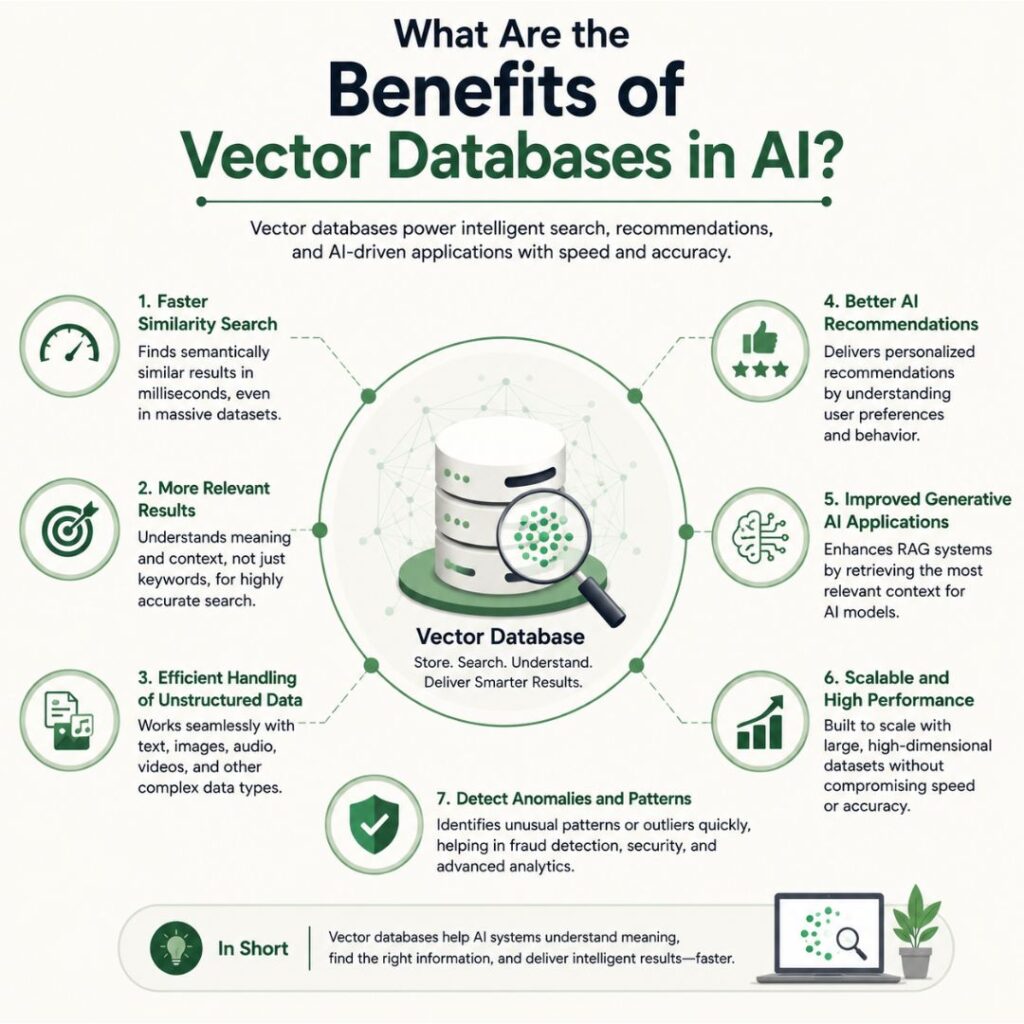
This fits naturally after “How Does a Vector Database Work?” and before the examples/applications section. You can cover benefits such as:
- Faster similarity search: quickly finds data that is semantically similar.
- Better AI recommendations: Helps systems provide more relevant products, content, or results.
- Efficient handling of unstructured data: works with text, images, audio, and other complex data.
- Improved generative AI applications: Supports RAG systems by retrieving relevant context for AI models.
- Scalable AI data retrieval: Can handle large collections of high-dimensional vectors.
- More relevant search results: goes beyond exact keyword matching to understand semantic relationships.
What Are the Applications of Vector Databases?
Vector databases are widely used in Vector Databases in AI applications that require fast similarity and semantic search. Common applications include:
- AI Chatbots – Retrieve relevant information for better responses.
- Semantic Search – Find content based on meaning rather than keywords.
- Recommendation Systems – Suggest relevant products, movies, or content.
- RAG Applications – Provide relevant context to generative AI models.
- Image Search – Find visually similar images and media.
- Fraud Detection – Identify unusual patterns and transactions.
- Personalization – Deliver customized content based on user behavior.
Conclusion
The constant advancement of AI and machine learning highlights the necessity of vector databases in the data-driven society of today. These databases are becoming essential in powering AI-driven applications, from recommendation systems to genomic analysis, thanks to their exceptional capacity for storing, searching, and analyzing multi-dimensional data vectors. You can check out the Artificial Intelligence online course to learn more about vector databases.
Understanding the role of Vector Databases in AI is crucial for anyone looking to leverage advanced AI technologies. Vector Databases in AI efficiently handle the complexities of multi-dimensional data.
FAQs About Vector Databases in AI
1. What is a vector database in AI?
A vector database stores and manages vector embeddings and enables fast similarity searches. It is commonly used in AI applications such as chatbots, recommendation systems, and semantic search.
2. How does a vector database work?
Data is converted into numerical vectors called embeddings. When a user submits a query, the system converts it into a vector and searches for the most similar stored vectors.
3. Why are vector databases important for AI?
Vector databases help AI systems quickly retrieve contextually relevant information, making them useful for generative AI, semantic search, and retrieval-augmented generation (RAG).
4. What is the difference between a vector database and a traditional database?
Traditional databases primarily search structured data using exact values or keywords. Vector databases search data based on similarity and semantic meaning.
5. What are vector embeddings?
Vector embeddings are numerical representations of data that capture its meaning, characteristics, or relationships, allowing AI systems to compare similar pieces of information.