Definitely, and with H2K Infosys, it’s easy for non-technical students to start structured cyber security training and job placements with programs that are more practical rather than heavy on programming. Analysts such as SOC, security, and risk focus more on analytics, problem solving, and tool-based practical experience as opposed to in-depth programming skills. Non-technical learners are able to move into cyber security successfully with the right training, supportive cross-industry training, portfolio projects, and interview prep.
Let’s be real, and let’s break this down, because this question comes up twenty times a day, and especially in relation to career switchers, new starters, and people coming in from non-IT sectors, such as business, healthcare, or even customer service.
What Makes Cybersecurity More Attainable Than Most Assume?
It’s a common misconception that only extreme coding geeks or computer science grads are able to get into cyber security. That was the case, but it’s outdated information, especially in the last 3 to 5 years.
Cybersecurity today depends on certain functions, tools, monitoring systems, and defined processes. You are not developing software systems, but you are investigating alerts and threats and responding to suspicious behaviors.
Take the example of a novice SOC analyst from the United States. They will use the following tools:
- Splunk or SIEM dashboards
- Endpoint detection systems
- Network monitoring tools
- Threat intelligence platforms
These tools report data in the form of graphics. Your role is to find and make sense of existing patterns, investigate the anomalies, and act. More of an investigator than a coder.
In my own experience, I have seen people from backgrounds like retail, teaching, banking support, and the like find their way into cyber security roles after undertaking targeted cyber security training and job placement initiatives.
Reasons Why the Job Market In The USA Is Strongly Positive For Cyber Security Practitioners
The demand for cyber security in the USA is not only high but also ever increasing. Here are the reasons.
1. Cyber Attacks Keep Increasing Every Single Year
In the last two years, major ransomware attacks were recorded on hospitals, airlines, and governmental organizations. Ransomware disrupts the normal running of an organization resulting in loss of millions of dollars.
Due to this, organizations have to recruit even more entry-level cyber security staff to help monitor their systems on a 24/7 basis.
Security personnel have also become a necessity even in smaller organizations.
2. Massive Workforce Gap in Cybersecurity in The USA
The recruitment challenges in the field of cybersecurity recruitment are widely known. It’s commonplace to encounter difficulty in recruiting individuals who have comprehension of tools and workflows surrounding security other than those who have undergone training in computer science.
As such, recruitment in the field of cybersecurity that offers training prospects has become commonplace. Qualified candidates who have practical experience, even in other fields and not in IT, are favored.
This is among the very few roles in the technology industry with modular training that can effectively allow an individual to transition to the role in a period ranging from 6 to 12 months.
3. Junior Positions are Meant to Be Entry-Level
Positions in the field of cybersecurity do not all necessitate a high level of technical know-how.
The following are roles that are known to be entry-level for non-technical graduates:
– SOC Analyst (Securities Operations Centre)
– Cybersecurity Analyst
– Security Analyst
– Risk Analyst
– Vulnerability Analyst
– IT Security Support Specialist
The emphasis in the aforementioned positions is in the area of surveillance, investigations, and the area of reporting as opposed to areas concerning software engineering.
What Skills Non-Technical Students Actually Need
What can be described as the reality of the matter is that there is in fact no need for an individual to assume the role of a developer.
1.What is required is that one has a basic comprehension of how computer systems work.
The following are the most important skills needed:
– An understanding of computer systems is essential.
You will learn the following:
– The basic construction of a network
– The definition of an IP address
– The movement of data among various systems
– The way in which vulnerable systems are manipulated
Although the above mentioned may sound technical, the training programs simplify the concepts to a great extent.
2. Please Describe the Security Tools You Have Encountered
Your real learning begins here.
You will be using the following tools:
- SIEM platforms like Splunk
- Tools for network monitoring
- Vulnerability scanners
- Systems for detecting endpoints
These tools do the majority of the work.
You don’t learn how to create the tools, you learn how to analyze the alerts.
3. Analytical Thought
Most of the work in cybersecurity consists of investigation.
You ask yourself the following questions
- Is this login suspicious?
- Why is this system communicating with an unknown server?
- Is this behavior normal or malicious?
Hands-on labs can help you develop this way of thinking.
4. Basic Technical Concepts (Not Advanced Programming)
You may learn small things like:
- Basic commands for Linux
- Basic understanding of logs
- Basic understanding of system alerts
However, creating sophisticated applications is not part of the expectation.
Even the cybersecurity sales training professionals within the cybersecurity business roles need to grasp security concepts without a significant understanding of programming.
Real-Life Example: How Non-Technical Students Successfully Navigate the Transition
Let me detail something I have observed on a number of occasions.
A business graduate working in customer service has a limited growth opportunity, so they change careers. They undertake a cybersecurity training and job placement initiative.
First two months:
They learn the fundamentals of networking, security, and the tools.
Next 3 months:
They analyze real security alerts, simulating attacks, and work on lab exercises.
Final stage:
They apply for entry-level positions, participate in mock interviews, and prepare resumes.
Within months, they obtained a position as a SOC analyst.
This isn’t theory, it’s regularly taking place in the US job market.
Why Cybersecurity Is Particularly Great For Career Switchers
Due to the nature of the Cybersecurity industry, job security and stability is a priority.
What is highly preferred, is for the individual to have:
– An ideal and strong work history
– A strong and suitable academic history.
What is preferred is:
– A working understanding of the domain
– A suitable and sufficient understanding of the domain
– Suitable and sufficient involvement in the domain
– A working involvement in the domain
Many jobs in the cybersecurity domain that have a training pathway focus on job readiness to a very good extent.
Salary Expectations in the USA for Beginners
At entry-level, salaries in cybersecurity are very high.
The average beginner salary is as follows:
- SOC Analyst – $65,000 to $85,000 per year
- Cybersecurity Analyst – $70,000 to $95,000 per year
- Security Analyst with a few years of experience – $90,000 to $120,000 per year
3 to 5 years of experience often leads to a salary of $120,000 and above.
This is a big factor to why many people are switching to jobs in cybersecurity.
Cybersecurity Jobs That Don’t Involve Coding
This often comes as a shock.
Here are some cybersecurity positions that are more focused on tools and analysis:
– SOC Analyst
– Incident Response Analyst
– Security Analyst
– Risk Analyst
– Compliance Analyst
– Threat Intelligence Analyst
These positions also have some degree of coding knowledge as a bonus, but it is not a requirement. Programming is something that can be learned on an as-needed basis.
Why Hands-On Training Is More Important Than Theoretical Training
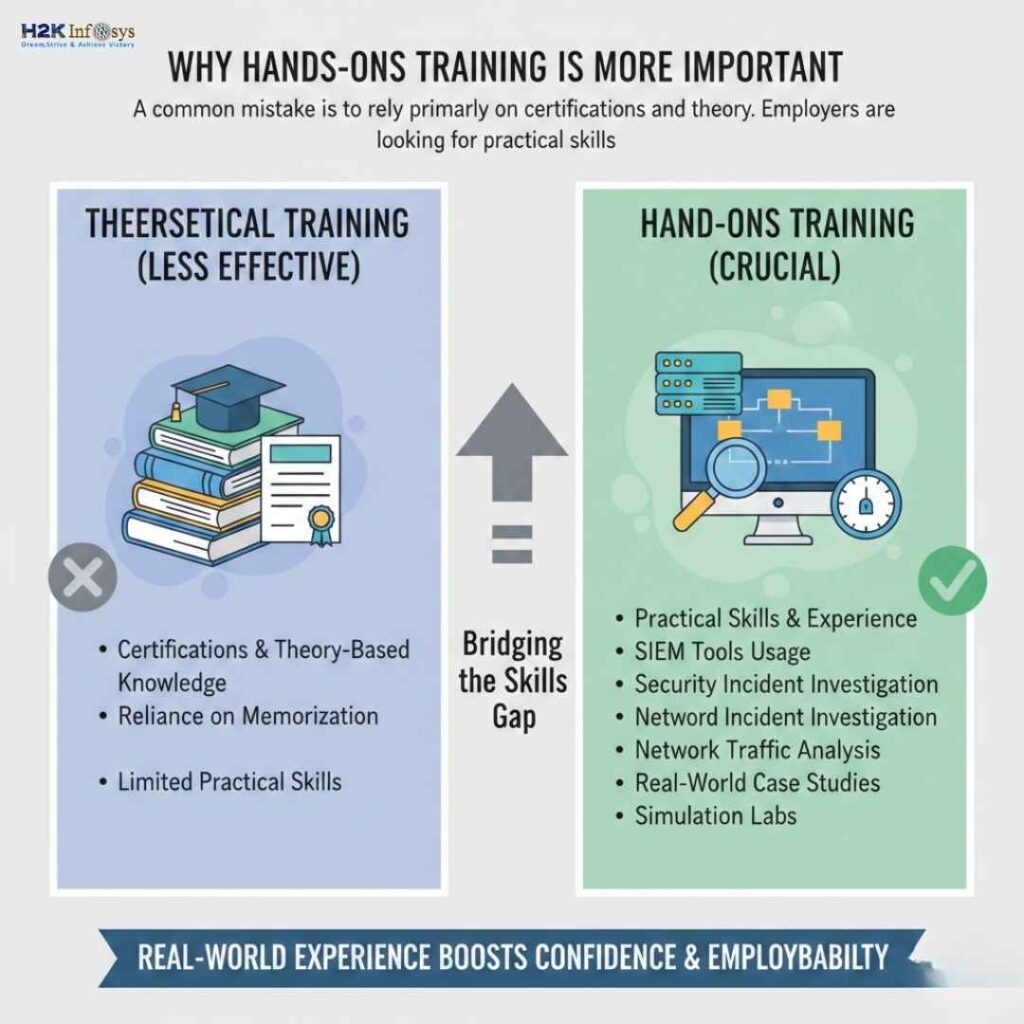
A common mistake is to rely primarily on certifications and theory.
Employers are looking for practical skills. They seek individuals who have:
– Experience using SIEM tools
– Experience in investigating security incidents
– Experience in network traffic analysis
– Experience in practical cybersecurity case studies
Cybersecurity training programs that offer simulation labs and real-world scenarios are invaluable for this reason. Real-world experience will increase your self-confidence.
How Training Helps Non-Technical Students Bridge the Gap
Training programs help break down difficult concepts. They focus on practical skills rather than theory.
They teach:
– Step-by-step workflows
– Real-world attack scenarios
– Use of tools
– Investigative techniques
They also help you prepare for job interviews, which is very important as many novices are unable to clear interviews due to a practical skills gap, not because they lack intelligence.
Cybersecurity Is More About a Mindset Than a Particular Background
This is something many novices tend to overlook. Cybersecurity experts are critical thinkers. They are perpetually curious. They analyze various scenarios and draw conclusions. They pay attention to and investigate anomalies.
It’s a common belief that a non-tech background works to a student’s advantage. A non-technical student looks at a problem or scenario in a unique way that is different from a technical student.
Learning technical skills is achievable.
Top-notch cybersecurity specialists possess exceptional analytical skills.
The Role of Placement Support in Career Transition
Placement support is crucial in assisting novice entrants to the industry.
Effective support from good programs involves:
– Resume writing
– Practice Interviews
– Technical Interview Practice
– Coaching on Interview Strategies
– Job Search Assistance
These factors enormously increase the chances of securing employment. A significant number of individuals who find it difficult to succeed on their own are able to do so by obtaining coherent and systemic assistance.
How Long It Takes to Transition into Cybersecurity
It is reasonable to expect that the majority of novices who have:
– Regular Practice Managing to Achieve 6 to 12 months of Transition will achieve this quicker for IT
– Experience Plus This will depend on their commitment, practice, and the extent to which they acquire practical skills.
It is skills that determine Cybersecurity and not a degree.
Why 2026 Is One of the Best Times to Enter Cybersecurity
The Cybersecurity Space is ripe for entry as a Professional due to the following:
The Cybersecurity Job Market is Booming.
– Cyber Threats are on the Loose.
– Cybersecurity is Working in the Cloud.
– Security is Remote for Workers.
– Cyber Attacks increase with the use of AI.
The Market is in dire need of Cyber Security Specialists, thus offering entry-level job opportunities.
Common Fears Non-Technical Students Have (And Why They’re Misleading)
“I don’t know programming.”
That’s fine. A majority of entry-level cybersecurity positions do not require coding.
“I don’t have an IT background.”
That’s not a problem. The novice-oriented design of the training programs handles that.
“Cybersecurity sounds too complicated.”
It sounds complicated, but it can be broken down into manageable parts and learned step-by-step.
Every journey starts with a single step.
Final Thoughts
Indeed, cyber security careers are currently ideal for non-technical graduates in the USA (especially with supported structured cybersecurity jobs with training programs with a focus on practical, hand-on, and real-world training). High demand for jobs, competitive pay, easy entry-level positions, and well-defined ascending career paths are all hallmarks of the industry.
Above all, it is relevant to note that a strong desire to learn and the ability to persevere reward a candidate in a cyber security career more so than a prior technical background.
If you are willing to learn, practice and be inquisitive, moving into cybersecurity is not only possible, it is becoming a common migration.
This opportunity is what makes the option so strong and compelling.