
Indeed, it is possible for career changers to enter Cyber Security provided that there is adequate training; for example, at H2K Infosys there is provision for hands-on training and structured learning, Cyber Security training is available in several professional areas. Many Cyber Security present and active practitioners started their working in completely different fields such as customer service, finance, teaching, or sales and then migrated to Civil Security with active training programmes that equip trainees with real skill sets for the job.
In 2026 Cyber Security will be one of the most unfriendly first career paths graduates will take, compared to other careers in computing, winning is practical and hands on. Cyber Security is one of the most easily accessible branches of professional Computing for beginners, primarily owing to the fact that there are very few other levels of specialised training required in the key professional roles which make Cyber Security necessary essential. Compared to other career changers computing branches, Cyber Security is one of the most hands-on essential fields to enter and is therefore one of the most beginner-friendly professional computing branches.
There are then, essentially only a few hands-on working essentials required to become a Computer professional. With the most breakthrough graduates, in terms of accessibility, Cyber Security is an easily accessible branch of Computer. Only a few are required to be one child dressed as a professional. It is then, essentially only a few.
Why Cyber Security Has Become The Fastest Growing Career Change Options
There is a marked demand for Cyber Security and that is unqualified to be promoted as such. With the sheer number of organisations that are faced with ransomware, loss of sensitive data and concerns about data protection in the cloud Cyber Security has become one of the most feared and most predicated career options as IT as a branch of Computing and one of the most beginner-friendly professional branches it has been essential that The Civil Security and within Computing branches.
Here’s what I find interesting: Most of these jobs don’t require years of programming expertise.
What employers want is someone who understands:
• The mechanisms of cyberattacks
• How to recognize and respond to threats
• How to safeguard systems and data
• How to apply security instruments to protect infrastructure
• How to use security tools in real-world scenarios
This is what cyber security training and job placement programs teach.
Training to improve specific skills is what enables people to make career transitions. I have witnessed countless transitions; people with no technical backgrounds have shifted to cybersecurity analyst positions within a year of intensive training.
Here’s an example of a successful career transition to cybersecurity.
One of my former colleagues worked in retail management and had no experience in IT or any other technical field. She began studying the fundamentals of cyber security in a methodical manner, starting with
• Networking
• Security monitoring tools
• Threat detection
• Practical lab exercises
At first, everything seemed to be random. There was no pattern to the alerts, and the logs consisted of random strings of digits.
Over time, things began to change. She began to demonstrate the following skills:
• Analyzing unrecognized logins
• Identifying phishing attempts
• Analyzing a system’s vulnerabilities
Eventually, she secured an entry-level Security Analyst position.
This type of change is especially prevalent in 2026 and the proliferation of structured cyber security positions in which there are beginner level training initiatives.
Why Cybersecurity is more Accessible than other Fields in Tech
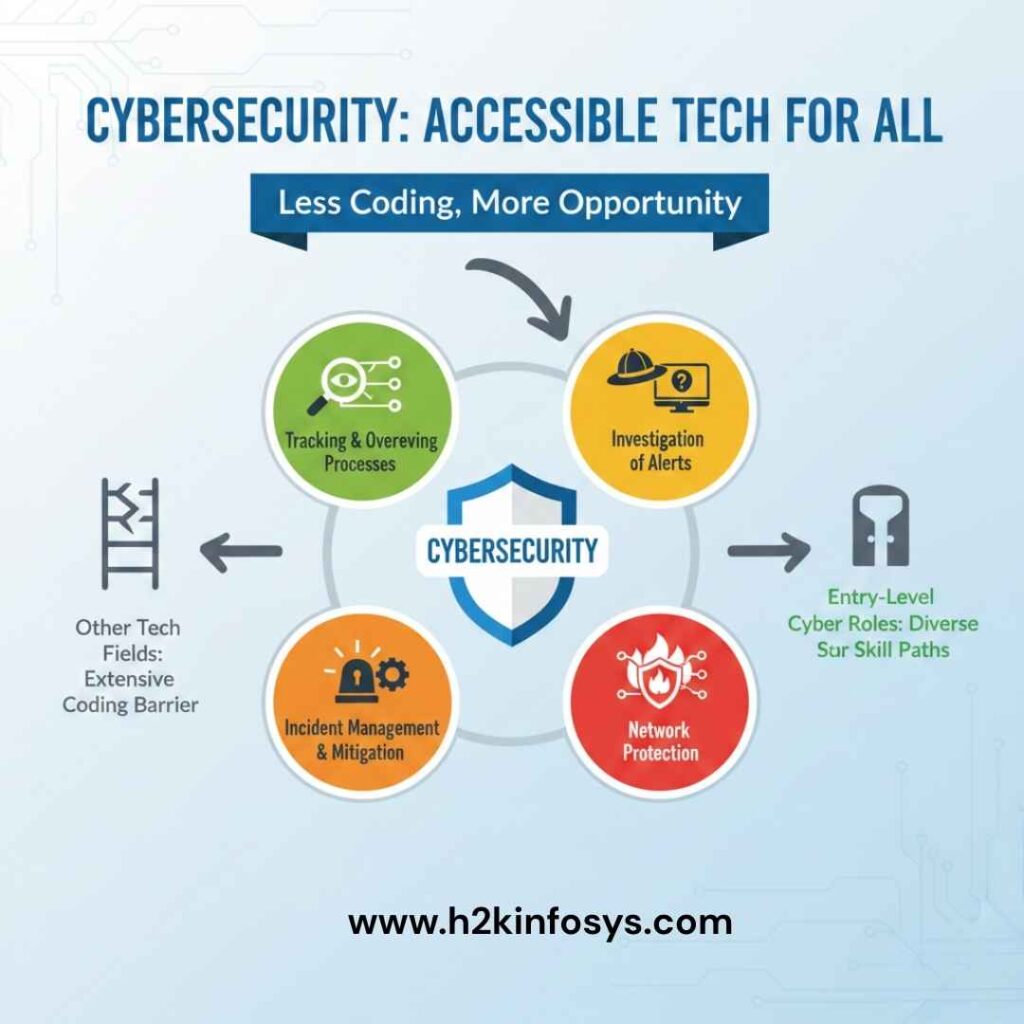
Many tech positions can be considerably exclusive, requiring extensive experience in coding for consideration. Cybersecurity is not in the same situation.
This is true of most entry level cyber security job positions.
Many cyber security jobs involve any combination of
- Tracking and Overseeing processes
- Investigation of alerts
- Incident management and Mitigation
- Network Protection
Cyber training involves a lot of hands on problem solving, as well as the technology used to create the systems.
This type of cyber training is more protective.
What Real Cybersecurity Training Assures
High quality cyber security training will involve more than just theory and concepts. It will involve application and practicality.
What most career changers learn is the following:
1. Basics of Networking
Understanding communications of different systems is paramount.
This will include,
- IP Addresses
- Protocol systems of Servers and Clients
- Patterns and Flows of Network traffic
Without mastering networking, you will not be able to master Cybersecurity.
2. Detection of Threats and Active Monitoring
This is the nucleus of Cybersecurity operations.
You will be trained to use tools such as SIEM platforms, log monitoring systems, alert investigative tools, etc. From these tools, you will gain your first insights into attacker behavior and detection.
3. Threat identification and detection.
This encompasses identifying:
– phishing
– malware
– suspicious logins
– unauthorized access
Exactly these skills make you attractive to recruiters.
4. Practical Security Labs
This is the most significant.
The real cyber attack simulations that hands-on labs offer allow you to respond in practice and investigate, analyze, and protect systems, which builds enormous confidence.
Why practical knowledge is more valuable than titles.
What your potential employer will be most interested in is the practical knowledge you have acquired, as opposed to the titles you hold.
- If you can investigate a security alert and describe the situation, as well as provide recommendations to resolve the issue, you will be a valuable employee.
- That is precisely why the value career changers of cyber security training with job placement programs is focused on practical labs, as well as projects and simulations, instead of solely lectures.
- The methods and practices of real work are the foundation of obtaining employment.
Occupations in Cyber Security Ideal for Career Transitions
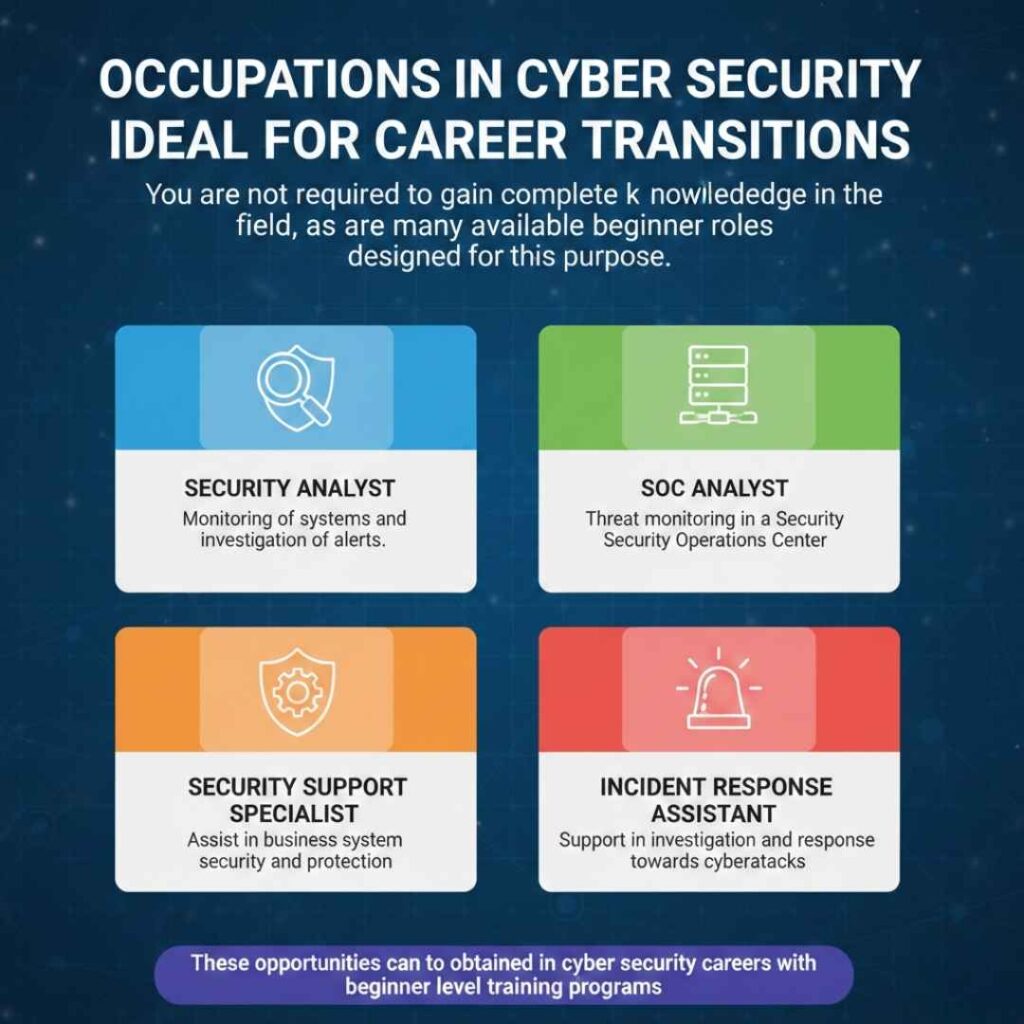
You are not required to gain complete knowledge in the field, as there are many available beginner roles designed for this purpose.
Common entry-level roles include:
– Security Analyst
He is responsible for the monitoring of systems and investigation of alerts.
– SOC Analyst
He is responsible for threat monitoring in a Security Operations Center.
-Security Support Specialist
Assist in business system security and protection.
-Incident Response Assistant
Support in investigation and response towards cyberattacks.
These opportunities can be obtained in cyber security careers with beginner level training programs.
Cybersecurity Is Not Just For “Technical People”
This is a long standing myth.
Many top cyber security experts have non-technical backgrounds.
Why? Because cyber security is about:
- Problem solving
- Investigations
- Recognizing patterns
- Critical thinking
This is true about a vast majority of roles.
As an example:
Customer service professionals understand user behavior
Sales professionals understand the manipulation and deception (useful in phishing attack identification)
Analysts understand patterns and data
Even cyber security sales professionals have relevant security knowledge that can facilitate the transition to non-technical roles and the technical roles down the line.
Cybersecurity is about the right mindset and a decent amount of technical know how.
What Makes Career Changers Successful in Cybersecurity
Based on experience, most successful career changers demonstrate the following:
Curiosity
They have a strong desire to understand how various systems work, and how to attack them.
Consistency
They practice, even when things are confusing.
Hands-On Learning
They learn through doing, as opposed to passive reading.
Patience
Understanding cyber security concepts takes time
Progress happens gradually, and is often the result of strong consistent effort.
How Long Will Your Transition to Cybersecurity Take?
It depends on how quickly you learn as well as the quality of the training program.
But typically:
– 3 to 6 months to understand the fundamentals
– 6 to 12 months to be considered job ready
– 12 months to obtain entry-level positions in cybersecurity
Some individuals achieve these goals more quickly, while others take more time.
In the end, the most important factor is consistency.
Why Companies Are Open to Hiring Career Changers
There is a gap in the industry, and companies need to fill that gap.
There is a large gap in the industry, and companies need to fill that gap.
Employers believe that:
– Skills can be taught
– The right mindset is more important than any other factor
– Taking a hands on approach to training candidates is the best way to prepare
Many hiring managers actually prefer candidates who have completed practical cybersecurity jobs with training programs because they are already familiar with the tools.
The Demand For Cybersecurity Professionals Will Continue To Grow
Cybersecurity is now considered a critical part of infrastructure.
There have been a number of recent global ransomware attacks that have caused companies to spend more and more on security teams.
As people start to adapt to remote work and the use of the cloud, coupled with the emergence of AI, the need for cybersecurity professionals will increase.
This creates more and more opportunities for individuals looking to change careers, and this trend for needed cybersecurity professionals will continue for a number of years.
What Challenges Will You Face As A Career Changer?
Everything in the beginning is hard, and that is the part that most people find the most difficult to get over.
At first, everything feels unfamiliar.It’s normal for tools to feel overwhelming and logs to be confusing. What helps the most is training broken down into structure and step by step. When you understand the patterns, you will notice a surge in growth with your confidence. The course is designed to make sense of the initially confusing knowledge.
This is why training of a certain structure is essential for making a quick and successful career jump.
When your training is organized, you work at a faster and smoother rate. You become a candidate for training programs in the field and your chances of being hired for that field become guaranteed.
This leads to a quick and successful career leap.
Conclusion
The knowledge-based training programs designed for candidates,offer real work simulation labs and a guided pathway to acquire the knowledge to work in the field. The candidates will develop the career changers confidence to enter the working environment.
It is not easy; however, there is light at the end of the tunnel. Cybersecurity is all about protecting companies’ systems, hence all the knowledge is subject to a long-term understanding. Success in a career of choice is a promise that the knowledge will deliver.
Patience is something that will pay off with all the knowledge that will be acquired throughout the endeavor.Graduates from computer science or engineering-related fields are not the only ones entering the field of cybersecurity.
It is now becoming one of the more accessible and highly lucrative professions for determined career changers, regardless of previous experience, who are willing to put in the effort to acquire the necessary knowledge.