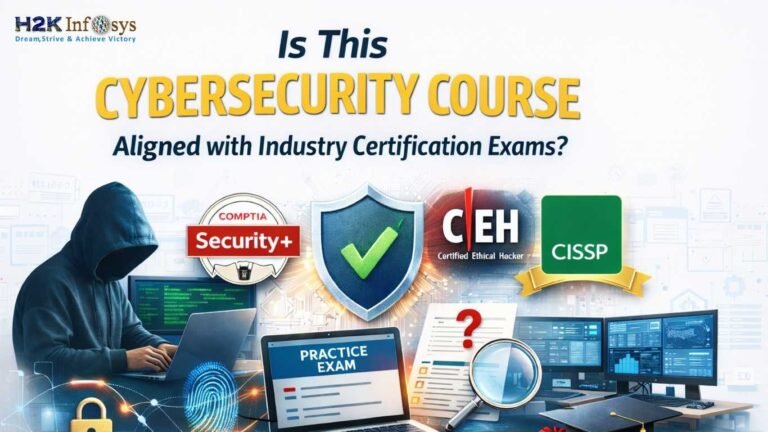
Yes, a well-structured cybersecurity course, especially one from H2K Infosys, is usually set up to be very similar to the key industry certification examinations. This is because certifications like CompTIA Security+, CEH, and CISSP are what employers use to see if someone is ready for the real world. If your course meets these standards, it’s not simply teaching you theory; it’s also getting you ready for the same abilities that certification tests and work utilize every day.
I have seen this with my own eyes. The best cybersecurity training and placement programs I looked at didn’t only teach topics; they also followed the certification goals almost exactly. That alignment makes a big difference whether you take certification tests or go to job interviews.
Let’s talk about how certification alignment really works and how to detect if a course is really industry ready.
Why industry Certification Alignment Will Be More Important Than Ever in 2026
Hiring for cybersecurity has evolved. Employers don’t just look at degrees nowadays. They want to see that you can manage actual threats, tools, and situations. Certifications are what show that.
For instance, job postings for SOC Analysts or Security Engineers in 2026 commonly say something like:
- Knowledge of CompTIA Security+ or something similar
- CEH certification is a plus
- Knowledge of SIEM tools and how to respond to incidents
- Knowledge of network security, risk management, and threat analysis
These prerequisites are exactly what courses that lead to certification teach.
When your cybersecurity training and placement program meets industry certification goals, you’re getting ready for three things at once:
- Tests for certification
- What you really have to do at work
- Questions for a technical interview
That overlap saves time and makes it more likely that you will get hired quickly.
Most courses are in line with the most important cybersecurity certifications.
A serious cybersecurity education usually leads to industry certification that are recognized around the world. These are the ones that happen the most.
CompTIA Security+ is the best choice for beginners.
This is frequently the first qualification that students go after. It includes basic cybersecurity abilities like:
- The basics of network security
- Finding and stopping threats
- Managing identification and access control
- Basics of cryptography
- Managing risk
A lot of beginner-friendly courses focus their whole curriculum on Security+ goals since they help students create a strong foundation.
I’ve seen that students who finish Security+ training feel a lot more sure of themselves in interviews. Instead of memorizing terminology, they may communicate ideas easily.
CEH: Certified Ethical Hacker
CEH is all about offensive security, or how to discover how hackers think and work.
Most of the time, the topics are:
- Basic information on penetration testing
- Scanning for weaknesses
- Techniques for social engineering
- Attacks targeting web apps
- Ways to break into a network
Courses that are in line with CEH usually have labs where you may do things. For instance, students might practice attacks in safe settings and learn how to spot them.
This kind of hands-on experience is exactly what employers want.
CISSP (Advanced Level Certification)
CISSP is more advanced and focuses on managing and building secure systems.
It includes:
- Security rules and management
- Frameworks for managing risk
- Designing security architecture
- Managing identity and access
- Operations for security
Not all starter courses are completely in line with CISSP, but effective ones teach its basic ideas early on.
How Certification Alignment Affects the Course Structure
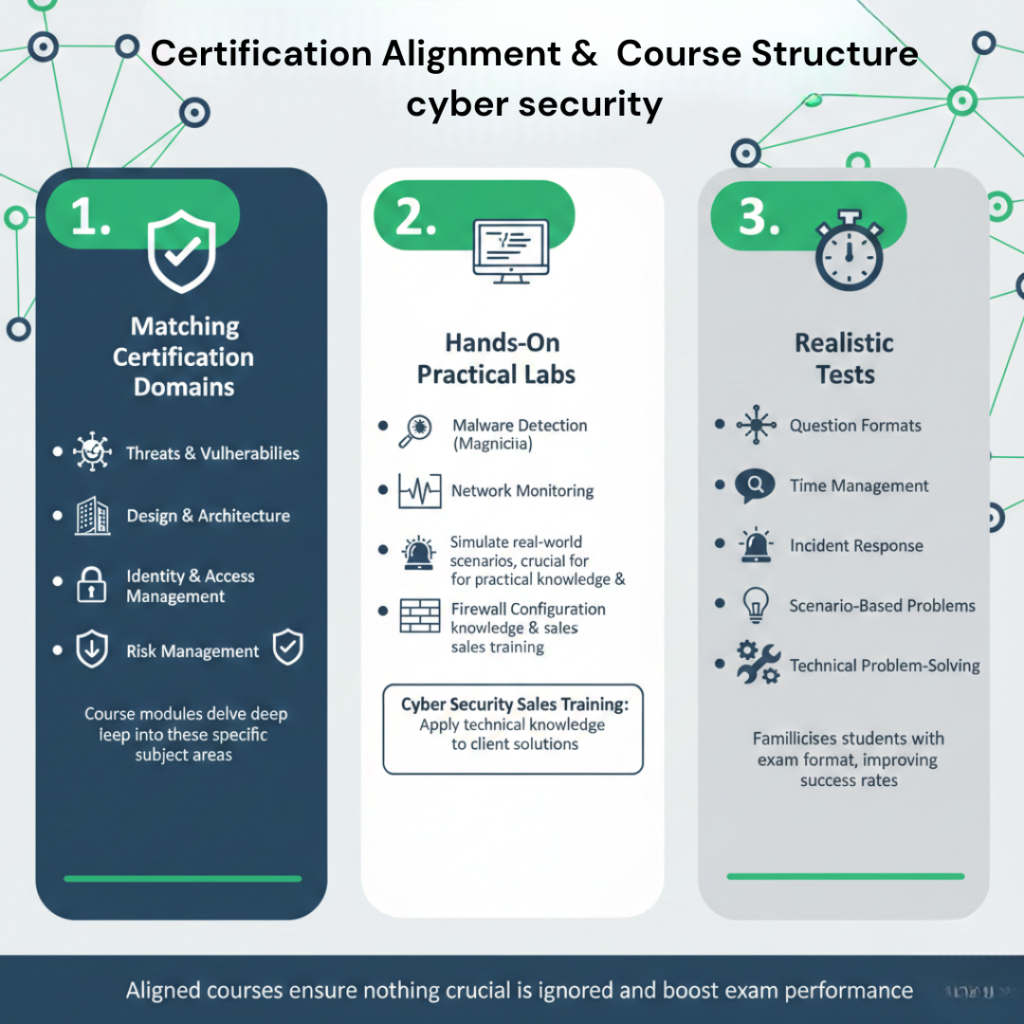
Things start to get interesting here. It’s not enough to just talk about the names of the tests; certification alignment is integrated into the course design itself.
1. Domains of the Certification Exam that Match
There are specific subject areas on industry certification tests. An excellent course goes into a lot of depth on those same things.
For instance, Security+ domains include:
- Threats and weaknesses
- Design and architecture
- Managing identities
- Managing risks
Courses that are in line with these areas make sure that nothing crucial is ignored.
2. Labs that let you practice real-life certification situations
Certifications test more than just theory; they also test practical knowledge.
Students can practice:
- Using security technologies to find malware
- Keeping an eye on network traffic
- Responding to fake attacks
- Setting up firewalls
This is especially crucial in cyber security sales training settings where workers need to know both how to do their jobs and how to present solutions to clients.
3. Practice Tests That Are Similar to the industry Certification Format
Aligned courses have practice tests that are like the genuine industry certification assessments.
This helps pupils learn about:
- How to ask questions
- Managing time
- Questions based on a scenario
- Solving technical problems
Students who take practice tests usually do significantly better on industry certification tests.
Example from the real world: Getting ready for the SOC Analyst role
For example, someone wishes to work as a SOC Analyst. Training that is in line with industry certification gets them ready step by step.
They learn how to:
- Keep an eye on SIEM tools like Splunk
- Analyze suspicious activity
- Look at security breaches
- Answer threats
These skills are exactly what you need to pass the certification exam and do your job.
Employers commonly ask candidates scenario questions during interviews, such as, “What would you do if you saw strange login activity?”
Students who have gone through industry certification-aligned programs can answer questions with confidence since they have already done similar things.
Why Employers Trust Training That Is Aligned with Certification
From the point of view of an employer, certificates are proof that you know what you’re doing.
They show that the person applying for the job knows:
- Standards for security in the industry
- Basic ideas for managing risk
- How to respond to an incident
- Technologies for security
Training that is associated with industry certification makes sure that students learn these exact skills.
This cuts down on the time firms need to train new hires.
Real-time tools are also part of modern cybersecurity courses.
Cybersecurity changes quickly. Courses that lead to industry certification now use new tools like:
- SIEM platforms
- Scanners for vulnerabilities
- Tools for detecting endpoints
- Platforms for cloud security
This is really important because a lot of businesses have moved their infrastructure to the cloud in the last several years.
Students that take classes that cover cloud security subjects also get ready for certifications like:
- CompTIA Security+
- Specialty in AWS Security
- Professional in Cloud Security Certification
These certificates are quite useful in the work market nowadays.
Training and certification that focuses on placement
This is when certification alignment is most useful.
Most programs that teach cybersecurity and help people find jobs also help them get certified and get jobs.
This could mean:
- Making a resume
- Coaching for interviews
- Practice interviews
- Help with finding a job
Knowing about industry certification helps people feel sure when they answer interview questions.
As an example, an interviewer might ask,
“What is the CIA triad?”
Students that studied for the industry certification realize that this means:
- Integrity
- Availability
- Very important but very simple.
Real-Life Example: A Success Story of Someone Who Changed Careers
I chatted with one person who changed careers from networking to cybersecurity. Their training was based on the goals of the Security+ and CEH certifications.
They were asked during interviews about:
- Threat detection
- Setting up firewalls
- Responding to an incident
They answered with confidence because the course covered the same themes as the certification.
They got a job as a SOC Analyst in just a few months.
That’s the real value of training that leads to certification.
How to Find Out If a Cybersecurity Course Is Right for Certification Exams
Not all of the courses are in the right order. This is how to check.
Look for:
- Goals for the certification exam that are in the curriculum
- Real-world situations and hands-on laboratories
- Included were practice tests
- Tools used in industry that are included
- Topics that are similar to Security+, CEH, or CISSP
Stay away from classes that just teach theory.
Skills that are useful in real life are more important.
Certification Alignment Also Helps Your Career Grow Over Time
There are more than just entry-level jobs in cybersecurity.
Training that is in line with certification helps students get ready for future certifications like:
- CISSP.
- CISM
- Certifications for cloud security
These qualifications assist people get jobs as other similar positions.
- security engineers
- Architect of Security
- Manager of Security
Building a firm foundation with certification alignment.
Last thoughts:
You’re on the correct track if your cybersecurity course is the same as the industry certification tests. It signifies that the course is teaching skills that are known and valued by employers all across the world.
Cybersecurity training and placement programs that are associated with certification help you become ready for certification examinations, technical interviews, and actual job duties all at the same time.
Based on my experience looking at many programs and talking to professionals, industry certification alignment is one of the best signals that a cybersecurity course is good. It indicates that the training is meant to do more than simply teach you; it’s also meant to help you succeed in the world of cybersecurity.
And to be honest, that alignment is what sets learning about cybersecurity apart from actually starting a career in it.