Introduction
Software testing has evolved rapidly in recent years, with automation becoming the core of efficient testing strategies. For many QA professionals and test engineers, TOSCA by Tricentis has emerged as one of the most reliable and advanced automation tools. It enables codeless testing, simplifies test case creation, and boosts testing efficiency across diverse applications.
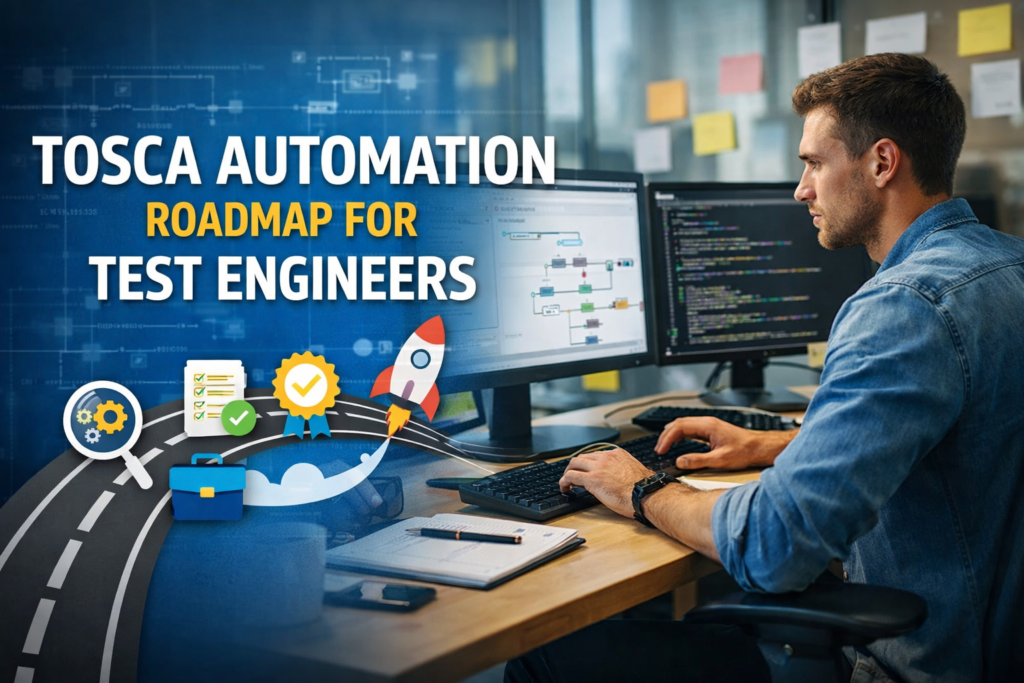
If you are planning to start your journey with TOSCA or aiming to enhance your existing automation skills, understanding the complete roadmap to a TOSCA Automation Course is essential. This guide covers everything from course structure, skills gained, and certification benefits to TOSCA Automation Course Fees, Tricentis TOSCA Training Videos, and practical project exposure that shapes you into a skilled test automation engineer.
What is TOSCA Automation?
TOSCA automation is a model-based test automation tool developed by Tricentis, designed to automate functional and regression testing for a wide range of applications. Unlike script-based tools, TOSCA offers a codeless automation approach, which means testers can design, execute, and manage tests without programming knowledge.
Key Features of TOSCA Automation
- Model-Based Testing: It replaces manual scripting with reusable modules.
- Codeless Test Design: Allows non-technical testers to create tests using drag-and-drop logic.
- Continuous Integration Support: Integrates seamlessly with CI/CD pipelines like Jenkins and Azure DevOps.
- Data-Driven Testing: Uses TDS (Test Data Service) and TDM (Test Data Management) for dynamic test execution.
- Cross-Platform Compatibility: Works across desktop, web, mobile, and SAP applications.
In short, TOSCA automation is the all-in-one testing platform that bridges the gap between manual and automated testing, making it an essential skill for every QA engineer.
Why TOSCA Is a Game-Changer for Test Engineers
Before diving into the roadmap, it’s important to understand why TOSCA stands out among automation tools.
- Reduced Maintenance Effort: Once modules are created, they can be reused across multiple test cases, saving time.
- End-to-End Coverage: TOSCA can test everything from web applications to databases and APIs.
- Integration with CI/CD: Enables teams to achieve continuous testing and deployment goals.
- Support for Agile and DevOps: TOSCA aligns with modern development practices, ensuring faster delivery cycles.
- Enterprise Adoption: Many Fortune 500 companies rely on Tricentis TOSCA for enterprise-scale automation.
According to Tricentis reports, organizations using TOSCA experience up to 90% reduction in regression testing time and 75% faster release cycles.
Understanding the Structure of a TOSCA Automation Course
A structured TOSCA Automation Course helps you learn the tool in a logical progression—from fundamentals to advanced techniques.
1. Introduction to Test Automation and TOSCA Overview
- Understanding test automation fundamentals
- Benefits of TOSCA over other tools
- Introduction to TOSCA Commander interface
- Overview of TOSCA architecture and workspace
2. Module-Based Test Automation
- Creating reusable modules using the Module section
- Understanding the Scan process for UI elements
- Managing test objects efficiently
3. Test Case Design and Execution
- Creating test cases with reusable modules
- Organizing and executing test cases
- Handling test configurations and parameters
4. Data-Driven Testing (TDS and TDM)
- Managing test data effectively
- Creating dynamic data-driven test scenarios
- Understanding the role of TOSCA Test Data Service (TDS)
5. API Testing with TOSCA
- Introduction to API testing concepts
- Designing and executing API tests
- Validating responses using TOSCA API Scan
6. TOSCA Execution Lists and Test Management
- Scheduling test executions
- Generating and analyzing execution reports
- Using Tosca ExecutionList for batch runs
7. Continuous Integration with DevOps Tools
- Integrating TOSCA automation with Jenkins, Git, and Azure DevOps
- Running automated tests as part of CI/CD pipelines
8. Advanced TOSCA Concepts
- TOSCA Extensions (Excel Engine, BI Testing, SAP Testing)
- Test Step Libraries and Templates
- Customizations and scriptless automation logic
Learning Through Tricentis TOSCA Training Videos
To strengthen theoretical concepts, learners benefit from Tricentis TOSCA Training Videos. These resources provide a visual walkthrough of every concept, from workspace setup to complex test case automation.
Benefits of Tricentis TOSCA Training Videos
- Step-by-step practical tutorials
- Real project use cases for better understanding
- Simulations for hands-on practice
- Clear demonstrations of module creation, scanning, and execution
Videos enhance retention and simplify the understanding of TOSCA’s intricate features. Watching demonstrations of real-time scenarios helps learners build confidence before applying skills in live environments.
Skills You’ll Gain from a TOSCA Automation Course
A comprehensive TOSCA course transforms you from a manual tester into a proficient automation engineer.
Core Technical Skills
- Module creation and maintenance
- API, Web, and Mobile test automation
- Test data management and parameterization
- CI/CD integration with DevOps pipelines
- Reporting and result analysis
Professional Skills
- Analytical thinking for test case design
- Problem-solving through modular automation
- Agile testing collaboration
- Automation strategy planning
By the end of the course, you’ll not only know how to use TOSCA but also how to integrate it into an enterprise automation ecosystem.
Hands-On Learning: Real-World Project Exposure
Practical application solidifies learning. A good TOSCA Automation Course includes hands-on labs and project assignments.
Example Real-World Projects
- Web Application Testing Project: Automate login, form submission, and validation workflows.
- SAP System Testing: Create reusable modules for SAP GUI components.
- API Testing: Validate REST and SOAP services with dynamic data.
- Database Validation: Compare UI and backend data consistency.
- End-to-End Regression Suite: Combine multiple modules into a unified regression framework.
Hands-on practice ensures that learners are industry-ready and can implement automation frameworks from day one.
Understanding TOSCA Automation Course Fees
Before enrolling, learners often evaluate TOSCA Automation Course Fees to plan their investment. While the exact fee structure varies by training mode and duration, most courses offer different levels beginner, intermediate, and advanced.
Typical Factors Affecting Course Fees
- Course Level: Beginner courses cost less, while advanced automation with CI/CD integration costs more.
- Duration: Intensive bootcamps or extended programs may charge higher fees.
- Certification Inclusion: Courses that include the official TOSCA Certification Course usually cost slightly more.
- Hands-on Projects: Training programs with real-world project exposure are priced higher due to practical mentoring.
Investing in a structured course is worthwhile because automation engineers with TOSCA expertise earn significantly higher salaries. According to global QA reports, certified TOSCA professionals can earn 30–40% more than manual testers.
Overview of the TOSCA Certification Course
Earning a TOSCA Certification Course credential validates your expertise and boosts your professional profile.
Certification Levels
- Automation Specialist Level 1 (AS1): Focuses on TOSCA basics, workspace setup, and module creation.
- Automation Specialist Level 2 (AS2): Covers advanced test design, reusable components, and API testing.
- Test Design Specialist: Concentrates on business-oriented test design practices.
- TOSCA BI Specialist: Focuses on business intelligence and data validation testing.
Certification Benefits
- Recognition from global employers using Tricentis tools.
- Access to advanced roles such as Automation Engineer or QA Lead.
- Validation of real-world automation skills.
- Career advancement opportunities across industries.
Many organizations prefer candidates with verified Tricentis certifications because it ensures proficiency in modern test automation practices.
How to Prepare for TOSCA Certification
A step-by-step preparation plan ensures success in TOSCA certification exams.
Step 1: Master Fundamentals
Understand TOSCA components, workspace creation, and basic automation principles.
Step 2: Explore Tricentis TOSCA Training Videos
Watch official videos that demonstrate the tool’s core functions.
Step 3: Practice Hands-On
Work on at least three end-to-end automation projects.
Step 4: Study Test Design Patterns
Focus on reusable modules, business components, and execution lists.
Step 5: Attempt Mock Tests
Test your readiness by solving practice questions available in learning portals.
With consistent effort, most learners can achieve TOSCA certification within two to three months.
Real-World Applications of TOSCA in Enterprises
TOSCA is widely used in industries that rely on continuous testing and large-scale automation.
Common Use Cases
- Banking and Finance: Validating loan processing, customer portals, and backend APIs.
- Healthcare: Automating complex data-driven workflows for patient systems.
- Retail and E-commerce: End-to-end testing for product catalogs, checkout processes, and integrations.
- Telecommunications: Ensuring quality in billing systems and CRM platforms.
With its scalability and integration capabilities, TOSCA supports over 160+ technologies, making it ideal for multi-domain automation.
Advantages of Learning TOSCA Automation
1. Codeless Testing Simplicity
Even non-programmers can create advanced automation workflows.
2. High Reusability
Modules can be reused across multiple test suites, reducing redundancy.
3. Improved Collaboration
Business analysts, developers, and testers can collaborate easily in Agile projects.
4. Enhanced Test Coverage
Covers UI, API, database, and mobile layers in one platform.
5. Better ROI on Automation
Reduces manual effort, speeds up testing, and improves delivery timelines.
By mastering TOSCA, you not only enhance your technical skills but also make yourself a valuable asset to QA teams.
Common Challenges in Learning TOSCA (and How to Overcome Them)
Challenge 1: Understanding the Model-Based Approach
Beginners may find TOSCA’s modular structure new.
Solution: Practice creating small modules daily and understand their reusability.
Challenge 2: Handling Complex Test Data
Data management can seem overwhelming.
Solution: Use TDS and TDM features to centralize and control test data efficiently.
Challenge 3: Integration with DevOps Tools
Setting up CI/CD pipelines may seem technical.
Solution: Learn step-by-step integrations with Jenkins or Azure DevOps through guided tutorials.
Consistency and hands-on repetition are key to mastering these challenges.
Career Opportunities After Completing TOSCA Automation Course
Learning TOSCA opens a wide range of career paths.
Job Roles You Can Pursue
- Automation Test Engineer
- QA Automation Analyst
- Test Automation Lead
- Continuous Testing Engineer
- DevOps QA Specialist
Salary Insights
According to QA industry reports, the average annual salary for TOSCA-certified professionals ranges between $90,000 and $130,000 in the U.S., depending on experience and role.
Industries Hiring TOSCA Professionals
- IT Consulting and Software Development
- Banking, Finance, and Insurance
- E-commerce and Retail
- Telecom and Healthcare
Best Practices to Succeed in TOSCA Automation
- Start Small: Begin with simple test cases before tackling complex ones.
- Leverage Reusability: Create modular test steps and avoid duplication.
- Maintain Clean Workspaces: Organize projects logically to simplify maintenance.
- Keep Learning: Stay updated with TOSCA upgrades and extensions.
- Collaborate in Agile Teams: Work closely with developers and business analysts for better test design.
Following these practices ensures long-term success in automation testing.
Conclusion
The TOSCA Automation Course is a complete roadmap for test engineers aiming to elevate their careers in automation testing. It offers structured learning, hands-on practice, and certification opportunities that align with the latest industry demands. Whether you are a beginner or an experienced tester, mastering TOSCA helps you deliver faster, smarter, and more reliable test automation outcomes.