Cybersecurity certifications paths usually lead to entry-level security certifications that are recognized by the industry. These certificates, offered by programs like H2K Infosys, prove that you have a basic understanding of network security, threat detection, risk management, and security operations. In 2026, the best cybersecurity certifications for beginners will be those that teach both theory and practice, as well as real-world enterprise security operations. Many people who want to work in cyber security focus on qualifications that are directly related to entry-level SOC, security analyst, or junior penetration testing support roles.
Cybersecurity certifications are a way for businesses to check if someone is ready for a security job by checking their technical knowledge in an organized way. Certifications that focus on basic security concepts, hands-on lab work, and knowledge of enterprise tools are often seen as the best places for beginners to start.
What is a beginner’s guide to cybersecurity certification?
Cybersecurity certifications is a formal validation of knowledge in protecting systems, networks, and data from cyber threats. Beginner certifications focus on: Security fundamentals
- Network protection basics
- Risk management concepts
- Incident response workflows
- Compliance awareness
- Basic threat detection techniques
These certifications are designed for professionals transitioning from IT support, networking, QA, or system administration into security-focused roles.
Common Beginner-Level Cybersecurity Certifications (2026)
| Certification | Focus Area | Typical Beginner Use Case |
| CompTIA Security+ | Security fundamentals | Entry-level SOC analyst |
| ISC2 Certified in Cybersecurity (CC) | Security operations basics | Security support roles |
| Microsoft Security Fundamentals | Cloud security basics | Azure security beginner roles |
| Google Cybersecurity Certificate (concept-level) | Security workflows | Security operations exposure |
How Does Cyber Security Training Online Work in Real-World IT Projects?
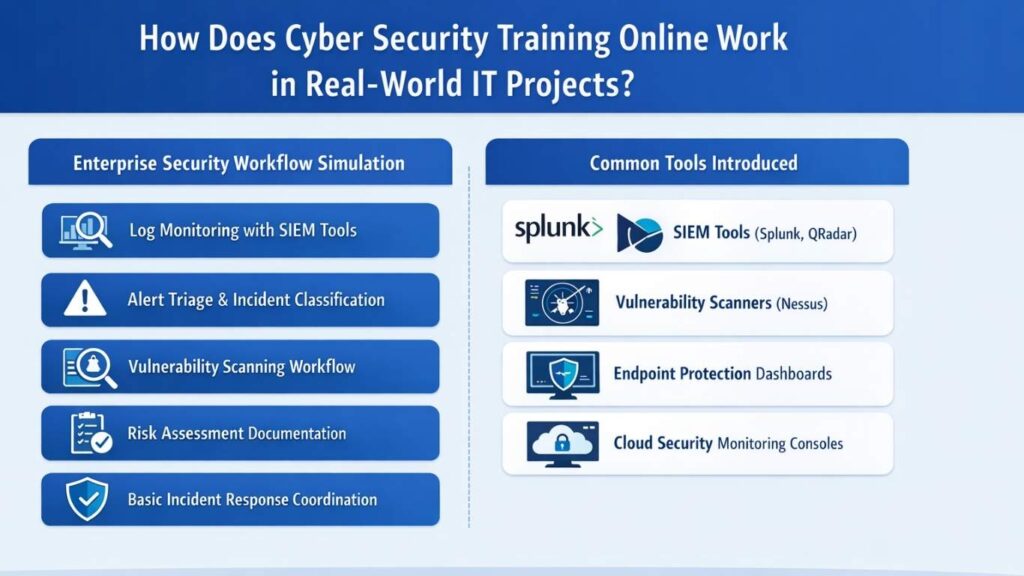
Modern Cyber Security Training Online programs simulate real enterprise environments. Training is usually structured around:
Enterprise Security Workflow Simulation
- Log monitoring using SIEM tools
- Alert triage and incident classification
- Vulnerability scanning workflow
- Risk assessment documentation
- Basic incident response coordination
Common Tools Introduced
- SIEM tools (Splunk, QRadar concept exposure)
- Vulnerability scanners (Nessus basics)
- Endpoint protection dashboards
- Cloud security monitoring consoles
Professionals entering cyber security jobs with training often begin with monitoring tasks, alert investigation, and security ticket workflows rather than advanced offensive security.
Why do people who work need cybersecurity certifications?
Certifications are a way to prove that you have the knowledge you say you do, and many job descriptions require or prefer them.
Important Benefits for Professionals
- Standardized skill testing
- Easier to move into security roles
- Helps show that you are serious about a job in security
- Fits with employment rules that are based on compliance
In many businesses, cybersecurity certifications enable individuals who are going from general IT to specialist security roles fill in the gaps in their knowledge.
What Skills Do You Need to Take Cyber Security Training Online?
People who are just starting to learn about cybersecurity should focus on basic technological skills first.
Basic Technical Skills
- Basic networking (TCP/IP, ports, and protocols)
- Basics of operating systems (Windows and Linux)
- Security ideas like the CIA triad and authentication models
- Basic scripting knowledge (like the basics of Python or PowerShell)
Knowledge of the Security Domain
- Types of threats (malware, phishing, ransomware)
- Basic security controls like firewalls and IDS/IPS
- Basic scripting exposure (Python or PowerShell basics)
Security Domain Knowledge
- Threat types (malware, phishing, ransomware)
- Security controls (firewalls, IDS/IPS basics)
- Identity and access management
- Security policy basics
Many programs combine these skills with cyber security sales training modules for professionals working in security solution consulting or technical sales roles.
How is Cybersecurity Used in Enterprise Environments?
Cybersecurity is integrated across all IT infrastructure layers.
Enterprise Security Layers
| Layer | Security Focus |
| Network | Firewall rules, traffic monitoring |
| Endpoint | Antivirus, EDR tools |
| Cloud | IAM, workload protection |
| Application | Secure coding, vulnerability scanning |
| Data | Encryption, DLP policies |
Real Enterprise Challenges
- Alert fatigue in SOC teams
- False positives from monitoring tools
- Compliance documentation requirements
- Security tool integration complexity
What Job Roles Use Cybersecurity Certifications Daily?
Entry-Level Security Roles
| Role | Daily Tasks |
| SOC Analyst Level 1 | Log monitoring, alert triage |
| Security Operations Associate | Ticket investigation |
| Vulnerability Management Assistant | Scan review, reporting |
| Security Support Analyst | Access review, policy enforcement |
Professionals completing structured training often target cyber security jobs with training where employers value practical tool familiarity over advanced theory.
What Careers Are Possible After Learning Cyber Security Training Online?
Career Progression Path
Stage 1 — Entry Level
- SOC Analyst
- Security Support Specialist
- Junior Security Analyst
Stage 2 — Mid Level
- Threat Analyst
- Cloud Security Associate
- Security Engineer
Stage 3 — Advanced
- Security Architect
- Incident Response Lead
- Red Team Specialist
Which Cybersecurity Certifications Should Beginners Prioritize in 2026?
Recommended Certification Learning Path
| Stage | Certification Type | Learning Goal |
| Beginner | Security Fundamentals | Understand threats and controls |
| Intermediate | SOC / Blue Team Certifications | Monitoring and response |
| Advanced | Specialized Security | Cloud, Pen Testing, DevSecOps |
How Do Certification Skills Translate Into Real Security Tasks?
Example SOC Workflow
Step 1 — Alert Detection
- SIEM generates suspicious login alert
Step 2 — Initial Investigation
- Analyst reviews logs
- Checks IP reputation
Step 3 — Escalation Decision
- If suspicious → escalate to Tier 2
- If false positive → document and close
How Does Cyber Security Sales Training Fit Into Cybersecurity Careers?
Some professionals enter cybersecurity through technical consulting or security solution sales.
Cyber Security Sales Training Covers
- Security product architecture basics
- Threat landscape overview
- Compliance requirements
- Customer risk discussion frameworks
This pathway is common for professionals moving from IT support into security product consulting roles.
Common Tools Beginners Should Learn Alongside Certifications
| Tool Type | Beginner Exposure Goal |
| SIEM | Log search basics |
| Vulnerability Scanners | Scan result interpretation |
| Endpoint Security | Alert dashboards |
| Cloud Security Tools | IAM policy basics |
Questions That Are Often Asked (FAQ)
Are certifications enough to get cybersecurity jobs?
Certifications help validate knowledge but are usually combined with lab practice and project experience.
How long does beginner cybersecurity certification preparation take?
Typically 2–4 months depending on learning pace and prior IT experience.
Do beginner certifications include hands-on labs?
Most modern programs include lab simulations of real security environments.
Can non-IT professionals start cybersecurity training?
Yes, but networking and operating system basics are strongly recommended first.
Which certification is easiest for beginners?
Security fundamentals certifications are generally considered the most accessible starting point.
Key Takeaways
- Beginner cybersecurity certifications validate foundational security knowledge
- Hands-on lab exposure is critical alongside certification preparation
- Entry-level security roles focus heavily on monitoring and incident triage
- Security fundamentals certification is usually the best starting point
- Enterprise cybersecurity requires both technical skills and workflow understanding
Explore structured, hands-on cybersecurity learning paths designed for real enterprise environments at H2K Infosys.
Enroll in H2K Infosys programs to gain practical experience aligned with modern cybersecurity career requirements.