Ethical hacking in cyber security is the authorized practice of identifying, testing, and reporting security weaknesses in systems, networks, and applications so organizations can reduce risk before attackers exploit those flaws. It operates within legal permission, defined scope, and professional standards, and is a foundational discipline taught across cyber security online training courses and enterprise security programs. In professional contexts, ethical hacking supports risk management, compliance, and resilience often as part of broader cyber security training and job placement pathways for practitioners.
What Is Ethical Hacking in Cyber Security?

Ethical hacking is the controlled, lawful assessment of security posture using attacker-like techniques with explicit authorization. The objective is not exploitation for gain, but risk reduction through discovery, validation, and remediation guidance.
Key characteristics
- Authorization: Written permission and defined scope.
- Methodology: Repeatable, standards-aligned testing processes.
- Reporting: Clear evidence, impact analysis, and remediation steps.
- Accountability: Professional conduct and data protection.
Ethical hacking is commonly delivered through online cybersecurity training programs as part of a broader defensive security curriculum.
Why Do Core Principles Matter?
Without principles, testing becomes unsafe or unreliable. Principles ensure:
- Legality: Activities stay within consent and jurisdiction.
- Safety: Production systems and data are protected.
- Consistency: Findings are comparable across tests.
- Trust: Stakeholders can act on results with confidence.
What Are the Core Principles of Ethical Hacking?
1) Explicit Authorization and Scope Definition
Ethical hacking begins with documented permission and a precise scope.
- Systems, IP ranges, applications, and environments included/excluded
- Testing windows and rate limits
- Allowed techniques (e.g., DoS explicitly excluded)
Why it matters: Prevents legal risk and operational disruption.
2) Least Impact and Safety-First Testing
Testing must minimize risk to availability, integrity, and confidentiality.
- Prefer non-destructive validation
- Use throttling and safe payloads
- Stop on instability indicators
Enterprise reality: Production systems often require read-only or staged testing.
3) Methodology and Repeatability
Use structured approaches so results are defensible and actionable.
- Reconnaissance → Enumeration → Exploitation (controlled) → Validation → Reporting
- Align with recognized frameworks (e.g., PTES, NIST guidance)
Benefit: Repeatable tests enable trend analysis and remediation tracking.
4) Evidence-Based Findings
Claims must be supported by proof without unnecessary data exposure.
- Screenshots, request/response pairs, hashes
- Reproduction steps and affected assets
- Impact explanation (likelihood × impact)
Best practice: Avoid dumping sensitive data; show minimal proof.
5) Confidentiality and Data Protection
Handle discovered data responsibly.
- Secure storage and transfer of artifacts
- Redaction of PII and secrets
- Time-bound retention and disposal
Constraint: Many organizations enforce strict data-handling policies.
6) Responsible Disclosure and Reporting
Findings are communicated to authorized stakeholders with remediation guidance.
- Severity ratings and prioritization
- Compensating controls and fixes
- Verification steps after remediation
Outcome: Enables security teams to act quickly and effectively.
7) Continuous Improvement
Ethical hacking informs ongoing security improvements.
- Retesting after fixes
- Lessons learned for architecture and process
- Feedback into secure SDLC and monitoring
How Does Cyber Security Training Online Teach Ethical Hacking?
Professional cyber security online training courses focus on applied learning aligned to real environments.
Typical learning flow
- Foundations: Networking, operating systems, threat models
- Tooling: Recon, scanning, exploitation, and validation tools
- Methodology: Structured testing and documentation
- Practice: Labs that mirror enterprise stacks
- Reporting: Writing actionable security reports
This approach supports learners pursuing cyber security training and job placement by emphasizing job-relevant skills.
How Is Ethical Hacking Used in Real-World IT Projects?
Common Enterprise Use Cases
- Pre-release testing: Validate new features before launch
- Cloud posture checks: Identify misconfigurations
- Third-party assessments: Evaluate vendor risk
- Incident response support: Validate suspected weaknesses
Example Workflow (High Level)
- Scope approval and rules of engagement
- Asset discovery and attack surface mapping
- Vulnerability identification and safe validation
- Impact assessment and prioritization
- Reporting and remediation verification
What Tools and Techniques Are Commonly Used?
| Phase | Common Techniques | Notes |
| Reconnaissance | Asset discovery, OSINT | Passive first, then active |
| Scanning | Vulnerability scans | Tune to reduce false positives |
| Validation | Safe exploitation | Proof without damage |
| Post-validation | Access review | Confirm scope adherence |
| Reporting | Evidence and fixes | Actionable, concise |
Professional constraint: Tools must be configured to respect scope and rate limits.
How Do Ethical Hackers Work in Enterprise Environments?
- Change management: Testing aligned with release cycles
- Segregation of duties: Clear roles between testers and operators
- Compliance alignment: Mapping findings to standards
- Collaboration: Close handoff to engineering and IT ops
Ethical hacking is one input among many in a mature security program.
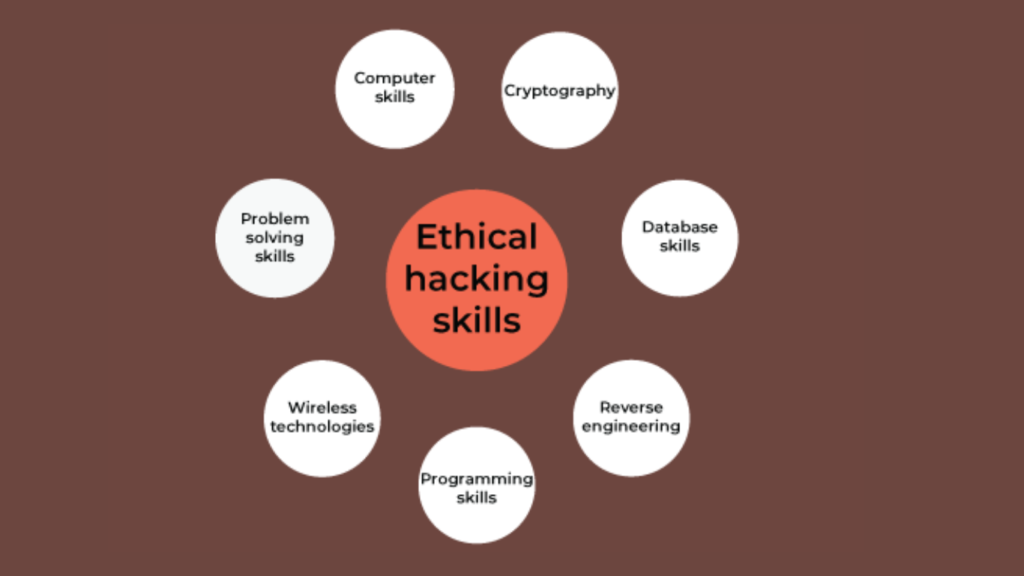
What Skills Are Required to Learn Ethical Hacking?
Core Technical Skills
- Networking fundamentals (TCP/IP, DNS, HTTP)
- Operating systems (Linux, Windows)
- Scripting basics for automation
- Web application fundamentals
Professional Skills
- Documentation and reporting
- Risk communication
- Time and scope management
- Ethical judgment and compliance awareness
These skills are emphasized in online cybersecurity training programs designed for working professionals.
What Standards and Frameworks Guide Ethical Hacking?
- Testing methodologies: Provide structure and repeatability
- Risk frameworks: Help prioritize findings
- Compliance mappings: Translate issues into audit-relevant language
Practice tip: Use frameworks as guides, not rigid checklists.
How Are Findings Prioritized and Fixed?
Prioritization factors
- Exploitability
- Business impact
- Exposure and controls
- Ease of remediation
Remediation patterns
- Configuration hardening
- Patch management
- Input validation
- Access control review
Verification testing confirms risk reduction.
What Job Roles Use Ethical Hacking Daily?
| Role | Primary Focus |
| Security Analyst | Validation and monitoring |
| Penetration Tester | Authorized offensive testing |
| Application Security Engineer | Secure SDLC and testing |
| Cloud Security Engineer | Posture and misconfiguration |
| SOC Specialist | Detection informed by attack paths |
What Careers Are Possible After Learning Ethical Hacking?
Ethical hacking skills support multiple career paths across blue and purple teams. Many learners pursue these roles through cyber security training and job placement tracks that combine labs, projects, and interview readiness.
FAQ: Ethical Hacking in Cyber Security
Is ethical hacking legal?
Yes when performed with explicit authorization and within scope.
Does ethical hacking require programming?
Basic scripting helps, but methodology and analysis are equally important.
How often should organizations test?
Commonly before major releases and periodically based on risk.
Is ethical hacking only for large companies?
No organizations of all sizes benefit, scaled to risk and resources.
How does ethical hacking differ from vulnerability scanning?
Ethical hacking validates impact and exploitability beyond automated scans.
Key Takeaways
- Ethical hacking is authorized, methodical, and safety-first, forming the foundation of professional security assessments taught across cyber security online training courses for working IT professionals.
- Core principles such as scope definition, evidence handling, confidentiality, and structured reporting ensure trust between security teams and business stakeholders.
- Enterprise use emphasizes minimal operational impact and actionable remediation, where ethical hacking findings are translated into prioritized fixes rather than disruptive exploitation.
- Skills blend strong technical foundations with professional judgment, documentation discipline, and ethical responsibility required in regulated environments.
- Ethical hacking supports multiple security career paths, including penetration testing, SOC operations, application security, and cloud security roles.
- Explore hands-on learning paths in ethical hacking and cyber security through H2K Infosys to build practical skills aligned with real enterprise environments.
Learn how structured labs and projects can support professional growth in cyber security.