Introduction
As cyber threats continue to grow in complexity, organizations are moving away from isolated security operations toward collaborative defense models. One of the most effective approaches shaping modern enterprise security is the Purple Team in Cyber security. This model brings together offensive and defensive security professionals to create a continuously improving security posture.
For learners enrolled in Cyber security training, especially those targeting cyber security training and job placement, understanding this concept is a major career advantage. At H2K Infosys, we emphasize real-world collaboration models that employers actively seek.
Understanding Modern Cybersecurity Team Models
Traditional cybersecurity teams often worked in silos. Red Teams tested systems by simulating attacks, while Blue Teams focused on detection and response. While effective to an extent, this separation slowed learning and left gaps in visibility. The Purple Team in Cyber security addresses this challenge by aligning both teams toward a shared goal stronger, measurable defense.
This collaborative model ensures that every simulated attack directly improves monitoring, detection, and response capabilities.
What Exactly Is a Purple Team?
The Purple Team in Cyber security is not a standalone department but a structured collaboration between Red Team (offensive security) and Blue Team (defensive security). Instead of working independently, both teams operate together, sharing insights in real time.
Red Team members explain how attacks were executed, while Blue Team analysts refine detection rules and response strategies. This knowledge exchange leads to faster learning cycles and stronger defenses skills heavily emphasized in cyber security training with job placement programs.
Why Purple Teaming Matters in Today’s Threat Landscape
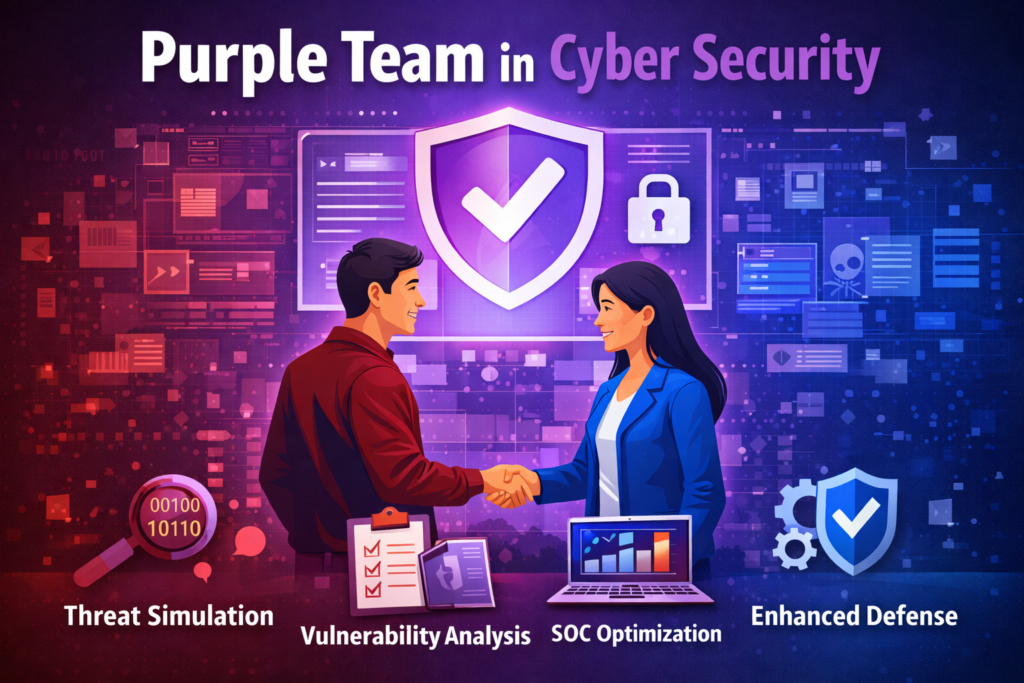
Cyberattacks now involve advanced persistent threats, ransomware groups, insider risks, and cloud-based attack surfaces. The Purple Team in Cyber security plays a critical role by validating whether security tools, people, and processes actually work against real-world attack techniques.
Organizations using this model significantly reduce breach impact and improve SOC performance, which is why employers increasingly expect candidates to understand Purple Team workflows.
Red Team vs Blue Team vs Purple Team
In traditional setups, Red Teams focus on breaking in and Blue Teams focus on defending. The Purple Team in Cyber security bridges this gap by ensuring that every attack simulation translates into improved defense.
This model eliminates blame, encourages transparency, and focuses on outcomes rather than competition, an approach that mirrors how security teams operate in mature enterprises.
Core Objectives of Purple Teaming
The Purple Team in Cyber security is built around continuous improvement. Its objectives include validating detection capabilities, strengthening incident response playbooks, improving threat visibility, and ensuring that security investments deliver measurable value.
These objectives align directly with the hands-on methodology used in cyber security course with placement programs at H2K Infosys.
How Purple Teaming Works in Real Organizations
A typical Purple Team exercise begins with threat modeling and scenario planning. The Purple Team in Cyber security then coordinates controlled attack simulations while defenders monitor systems in real time.
After the exercise, both teams collaborate on gap analysis, rule tuning, and response optimization. This practical, feedback-driven cycle is what makes Purple Teaming such a powerful learning experience for professionals in cybersecurity training and placement programs.
Tools Used by Purple Teams
Professionals working within the Purple Team in Cyber security use a combination of offensive, defensive, and validation tools. These include penetration testing frameworks, SIEM platforms, EDR solutions, and threat-mapping models like MITRE ATT&CK.
Hands-on exposure to these tools is a critical component of online courses for cybersecurity that focus on job readiness rather than theory alone.
Skills Required to Work in a Purple Team Role
Success in the Purple Team in Cyber security requires a hybrid skill set. Professionals must understand attack techniques, detection logic, operating systems, networking, and cloud security. Equally important are communication and documentation skills, as Purple Teaming relies heavily on collaboration.
This blended skill profile makes Purple Team professionals highly valuable and well-compensated in the job market.
Purple Teaming and CEH Certification
The CEH Certification is highly relevant for professionals aspiring to Purple Team roles. The Purple Team in Cyber security benefits greatly from CEH knowledge because it enables defenders to think like attackers and understand exploitation methods.
At H2K Infosys, CEH training is combined with defensive labs to create a well-rounded Purple Team skill set.
Career Opportunities in Purple Teaming
Job roles associated with the Purple Team in Cyber security include Purple Team Engineer, SOC Analyst, Threat Detection Engineer, Incident Response Analyst, and Security Operations Engineer.
These roles are frequently featured in employer hiring pipelines connected to cyber security training and job placement programs.
Why Employers Prefer Purple Team Experience
Employers value professionals trained in the Purple Team in Cyber security model because they reduce false positives, improve detection accuracy, and enhance SOC efficiency. These professionals understand security from both attacker and defender perspectives, making them immediately productive.
This is a key reason Purple Team exposure significantly improves placement success.
How H2K Infosys Prepares You for Purple Team Roles
At H2K Infosys, our curriculum is designed to reflect enterprise security operations. The Purple Team in Cyber security approach is integrated into our training through live labs, real attack simulations, SOC workflows, and expert-led sessions.
Learners gain not just knowledge, but practical experience that translates directly into job performance.
Cyber Security Training and Placement Advantage
Choosing cyber security training with job placement that includes the Purple Team in Cyber security methodology gives learners a competitive edge. Employers want professionals who can test defenses, analyze alerts, and improve security controls, not just memorize concepts.
This is why Purple Teaming is a cornerstone of effective cybersecurity education.
The Future of Purple Teaming
As automation, AI, and cloud technologies evolve, the Purple Team in Cyber security will become even more important. Continuous validation, automated attack simulations, and DevSecOps integration will make Purple Teaming a standard security practice across industries.
Professionals trained in this model will remain in high demand for years to come.
Conclusion
The Purple Team in Cyber security represents the future of collaborative, intelligence-driven defense. It transforms security from reactive monitoring into proactive improvement. For professionals pursuing Cyber security training with job placement, mastering this concept can be career-defining.
H2K Infosys equips learners with the technical skills, hands-on experience, and career support needed to succeed in Purple Team–aligned roles.
Start Your Cybersecurity Career with H2K Infosys Cyber Security Training | Hands-on Labs | CEH Certification Live Instructor-Led Sessions | Real-World Projects Dedicated Job Placement Support Enroll Today and Become Industry-Ready