The best job-oriented cybersecurity training in the USA are the ones that go beyond the theory and the certifications and actually train you for the job, like the h2kinfosys training, where you can practically apply what you have learned. Such training will help you get a job sooner than the other training that focuses on the theories and the certifications.
Why “job-oriented” matters more than ever
I have seen many individuals jumping into cyber security jobs with training and thinking that a certification will help them get a job. It does not anymore.
Hiring managers in 2026 are asking a very different question:
“Can you actually handle a real incident on day one?”
With the rise of ransomware, AI-powered phishing, and cloud misconfigurations, companies need individuals who can handle a real security incident even if it is a simulated environment. This is the reason the definition of a “good job-oriented cybersecurity training” has quietly changed.
What really makes a cybersecurity training “job-ready”?
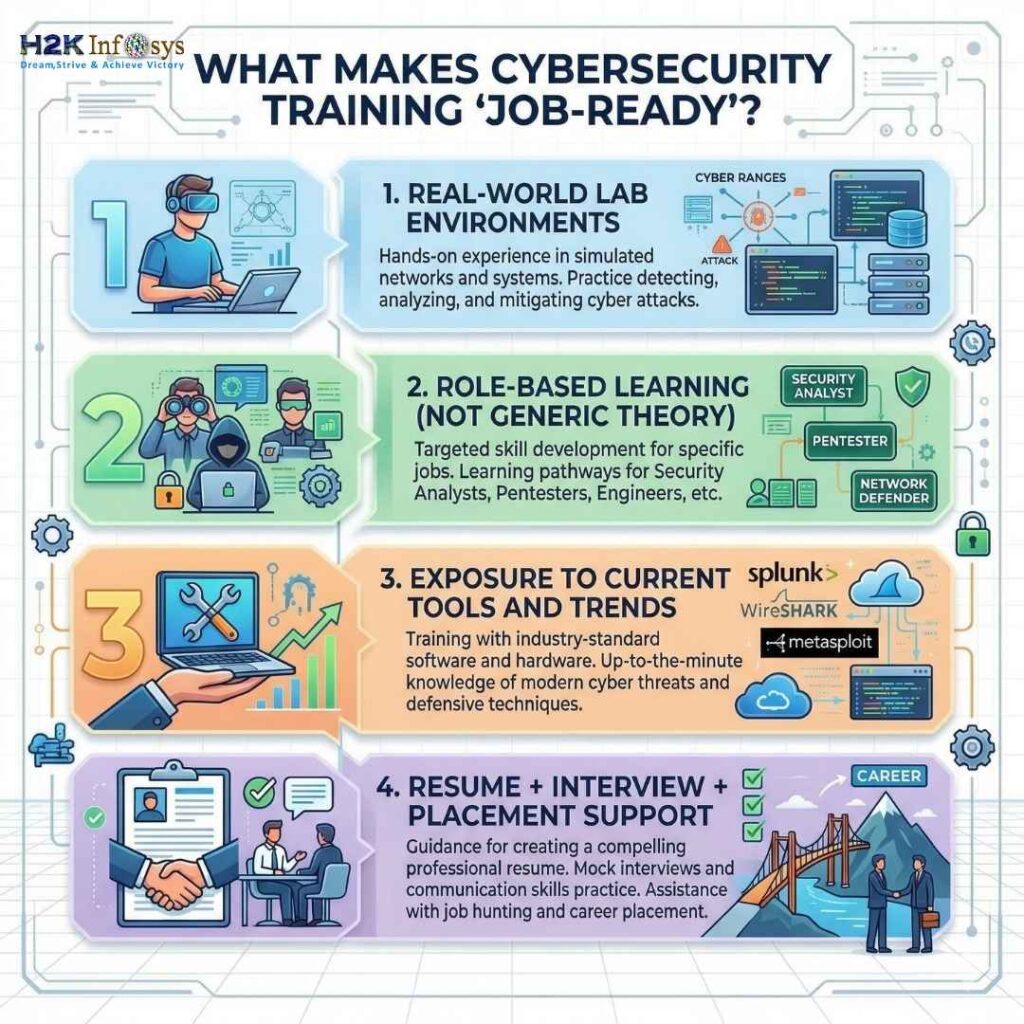
From what I have personally observed (and honestly, from seeing individuals struggle after choosing the wrong training), the best trainings seem to have a few things in common:
1.Real-world lab environments
A good job-oriented cybersecurity training will give you hands-on practice with the tools of the trade. This means:
Investigating security alerts
Working with SIEM tools
Responding to simulated security breaches
Practicing penetration testing on sandbox systems
If a cybersecurity training does not give you hands-on practice with the tools of the trade, it is a bad sign.
2. Role-based learning (not generic theory)
- SOC Analyst
- Security Analyst
- Penetration Tester
- GRC Specialist
This is important because job-oriented cybersecurity training programs that exist today tend to be very specialized. You don’t get hired as a “cyber security generalist” to solve cyber security problems. You get hired to solve a specific problem.
3.Exposure to current tools and trends
Cyber security is constantly evolving. What worked 2 years ago is no longer relevant today.
Good cyber security training online programs today cover:
Cloud security (AWS and Azure misconfigurations)
- AI-based threat detection 101
- Zero Trust architecture 101
- Real-life examples of ransomware attacks
I have noticed that those who can explain the latest patterns of cyber attacks can get noticed right away.
4.Resume + interview + placement support
This is another area that is often overlooked.
Better job-oriented cybersecurity training programs in the US today can help you:
Rewrite your resume to get noticed
Conduct mock interviews to get you ready
Help you apply to jobs
Provide networking and/or referral support
Without this kind of support, even the most capable individuals may struggle.
A quick reality check (based on what I have seen)
Not all training programs today can back up their claims. While they may look good on the surface, they may fail to deliver where it really matters.
A few things that I recommend that you check carefully:
Do they have live environments or just demos?
Do they teach tools that are used in real-life jobs?
Do they have mentors to guide you through the journey?
Do they have any success stories of their past students?
If their answers to these questions seem vague, that is a bad sign.
Where cyber security sales training fits in
However, not everyone in job-oriented cybersecurity training ends up in a technical position. There is a growing need for cyber security sales training professionals because of the increase in security products and SaaS applications.
These include:
Understanding security tools (on a high level)
Explaining risks to clients
Helping out with enterprise sales teams
And surprisingly, they can also pay really well, especially if you add tech knowledge with communication skills.
A practical example of what job-ready training really is.
For instance, you’re preparing to be a SOC Analyst.
A good program will not only teach you about what a SIEM is, but it will also give you a chance to do something like this:
Log in to a simulated SIEM system’s dashboard.
See unusual login attempts from all over the world.
Analyze the logs and correlate everything.
Then, resolve the issue.
This will stick with you, and most importantly, you can use this as an example in an interview.
So, what’s the “best” option?
Well, there’s no right answer, and the best cyber security sales training online programs in the USA generally fall under this category:
Hands-on learning with labs.
Specifically, job roles.
Includes real-world scenarios.
Keeps you current with new threats and tools.
Career and placement services.
Some of these and new hybrid job-oriented cybersecurity training providers are going all-in on this right now, and this is a great thing for newbies.
Final thoughts.
The honest version.
If you’re really interested in entering the field, don’t bother with certificates.
Choose something that makes you uncomfortable, in a good way, meaning you really have to think and possibly get stuck on something before you finally get it.
This is basically what the job will be like anyway.
And if you start to feel like you’re really learning, you’re probably doing something right.