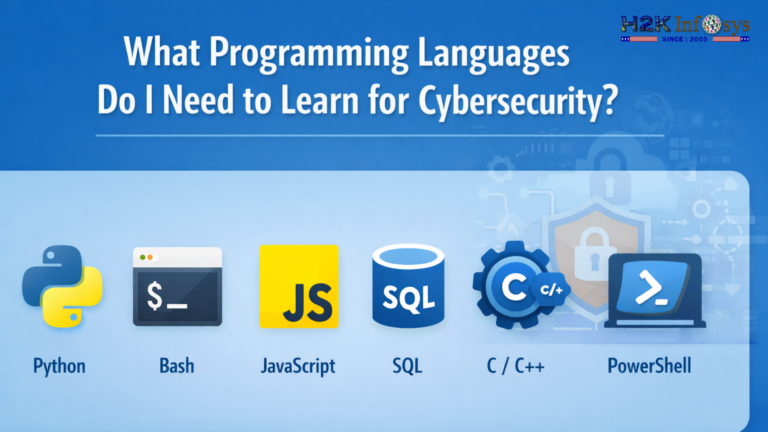
Most cybersecurity jobs require knowledge of programming languages. At structured learning centers like H2K Infosys, security work involves learning how software works, how vulnerabilities are created, and how attacks are carried out and stopped. Depending on their position and area of expertise, cybersecurity experts usually study a mix of scripting, system-level, and application-focused languages like Python, Bash, JavaScript, SQL, and C/C++.
What is cybersecurity, and why are programming languages important?
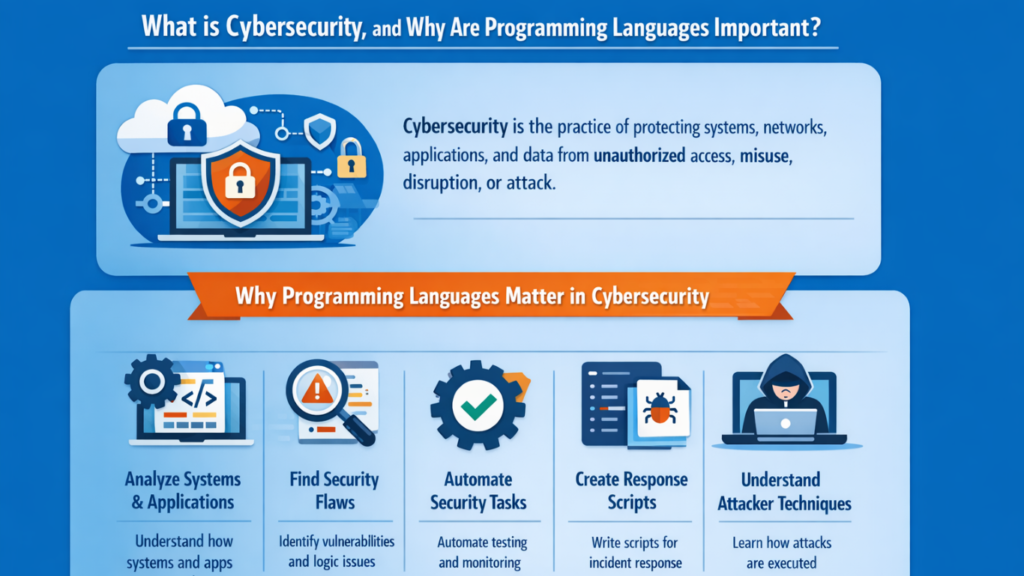
Cybersecurity is the act of keeping systems, networks, applications, and data safe from being accessed, misused, disrupted, or attacked by anyone who shouldn’t have access. Security measures are now closely linked to software systems, cloud platforms, and automated workflows in businesses.
Programming languages are important in cybersecurity because they let professionals:
- Look at how systems and apps are made.
- Find faults in logic or implementation that make it less secure.
- Make security testing and monitoring chores automatic.
- Make scripts for responding to and fixing problems
- Know how attackers work on a technical level
Not every cybersecurity profession requires extensive software development abilities, but most of them do require at least basic knowledge of one or more programming or scripting languages.
How does online cyber security training help with real-world IT projects?
- Cybersecurity is not separate from development or operations in business settings. Every day, security teams work with application code, infrastructure automation, and system settings.
- People who have taken cyber security training online usually do things like these on real-world projects:
- Checking application code for security holes
- Writing programs to do vulnerability scans automatically
- Using custom queries or scripts to look at logs
- Adding security checks to CI/CD pipelines
- Using programmed playbooks to deal with situations
Programming languages are used to carry out these tasks in a way that is both efficient and consistent across different settings.
Why do people who work in cybersecurity need to learn how to code?
Programming skills are useful for IT workers who want to move into security roles:
- Better problem analysis means knowing how systems work from the inside.
- Ability to automate tasks, which cuts down on manual security work
- Better teamwork being able to talk to developers and DevOps teams in a clear way
- Career flexibility: being able to qualify for more cyber security jobs training paths
Many cyber security training and job placement programs stress the basics of programming to get students ready for real-world situations instead of just teaching them theory.
What Programming Languages Are Commonly Used in Cybersecurity?
There is no single “best” programming language for cybersecurity. Instead, different languages serve different purposes across security domains.
Overview of Common Cybersecurity Programming Languages
| Language | Primary Use in Cybersecurity | Skill Level Needed |
| Python | Automation, scripting, analysis | Beginner to Intermediate |
| Bash | Linux system automation | Beginner |
| PowerShell | Windows security tasks | Beginner to Intermediate |
| JavaScript | Web security testing | Intermediate |
| SQL | Database security analysis | Beginner |
| C / C++ | Low-level vulnerability research | Advanced |
| Java | Enterprise application security | Intermediate |
| Go | Cloud and security tooling | Intermediate |
Python: The Language Used Most in Cybersecurity
Why Python is Important for Cybersecurity
Many security professionals prefer Python because it is easy to read, has a lot of libraries, and has a strong community behind it. It is generally the first language that online programs for cyber security training suggest.
People use Python for:
- Writing scanners for vulnerabilities
- Making security jobs that happen over and over again automatic
- Support for reverse engineering and malware analysis
- Reading logs and security alerts
- Making proof-of-concept exploits
Example of Use in the Real World
- A security analyst might use Python to develop a script that
- Get logs from more than one server
- Find IP addresses that look suspicious
- Check signs against threat intelligence feeds
- Make alerts for more research
This kind of automation is popular in Security Operations Centers (SOCs) for businesses.
Linux Security Tasks with Bash and Shell Scripting
What Bash Does in Cybersecurity
If you work with Linux-based servers, cloud environments, or network appliances, you need to know how to write bash scripts. Linux is the operating system that many security tools and servers use.
Bash is used to:
- Automate processes that make systems more secure
- Set up security scans
- Control who can view and change files
- Process log files right on the servers
Example in Real Life
You may use a Bash script to:
- Find users with unsafe permissions
- Look for packages that are out of date
- Check firewall rules on more than one system
Most entry-level cyber security professions anticipate these skills, and training usually focuses on securing infrastructure.
PowerShell for Security Operations on Windows
What PowerShell is and why it matters
PowerShell is the main language for automation and administration in Windows business settings. It is important for security teams to have
PowerShell is used for:
- Investigating suspicious processes
- Collecting forensic artifacts
- Automating security policy enforcement
- Managing Active Directory security
Enterprise Context
During an incident, a security engineer may use PowerShell to remotely collect system information from hundreds of endpoints within minutes, supporting faster containment and analysis.
JavaScript for Web Application Security
Importance of JavaScript in Cybersecurity
JavaScript is essential for professionals working in web application security because it is the core language used in browsers and many modern applications.
JavaScript knowledge helps with:
- Understanding client-side vulnerabilities
- Testing for Cross-Site Scripting (XSS)
- Analyzing insecure authentication logic
- Reviewing front-end security controls
Real-World Scenario
A penetration tester examining a web application may analyze JavaScript files to identify exposed API endpoints or insecure token handling, which could lead to authentication bypass vulnerabilities.
SQL for Database Security and Data Protection
Why SQL Is Relevant
Databases store critical business data, making them a frequent target for attacks. Understanding SQL is essential for identifying and preventing data exposure.
SQL is used for:
- Detecting SQL injection vulnerabilities
- Reviewing database access controls
- Analyzing audit logs
- Validating data integrity
Practical Use
Security teams often test applications by crafting SQL queries to determine whether user inputs are properly sanitized before being executed against the database.
C and C++ for Low-Level Security and Exploit Development
When Are C and C++ Needed?
C and C++ are primarily used in advanced security roles such as exploit development, malware research, and operating system security.
These languages help professionals:
- Understand memory management vulnerabilities
- Analyze buffer overflows and memory corruption
- Review system-level code
- Reverse engineer compiled binaries
These skills are usually taught in advanced cyber security jobs training programs rather than beginner-level courses.
Java in Enterprise Application Security
Role of Java in Security
Java is widely used in large-scale enterprise applications. Security professionals working in regulated industries often encounter Java-based systems.
Java knowledge is useful for:
- Secure coding reviews
- Authentication and authorization analysis
- Identifying insecure object handling
- Reviewing application logs
Java security expertise is especially relevant in financial services, healthcare, and government IT environments.
Go (Golang) in Cloud and Modern Security Tools
Why Go Is Becoming Relevant
Go is increasingly used for cloud-native applications and security tools due to its performance and scalability.
Go is used in:
- Cloud security platforms
- Container security tools
- Network scanning utilities
- Infrastructure automation
Professionals working with Kubernetes and cloud security may benefit from learning Go as part of advanced cyber security training online.
What Skills Are Required to Learn Cyber Security Training Online?
To effectively learn cybersecurity programming languages, professionals should develop foundational technical skills:
- Basic networking concepts (TCP/IP, DNS, HTTP)
- Operating system fundamentals (Linux and Windows)
- Understanding of application architectures
- Familiarity with security principles (CIA triad, least privilege)
Programming is typically introduced gradually, focusing on practical tasks rather than software engineering theory.
How Are Programming Languages Used in Enterprise Cybersecurity Workflows?
Common Enterprise Security Workflow
- Monitoring – Collect logs and alerts
- Analysis – Use scripts to identify anomalies
- Detection – Apply rules or automated checks
- Response – Execute scripts or tools for containment
- Reporting – Generate technical findings
Programming languages support each stage by enabling automation, customization, and scalability.
What Job Roles Use Programming Languages Daily?
Different cybersecurity roles use programming languages to varying degrees.
Role vs Language Mapping
| Job Role | Commonly Used Languages |
| SOC Analyst | Python, Bash, PowerShell |
| Penetration Tester | Python, JavaScript, SQL |
| Application Security Engineer | Java, JavaScript, Python |
| Cloud Security Engineer | Python, Go, Bash |
| Malware Analyst | Python, C/C++ |
| Security Automation Engineer | Python, PowerShell |
Most cyber security jobs with training focus on role-specific language requirements rather than broad development expertise.
What Careers Are Possible After Learning Cyber Security Training Online?
Professionals who complete structured cyber security training and job placement pathways may pursue roles such as:
- Security Analyst
- Application Security Engineer
- Cloud Security Specialist
- Threat Intelligence Analyst
- Security Automation Engineer
Programming skills expand career options and support long-term role growth within security teams.
Learning Path: Programming for Cybersecurity Beginners
Suggested Learning Sequence
| Stage | Focus Areas |
| Stage 1 | Python basics, Linux commands |
| Stage 2 | Bash or PowerShell scripting |
| Stage 3 | Web basics and JavaScript |
| Stage 4 | SQL and database security |
| Stage 5 | Role-specific advanced languages |
This phased approach aligns with how cyber security training online programs are typically structured.
Common Challenges When Learning Programming for Cybersecurity
Professionals often encounter challenges such as:
- Over-focusing on language syntax rather than use cases
- Trying to learn too many languages at once
- Lack of hands-on security-focused examples
- Difficulty connecting programming tasks to real incidents
Best practice is to learn languages through security-specific tasks rather than general programming exercises.
Frequently Asked Questions (FAQ)
Do I need to be a software developer to work in cybersecurity?
No. Most roles require scripting and analysis skills rather than full-scale application development.
Which programming language should I learn first for cybersecurity?
Python is commonly recommended due to its versatility and relevance across multiple security roles.
How many programming languages are required for cybersecurity jobs?
Typically, one primary scripting language and familiarity with one or two others is sufficient for most roles.
Is programming mandatory for all cyber security jobs with training?
Entry-level roles may require minimal scripting, but programming skills significantly improve job readiness and growth potential.
Can cyber security training and job placement programs teach programming from scratch?
Many structured programs introduce programming gradually, assuming no prior coding background.
Key Takeaways
- Cybersecurity relies on programming to analyze, automate, and secure systems
- Python, Bash, PowerShell, JavaScript, and SQL are commonly used across roles
- Advanced roles may require C/C++ or Go
- Programming skills align cybersecurity work with real enterprise workflows
- Structured cyber security training online helps professionals build role-specific language proficiency
To gain hands-on experience with cybersecurity programming and real-world security workflows, explore structured learning paths offered by H2K Infosys.
Their training programs are designed to support working professionals preparing for practical cybersecurity roles and long-term career growth.