Introduction
If you’re choosing data analytics classes online, the most important thing to check is whether the course actually helps you build real projects and job-ready skills, not just complete lessons and collect a certificate.
That’s the quick answer. But if you’ve ever browsed course pages, you already know… everything sounds good on paper. So let’s break down what really matters (and what I wish more people looked at before enrolling).
1. Does the course teach you to do, not just watch?
This is the first filter. And honestly, it eliminates half the options out there.
A lot of Data Analytics Classes Online still rely heavily on:
- Pre-recorded videos
- Step-by-step demos
- “Follow-along” tutorials.
Which feels productive… until you try solving something on your own.
A better course will:
- Give you messy datasets (the kind companies actually use)
- Ask you to figure things out with minimal hand-holding
- Let you make mistakes.
I recall opening my first dataset, which contained missing values, duplicate entries, and inconsistent formatting. I thought something was wrong with the file. It turns out that is the job.
2. Are There Real Projects You Can Show Recruiters?
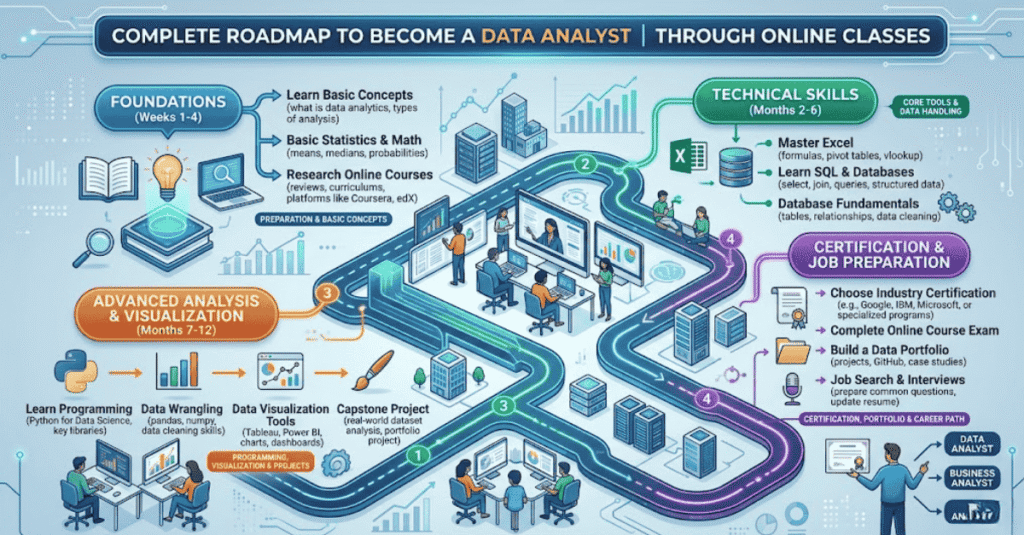
If a course doesn’t include projects, it’s a red flag. Simple as that.
Good data analytics classes online usually include:
- 2–5 portfolio projects
- Real business scenarios (sales, marketing, finance, etc.)
- End-to-end workflows (from raw data to insights)
Here’s why this matters:
Recruiters don’t ask:
“Did you complete certification courses for Data Analytics Classes Online”
They ask:
“Can you show me what you’ve built?”
There’s a big difference.
3. What Tools Are Actually Covered (And Are They Relevant in 2026?)
Other courses teach old workflows, and that can hinder your speed.
At a minimum, your course should include:
- SQL (non-negotiable
- Excel or Google Sheets
- One visualization tool (Power BI or Tableau)
Bonus points if they include:
- Python basics
- AI-assisted analytics tools (this is becoming more common now)
I’ve seen newer Data Analytics Classes Online introduce AI features like automated insights or smart data cleaning. Not essential, but definitely useful.
4. Is It Beginner-Friendly… or Just Marketed That Way?
Lots of courses are described as beginner-friendly, but they jump too fast.
Beginner’s analytics courses will contain the following headings:
- Repeat abstract concepts (with no knowledge of previous thought)
- Prepare a practice question on each topic.
- Provide doubt support or mentoring.
Bad ones?
They rush through the basics and leave you Googling half the time.
If you constantly feel lost in week one, it’s not you; it’s the course.
5. Do They Offer Any Kind of Career Support?
This part is often overlooked.
Some data analytics classes online go beyond teaching and include:
- Resume building
- Mock interviews
- Job referrals or placement assistance
Now, not every course needs placement support, but if you’re switching careers, it helps. A lot.
One learner I know struggled for months applying blindly. After joining a program with mock interviews, things changed quickly, mainly because they finally understood what companies were actually asking.
6. Check How They Teach Problem-Solving (This Is Huge)
Here’s something subtle but important.
A strong course doesn’t just teach tools; it teaches thinking.
For example:
Instead of saying:
“Here’s how to create a chart.”
It should ask:
“What kind of chart makes sense for this data and why?”
That shift from execution to thinking is what separates beginners from job-ready analysts.
7. Are Reviews and Outcomes Actually Genuine?
Don’t just look at star ratings.
Look for:
- Real student projects
- LinkedIn profiles from previous students
- Constructive feedback (not just “awesome course!”).
If you can, take a look at where students went to work. That’s more than any marketing page can tell you.
8. How Flexible Is the Learning Structure?
Life happens. Not everyone can study 6 hours a day.
Features of good Data Analytics Classes Online:
Self-paced learning
Recorded + live sessions
Resources are available even post-course completion.
Flexibility is more important than many people realize, especially if you’re juggling studies or a job.
A Brief Real-World Scenario (Which You Are Preparing For)
Let’s say you score an entry-level gig.
Your task:
“Analyze last quarter’s sales drop.”
If your course did an adequate job of preparing you, you will:
Extract data using SQL.
Clean and analyze it
Build a dashboard
Present insights clearly
If your course didn’t prepare you for this, you’ll feel it immediately.
What’s Different Now (And Why You Should Care)
In 2026, hiring trends are shifting fast:
- Employers care more about skills and projects than degrees.
- AI tools are assisting analysts, not replacing them.
- Business understanding is becoming just as important as technical skills.
So modern certification courses for Data Analytics Classes Online are evolving:
- More hands-on work
- Real-world simulations
- Focus on storytelling
If a course still feels too theoretical, it’s probably outdated.
Final Thought
Choosing the right course won’t magically make things easy, but it will make things clearer.
The best data analytics classes online for beginners don’t just teach you tools; they help you think, practice, and slowly build confidence.
And yeah, you’ll feel stuck at times. Everyone does.
But if the course is structured well, you won’t stay stuck for long.
You do not have enough Humanizer words left. Upgrade your Surfer plan.