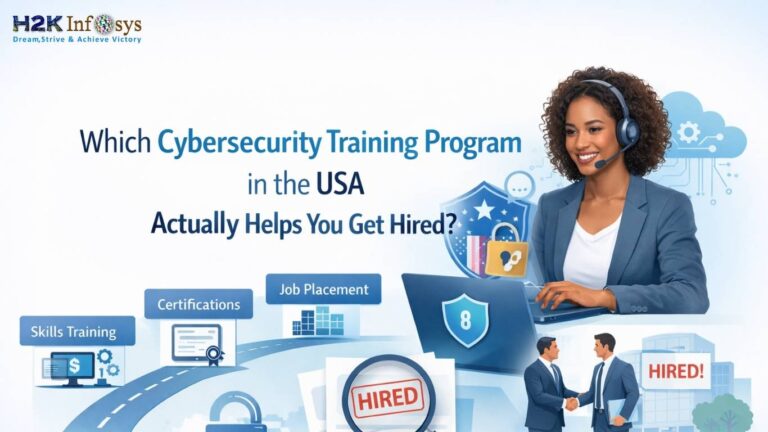
The cybersecurity training programs which actually help you get hired like h2kinfosys are the ones which include hands-on labs, real-world attack simulations, mentorship, and job placement, not just videos and theory.
So… what really gets you hired in cybersecurity?
I have noticed a lot of people taking cyber security training online, watching a lot of videos, and completing a lot of videos, and finally earning a certificate in cybersecurity training program, but they fail to get hired. The gap between what they have learned and what they actually need to get hired is the lack of real-world experience.
You’re not just being asked, “Did you complete a course?”
You’re being asked, “Can you investigate a breach?”
“Can you think like an attacker?”
“Can you solve problems?”
Well, to be honest, this is fair.
The 4 things that actually make a cybersecurity training program worth it
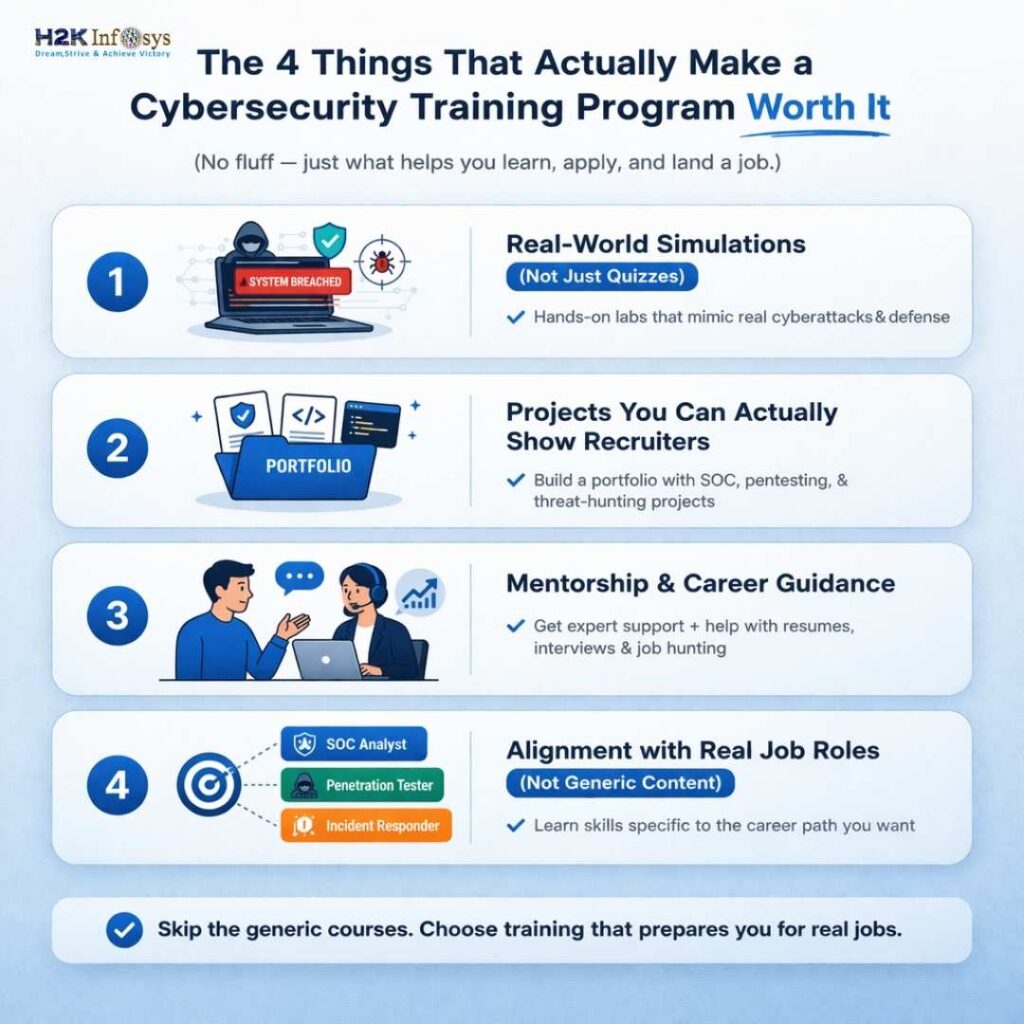
1.Real-world simulations (not just quizzes)
This is probably the biggest difference today.
You want to make sure your cybersecurity training program has simulations on:
Ransomware attacks
Phishing campaigns
SIEM alert investigations
Incident responses, etc.
You’re not just watching what you’re doing. You’re logging in, you’re analyzing, you’re responding to threats, and you’re even making mistakes (which, by the way, is where the real learning happens).
I remember taking a basic course a while back, and it felt like I had learned so much, but when I had to actually perform my first log analysis, it was a whole different world.
2.Projects you can actually show recruiters
If your training does not give you:
A portfolio
GitHub projects
Documented case studies, etc.
Then, to be honest, it’s going to be tough.
You want to be able to say to recruiters:
“Hey, I have a simulated SOC investigation I have handled.”
or
“I created a mini threat detection system using Splunk.”
This sort of evidence has a way of cutting through the noise quickly.
3.Mentorship and career guidance
This aspect is often overlooked.
The top cybersecurity training program don’t only educate, but also provide guidance.
How to build a resume for a cybersecurity training program
Mock interviews
How to optimize a LinkedIn profile
Referral networks
Some even go as far as connecting cyber security jobs with training, which means the training is designed in a way that can help you get a job.
And in 2026, networking has never been more important. A referral can honestly get you through the hiring process more than 100 times faster than sending in a job application.
4.Alignment with real job roles (not generic content)
There isn’t just one cybersecurity training job. There are dozens.
A good program will help you specialize in a role you enjoy.
SOC Analyst
Penetration Tester
Cloud Security Engineer
GRC Analyst
If a program promises to teach you everything at a surface-level, it probably means you’ll be prepared for absolutely nothing.
What most people get wrong (and regret later)
Let me tell you something bluntly because it will save you a lot of time.
Choosing the cheapest course means you’re probably not going to get any hands-on practice
Pursuing certificates means you’re not really going to be able to prove you know anything
Avoiding technical labs means you’re probably going to make the biggest mistake as a beginner
And don’t even get me started on soft skills, because, trust me, it matters a lot in cybersecurity training program.
A quick real-world example
My friend decided to make a career switch from a non-IT background last year.
Instead of racking up a bunch of random certifications, he went with a program that includes:
Live SOC simulations
Weekly mentor sessions
Resume and interview prep
Actual case studies on real-world incidents
Within 5 months, he secured a junior SOC Analyst role.
Was it easy?
Absolutely not.
Was it structured the right way?
Absolutely.
Where cybersecurity training fits in
Niche?
Yes, it is.
Growing?
Yes, it is.
Not everyone wants to be super technical. And that’s okay.
What does cyber security sales training actually cover?
Understanding security products.
Communicating risks to clients.
Supporting pre-sales engineering teams.
And with the advent of SaaS security platforms and AI-based security tools, companies need people who can translate security into business results.
It’s a different track, yes. But it’s still a great one.
What’s trending right now?
2026 reality check
There are a few things that are trending right now. And by trending, I mean that they are affecting how companies are hiring people like us.
AI-based threat detection?
Huge.
Cloud security?
No longer optional.
Hands-on platforms like cyber security sales training ranges?
The norm.
And companies are looking for “job-ready” candidates rather than “certificate-focused” ones.
Yeah. cybersecurity Training program are changing fast. And the good ones are already changing fast.
So, which training programs actually help?
Don’t worry about the names. Worry about the features.
✔ Live attack simulations?
✔ Real tools like Splunk, Wireshark, SIEM platforms?
✔ Projects that are portfolio-ready?
✔ Mentorship?
✔ Career support?
If it’s got all of these features, congratulations. You’re on the right track.
Final thought
From someone who’s been on both sides of the fence…
If I had to start over again?
I wouldn’t worry about finding the best cybersecurity training program course out there.
I’d find one that forces me to practice. Forces me to struggle. Forces me to learn.
Because at the end of the day, it’s not about what you watched. It’s about what you can actually do.